Abstract
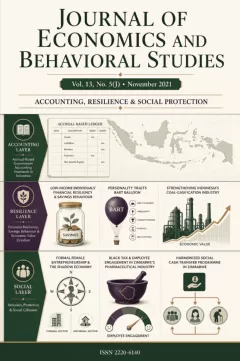
The Coronavirus disease 2019 (COVID-19) pandemic has helped expose and exacerbate individuals’ and households’ financial vulnerability worldwide. Meanwhile, behavioral elements affecting low-income populations’ ability to save and become more financially resilient have yet to receive sufficient academic attention. This exploratory study aims at beginning to help elucidate the determinants of lowincome individuals’ real-life savings behavior by utilizing laboratory performance measures (to characterize participants’ risk preferences by using the Balloon Analog Risk Task – BART, in study 1), as well as self-report surveys (to characterize participants’ personality traits, in study 2). Combining results from both studies, latent personality traits (i.e., attitude towards risk, perseverance, distractibility, and state anxiety) are found to affect the risk preferences of low-income individuals (captured using a novel BART performance measure indicative of an individual’s strategic risk preference adaptation), which in turn impact their ability to successfully complete matched savings programs and, thus, their ability to save and enhance their financial resilience.
Keywords
- Financial Vulnerability/Resilience Search this journal for Financial Vulnerability/Resilience (opens in a new tab)
- Low-income Participants Search this journal for Low-income Participants (opens in a new tab)
- Matched Savings Programs Search this journal for Matched Savings Programs (opens in a new tab)
- Personality Traits Search this journal for Personality Traits (opens in a new tab)
- Balloon Analog Risk Task (BART) Search this journal for Balloon Analog Risk Task (BART) (opens in a new tab)
References
- Aklin, W. M., Lejuez, C., Zvolensky, M. J., Kahler, C. W. & Gwadz, M. (2005). Evaluation of behavioral measures of risk-taking propensity with inner-city adolescents. Behavior Research and Therapy, 43(2), 215– 228. https://doi.org/10.1016/j.brat.2003.12.007
- Arrow, K. . (196 ). Aspects of the Theory of Risk-Bearing. rjo ahnsonian Sa tio .
- Bagby, R. M., Parker, J. D. & Taylor, G. J. (1994). The twenty-item Toronto Alexithymia Scale—I. Item selection and cross-validation of the factor structure. Journal of psychosomatic research, 38(1), 23-32. https://doi.org/https://doi.org/10.1016/0022-3999(94)90005-1
- Barratt, E. S. (1993). Impulsivity: Integrating cognitive, behavioral, biological, and environmental data. In The Impulsive Client: Theory, Research, and Treatment (pp. 39–56). American Psychological Association. https://doi.org/https://doi.org/10.1037/10500-003
- Birkenmaier, J., Curley, J. & Kelly, P. (2014). Matched savings account program participation and goal completion for low-income participants: Does financial credit matter? Journal of Social Service Research, 40(2), 215–231. https://doi.org/10.1080/01488376.2013.875095
- Broadbent, D. E., Cooper, P. F., FitzGerald, P. & Parkes, K. R. (1982). The cognitive failures questionnaire (CFQ) and its correlates. British journal of clinical psychology, 21(1), 1-16. https://doi.org/https://doi.org/10.1111/j.2044-8260.1982.tb01421.x
- Brown, S. & Taylor, K. (2014). Household finances and the ‘Big Five’personality traits. Journal of Economic Psychology, 45, 197-212.
- Brunell, A. B. & Buelow, M. T. (2017). Narcissism and performance on behavioral decision‐making tasks. Journal of Behavioral Decision Making, 30(1), 3-14.
- Carvalho, L. S., Prina, S. & Sydnor, J. (2016). The effect of saving on risk attitudes and intertemporal choices. Journal of Development Economics, 120, 41–52. https://doi.org/10.1016/j.jdeveco.2016.01.001
- CBPP. (2020). Tracking the COVID-19 Recession’s Effects on Food, Housing, and Employment Hardships. Center on Budget and Policy Priorities. https://www.cbpp.org/research/poverty-andinequality/tracking-the-covid-19-recessions-effects-on-food-housing-and
- Claus, E. D. & Hutchison, K. E. (2012). Neural mechanisms of risk-taking and relationships with hazardous drinking. Alcoholism: Clinical and Experimental Research, 36(6), 932–940. https://doi.org/10.1111/j.1530-0277.2011.01694.x
- Cloninger, C. R., Przybeck, T. R., Svrakic, D. M. & Wetzel, R. D. (1994). The Temperament and Character Inventory (TCI): A guide to its development and use. Center for Psychobiology of Personality, Washington University.
- Conell-Price, L. & Jamison, J. (2015). Predicting health behaviors with economic preferences & locus of control. Journal of Behavioral and Experimental Economics, 54, 1–9. https://doi.org/10.1016/j.socec.2014.10.003
- De Jong, S. (1993). SIMPLS: An alternative approach to partial least squares regression. Chemometrics and Intelligent Laboratory Systems, 18(3), 251–263. https://doi.org/10.1016/0169-7439(93)85002-X
- Duflo, E., Gale, W., Liebman, J., Orszag, P. & Saez, E. (2006). Saving incentives for low-and middle-income families: Evidence from a field experiment with H&R Block. The Quarterly Journal of Economics, 121(4), 1311–1346. https://doi.org/10.1162/qjec.121.4.1311
- Everitt, B. S., Landau, S., Leese, M. & Stahl, D. (2011). Cluster Analysis. John Wiley & Sons.
- Fairley, K., Parelman, J. M., Jones, M. & Carter, R. M. (2019). Risky health choices and the balloon economic risk protocol. Journal of Economic Psychology, 73, 15-33.
- Franken, R. E., Gibson, K. J. & Rowland, G. L. (1992). Sensation seeking and the tendency to view the world as threatening. Personality and Individual Differences, 13(1), 31–38. https://doi.org/10.1016/01918869(92)90214-A
- Gabler, N. (2016, May 2016). The secret shame of middle-class Americans. The Atlantic, 317.
- Gambetti, E. & Giusberti, F. (2019). Personality, decision-making styles and investments. Journal of Behavioral and Experimental Economics, 80, 14–24. https://doi.org/10.1016/j.socec.2019.03.002
- Gauthier, A. H. & Furstenberg, F. F. (2010). The experience of financial strain among families with children in the United States. Working Paper WP-10-17. National Center for Family & Marriage Research.
- Greenberg, A. E., Sussman, A. B. & Hershfield, H. E. (2020). Financial product sensitivity predicts financial health. Journal of Behavioral Decision Making, 33(1), 15-26.
- Gutter, M. S., Hayhoe, C. R., DeVaney, S. A., Kim, J., Bowen, C. F., Cheang, M., Cho, S. H., Evans, D. A., Gorham, E. & Lown, J. M. (2012). Exploring the relationship of economic, sociological, and psychological factors to the savings behavior of low‐to moderate‐income households. Family and Consumer Sciences Research Journal, 41(1), 86–101. https://doi.org/10.1111/j.1552-3934.2012.02130.x
- Guven, C. (2012). Reversing the question: Does happiness affect consumption and savings behavior? Journal of Economic Psychology, 33(4), 701–717. https://doi.org/10.1016/j.joep.2012.01.002
- Hadlington, L. J. (2015). Cognitive failures in daily life: Exploring the link with Internet addiction and problematic mobile phone use. Computers in Human Behavior, 51, 75–81. https://doi.org/10.1016/j.chb.2015.04.036
- Hall, C. C. (2021). Promoting savings for financial resilience: Expanding the psychological perspective. Current Directions in Psychological Science, 30(1), 49–54. https://doi.org/10.1177/0963721420979603
- Hayhoe, C. R., Cho, S. H., DeVaney, S. A., Worthy, S. L., Kim, J. & Gorham, E. (2012). How do distrust and anxiety affect saving behavior? Family and Consumer Sciences Research Journal, 41(1), 69–85. https://doi.org/10.1111/j.1552-3934.2012.02129.x
- Holzmeister, F. (2017). oTree: Ready-made apps for risk preference elicitation methods. Journal of Behavioral and Experimental Finance, 16, 33–38. https://doi.org/10.1016/j.jbef.2017.08.003
- Kass, S. J., Beede, K. E. & Vodanovich, S. J. (2010). Self-report measures of distractibility as correlates of simulated driving performance. Accident Analysis & Prevention, 42(3), 874–880. https://doi.org/10.1016/j.aap.2009.04.012
- Kesavayuth, D., Ko, K. M. & Zikos, V. (2018). Locus of control and financial risk attitudes. Economic Modeling, 72, 122–131. https://doi.org/10.1016/j.econmod.2018.01.010
- Kirby, K. N. & Maraković, N. N. (1996). Delay-discounting probabilistic rewards: Rates decrease as amounts increase. Psychonomic bulletin & review, 3(1), 100-104. https://doi.org/https://doi.org/10.3758/BF03210748
- Kohno, M., Nurmi, E. L., Laughlin, C. P., Morales, A. M., Gail, E. H., Hellemann, G. S. & London, E. D. (2016). Functional genetic variation in dopamine signaling moderates prefrontal cortical activity during risky decision making. Neuropsychopharmacology, 41(3), 695–703. https://doi.org/10.1038/npp.2015.192
- Krijnen, J. M., Zeelenberg, M., Breugelmans, S. M. & van Putten, M. (2020). Inaction inertia in retirement saving. Journal of Behavioral Decision Making, 33(1), 52-62.
- Lejuez, C. W., Aklin, W. M., Jones, H. A., Richards, J. B., Strong, D. R., Kahler, C. W. & Read, J. P. (2003). The balloon analog risk task (BART) differentiates smokers and nonsmokers. Experimental and Clinical Psychopharmacology, 11(1), 26–33. https://doi.org/10.1037/1064-1297.11.1.26
- Lejuez, C. W., Read, J. P., Kahler, C. W., Richards, J. B., Ramsey, S. E., Stuart, G. L., Strong, D. R. & Brown, R. A. (2002). Evaluation of a behavioral measure of risk-taking: The Balloon Analogue Risk Task (BART). Journal of Experimental Psychology: Applied, 8(2), 75–84. https://doi.org/10.1037/1076-898X.8.2.75
- Liu, H. H. & Chou, H. Y. (2018). Promotional formats and inaction inertia. Journal of Economic Psychology, 66, 22-32.
- Loibl, C., Jones, L. & Haisley, E. (2018). Testing strategies to increase saving in individual development account programs. Journal of Economic Psychology, 66, 45-63.
- Loibl, C., Kraybill, D. S. & DeMay, S. W. (2011). Accounting for the role of habit in regular saving. Journal of Economic Psychology, 32(4), 581-592.
- Loke, Y. J. (2016). Financial preparedness for income shock among Malaysians. Malaysian Journal of Economic Studies, 53(2), 279–295.
- Ludwig, J., Jaudas, A. & Achtziger, A. (2020). The role of motivation and volition in economic decisions: Evidence from eye movements and pupillometry. Journal of Behavioral Decision Making, 33(2), 180195.
- Lusardi, A. (2011). Americans' Financial Capability. National Bureau of Economic Research (NBER) Working Paper 17103. National Bureau of Economic Research.
- Lusardi, A., Schneider, D. J. & Tufano, P. (2011). Financially fragile households: Evidence and implications. National Bureau of Economic Research (NBER) Working Paper No. 17072. National Bureau of Economic Research.
- Mason, C. L. J. & Wilson, R. M. S. (2000). Conceptualizing Financial Literacy (Vol. 7). Business School, Loughborough University.
- McElroy, T., Seta, J. J. & Waring, D. A. (2007). Reflections of the self: how self‐esteem determines decision framing and increases risk-taking. Journal of Behavioral Decision Making, 20(3), 223-240.
- Mullainathan, S. & Shafir, E. (2013). Scarcity: Why Having too Little Means So Much. Macmillan.
- Schürmann, O., Frey, R. & Pleskac, T. . (2019). Mapping risk perceptions in dynamic risk‐taking environments. Journal of Behavioral Decision Making, 32(1), 94-105.
- Sherraden, M. (2000). From research to policy: Lessons from individual development accounts. Journal of Consumer Affairs, 34(2), 159–181. https://doi.org/10.1111/j.1745-6606.2000.tb00089.x
- Sherraden, M. (2008). IDAs and Asset-Building Policy: Lessons and Directions. Center for Social Development, George Warren Brown School of Social Work, Washington University.
- Sherraden, M., Schreiner, M. & Beverly, S. (2003). Income, institutions, and saving performance in individual development accounts. Economic Development Quarterly, 17(1), 95–112. https://doi.org/10.1177/0891242402239200
- Shim, S., Serido, J. & Tang, C. (2012). The ant and the grasshopper revisited: The present psychological benefits of saving and future-oriented financial behaviors. Journal of Economic Psychology, 33(1), 155-165.
- Smeeding, T. M. (2005). The EITC and USAs/IDAs: Maybe a Marriage Made in Heaven? Working Paper 00-18. Center for Social Development, George Warren Brown School of Social Work, Washington University.
- Smith, C. E., Echelbarger, M., Gelman, S. A. & Rick, S. I. (2018). Spendthrifts and tightwads in childhood: Feelings about spending predict children's financial decision making. Journal of Behavioral Decision Making, 31(3), 446-460.
- Spielberger, C. D., Gorsuch, R. L., Lushene, R., Vagg, P. R. & Jacobs, G. A. (1983). State-Trait Anxiety Inventory for Adults. Consulting Psychologists Press Inc. PsycNET [WWW Document]. URL https://psycnet.apa.org/record/9999-06496-000?doi=1
- Sproten, A. N., Diener, C., Fiebach, C. J. & Schwieren, C. (2018). Decision making and age: Factors influencing decision making under uncertainty. Journal of Behavioral and Experimental Economics, 76, 43–54. https://doi.org/10.1016/j.socec.2018.07.002
- Taylor, M. P., Jenkins, S. P. & Sacker, A. (2011). Financial capability and psychological health. Journal of Economic Psychology, 32(5), 710–723. https://doi.org/10.1016/j.joep.2011.05.006
- Thaler, R. H. (1994). Psychology and savings policies. The American Economic Review, 84(2), 186–192.
- Voigt, D. C., Dillard, J. P., Braddock, K. H., Anderson, J. W., Sopory, P. & Stephenson, M. T. (2009). BIS/BAS scales and their relationship to risky health behaviors. Personality and Individual Differences, 47(2), 89-93. https://doi.org/https://doi.org/10.1016/j.paid.2009.02.003
- Weiss, M. G. & Sherraden, M. (2005). Racial differences in performance in a matched savings program. Journal of Income Distribution, 13(3-4), 6.
- Westfall, J. E., Jasper, J. D. & Christman, S. (2012). Inaction inertia, the sunk cost effect, and handedness: Avoiding the losses of past decisions. Brain and cognition, 80(2), 192-200.
- Wold, H. (1980). Model construction and evaluation when theoretical knowledge is scarce: Theory and application of partial least squares. In J. Kmenta & J. B. Ramsey (Eds.), Evaluation of Econometric Models (pp. 47–74). Academic Press.
- Wold, S., Ruhe, A., Wold, H. & Dunn III, W. (1984). The collinearity problem in linear regression. The partial least squares (PLS) approach to generalized inverses. SIAM Journal on Scientific and Statistical Computing, 5(3), 735–743. https://doi.org/10.1137/0905052
Downloads
No downloads have been recorded for this article yet. Figures appear here once readers begin downloading the full text.
How to Cite
Share this article
License
Copyright (c) 2021 Carlos M. Parra, Ranjita Poudel, Matthew T. Sutherland (Author)

This work is licensed under a Creative Commons Attribution 4.0 International License.
Author (s) should affirm that the material has not been published previously. It has not been submitted and it is not under consideration by any other journal. At the same time author (s) need to execute a publication permission agreement to assume the responsibility of the submitted content and any omissions and errors therein. After submission of revised paper in the light of suggestions of the reviewers, the editorial team edits and formats manuscripts to bring uniformity and standardization in published material.
This work will be licensed under Creative Commons Attribution 4.0 International (CC BY 4.0) and under condition of the license, users are free to read, copy, remix, transform, redistribute, download, print, search or link to the full texts of articles and even build upon their work as long as they credit the author for the original work. Moreover, as per journal policy author (s) hold and retain copyrights without any restrictions.
Keywords
- Financial Vulnerability/Resilience Search this journal for Financial Vulnerability/Resilience (opens in a new tab)
- Low-income Participants Search this journal for Low-income Participants (opens in a new tab)
- Matched Savings Programs Search this journal for Matched Savings Programs (opens in a new tab)
- Personality Traits Search this journal for Personality Traits (opens in a new tab)
- Balloon Analog Risk Task (BART) Search this journal for Balloon Analog Risk Task (BART) (opens in a new tab)
Section
Published
Submissions
Have research to publish? Journal of Economics and Behavioral Studies welcomes submissions.
Make a Submission