Abstract
The organizational fairness literature is frequently used by fairness scholars to evaluate tax fairness models, conceptions, and measurements, even though tax fairness and tax justice are contextdependent and require further formulation. However, the generalizability of organizational justice studies to other domains and the extent to which context affects justice perceptions remain unknown. There is a dearth of literature that defines the terms tax fairness, tax equity, tax equality, and tax justice accurately. The purpose of this research is to distinguish between the tax phrases "fairness," "equity," "equality," and "justice." Additionally, the author refined the tax words inside the operationalized idea to produce more precise measures for future research. A systematic literature review was conducted as the research method, utilizing the PRISMA research approach and NVivo for qualitative data processing. As a result of the research findings, the phrase "tax fairness," which was previously believed to refer to a lesser degree of tax justice than "tax equity," is now used to refer to tax justice in a broader sense. Tax equity has the most extensive set of characteristics and indicators. Meanwhile, the word "tax justice" refers to a more specialized area of law and procedure, namely tax law. The phrase "tax equity" is included in the indicator "tax fairness," although the term "tax equality" is rarely used in the worldwide tax literature. The more distinct the tax terms, the easier it will be for the tax researcher to use terms like tax fairness, tax justice, tax equity, and tax equality correctly.
Keywords
- Tax Fairness Search this journal for Tax Fairness (opens in a new tab)
- Tax Equity Search this journal for Tax Equity (opens in a new tab)
- Tax Justice Search this journal for Tax Justice (opens in a new tab)
- Tax Equality Search this journal for Tax Equality (opens in a new tab)
- Systematic Literature Review Search this journal for Systematic Literature Review (opens in a new tab)
- PRISMA Search this journal for PRISMA (opens in a new tab)
References
- Areopagus. (2020). Modul Pelatihan Online Penggunaan NVivoR1 & Mendeley dalam Systematic Literature Review with PICO & PRISMA. Jakarta.
- Compin, F. (2015). Tax fraud: A socially acceptable financial crime in France? Journal of Financial Crime. DOI: 10.1108/JFC-09-2013-0052.
- Dekker, R., Franco Contreras, J. & Meijer, A. (2020). The Living Lab as a Methodology for Public Administration Research: a Systematic Literature Review of its Applications in the Social Sciences, International Journal of Public Administration , 43(14), 1207–1217.
- Evans, L. (1978). Obstacles to Federal Tax Reform: An Exploratory Inquiry Into the Fiscal Attitudes of a Small Group of Taxpayers, American Journal of Economics and Sociology.
- Farrar, J., Massey, W. D., Osecki, E. and Thorne, L. (2020). Tax Fairness: Conceptual Foundations and Empirical Measurement, Journal of Business Ethics , 162(3), 487–503.
- Farrar, J. M., Donnelly, M. E. & Dhaliwal, S. B. (2013). Procedural aspects of tax fairness: A content analysis of Canadian tax jurisprudence, ATA Journal of Legal Tax Research , 11(2), 21–37.
- Galle, B. (2008). Tax Fairness, Washington and Lee Law Review.
- Gilligan, G. & Richardson, G. (2005). Perceptions of tax fairness and tax compliance in Australia and Hong Kong ‐ a preliminary study, Journal of Financial Crime , 12(4), 331–343.
- Hartner, M., Rechberger, S., Kirchler, E. and Schabmann, A. (2008). Procedural Fairness and Tax Compliance, Economic Analysis and Policy. Economic Analysis and Policy, 38(1), 137-152.
- Huerlimann, G. (2017). Swiss worlds of taxation: The political economy of fiscal federalism and tax competition, in The Political Economy of Public Finance: Taxation, State Spending and Debt since the 1970s.
- Jun, B. W. & Yoon, S. M. (2018). Taxpayer’s religiosity, religion, and the perceptions of tax equity: Case of South Korea, Religions , 9(11).
- Kim, C. K. (2002). Does fairness matter in tax reporting behavior? Journal of Economic Psychology , 23(6), 771– 785.
- Kinsey, K. A., Grasmick, H. G. & Smith, K. W. (1991). Framing Justice: Taxpayer Evaluations of Personal Tax Burdens, Law & Society Review.
- Kirchler, E. & Hoelzl, E. (2017). Tax Behaviour, in Economic Psychology, 255–271.
- Lindsay, I. (2016). Tax Fairness by Convention: A Defense of Horizontal Equity, Florida Tax Review.
- O’Neill, M. M., Booth, S. R. & Lamb, J. T. (2018). Using NVivo for Literature Reviews: The Eight Step Pedagogy (N7+1), The Qualitative Report , 23(13), 21–39.
- Papadeas, P. V. & Sykianakis, N. (2014). Tax Leverage in Greece, Procedia Economics and Finance.
- Petticrew, M. & Roberts, H. (2006). Systematic Reviews in the Social Sciences: A Practical Guide, Systematic Reviews in the Social Sciences: A Practical Guide. Oxford: Blackwell Publishing.
- PRISMA-Statement. (2021). Welcome to the Preferred Reporting Items for Systematic Reviews and MetaAnalyses (PRISMA) website! Available at: http://www.prisma-statement.org/.
- Rakowski, E. (2005). Can Wealth Taxes Be Justified?, SSRN Electronic Journal.
- Stebbings, C. (2016). The equity of the executive: Fairness in tax law in nineteenth-century England, in Equity and Administration, 258–287.
- Winchester, C. L. & Salji, M. (2016). Writing a literature review, Journal of Clinical Urology , 9(5), 308–312.
Downloads
No downloads have been recorded for this article yet. Figures appear here once readers begin downloading the full text.
How to Cite
Share this article
License
Copyright (c) 2022 Neni Susilawati, Gunadi, Ning Rahayu (Author)

This work is licensed under a Creative Commons Attribution 4.0 International License.
Author (s) should affirm that the material has not been published previously. It has not been submitted and it is not under consideration by any other journal. At the same time author (s) need to execute a publication permission agreement to assume the responsibility of the submitted content and any omissions and errors therein. After submission of revised paper in the light of suggestions of the reviewers, the editorial team edits and formats manuscripts to bring uniformity and standardization in published material.
This work will be licensed under Creative Commons Attribution 4.0 International (CC BY 4.0) and under condition of the license, users are free to read, copy, remix, transform, redistribute, download, print, search or link to the full texts of articles and even build upon their work as long as they credit the author for the original work. Moreover, as per journal policy author (s) hold and retain copyrights without any restrictions.
Keywords
- Tax Fairness Search this journal for Tax Fairness (opens in a new tab)
- Tax Equity Search this journal for Tax Equity (opens in a new tab)
- Tax Justice Search this journal for Tax Justice (opens in a new tab)
- Tax Equality Search this journal for Tax Equality (opens in a new tab)
- Systematic Literature Review Search this journal for Systematic Literature Review (opens in a new tab)
- PRISMA Search this journal for PRISMA (opens in a new tab)
Section
Published in
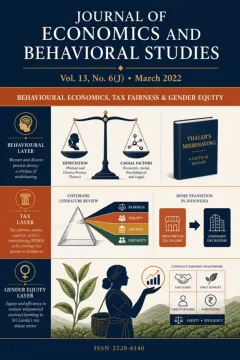 Vol. 13 No. 6(J) (2021)
Behavioural Economics, Tax Fairness & Gender Equity
View issue contents
Published
Submissions
Have research to publish? Journal of Economics and Behavioral Studies welcomes submissions.
Make a Submission