Articles

  • Article 1 in this issue

    Women-the Best of Creatures in World: Are They Upholding the Premise?

    • Author: Akim M. Rahman

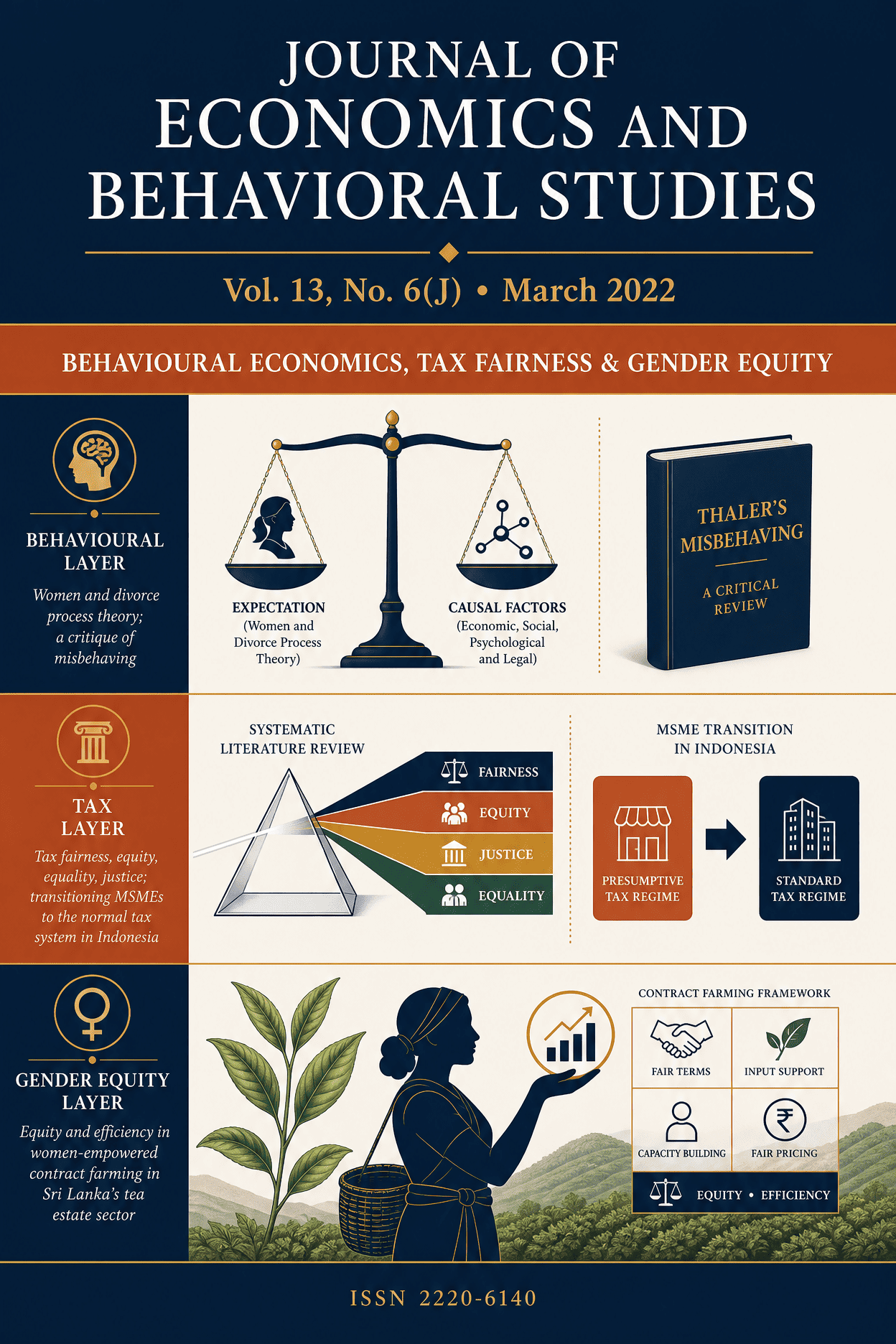
    Women are the best of creatures no matter what part of the world they reside in. However, the premise is being questioned because of the high rise of divorce rates in many parts of the modern- world where humankind behaves with a business mentality in work, life and activities without reservation. In reality, the collapse of marriage is not a sudden event. It happens at an onset moment. It is a process during which various factors lead to a decision- for divorce. The purpose of this study was to build a theory about the process of divorce, which can be suitable to all cultures or faiths without reservation. All factors involved in the process are categorized into two parts: Expectation-factors and Causal-factors. The net profit (NP) staying in the marriage is calculated based on the weight assigned by each spouse for each Expectation-factor. Netloss (NL) is calculated based on the weight assigned by each spouse for each Causal-factor. The difference between NP and NL guides a spouse or both for a decision on opportunity correcting errors or living separately but no divorce or divorce. The findings of this study can be helpful to professionals gaining better knowledge on extending help for their reunion or smooth divorce approach for the betterment of both. It can further be helpful to authorities responsible for divorce prevention and improving marriage-relationship by counseling based on the result(s) of this study emphasizing their future plans. It can be helpful recovering wives’ or husbands’ shortcomings without letting the other party knows about them. This framework can be helpful to wives sharpening its qualities, which can be helpful upholding the premise, Women the best of the creature . Thus, the answer to the question posed in the title depends on who we ask.

    Pages 1-11

    PDF - Women-the Best of Creatures in World: Are They Upholding the Premise? (opens in a new tab)
  • Article 2 in this issue

    Misbehaving: The Making of Behavioral Economics by Richard H. Thaler: Critical Evaluation & Review

    • Author: Turkiah Alotibi

    Thaler's ability for writing has resulted in a book that is a mix of his experiences as a faculty member, anecdotes from other economists he encountered along the journey, and a background in Behavioral Economics. Richard Thaler provides an analysis of how subjective factors influence decisionmaking in matters related to the economy and personal finances. The subject of "Misbehaving" is one of dominance and special interests; its power that economists were refusing and defending against the possibility of being irrational. Reading "Misbehaving" is recommended for those who want to understand how psychology influences decision-making with money and the economy, and for those who want to understand Behavioral Economics. This review will look further into evaluating the concept of irrationality and decision-making in behavioral economics.

    Pages 12-18

    PDF - Misbehaving: The Making of Behavioral Economics by Richard H. Thaler: Critical Evaluation & Review (opens in a new tab)
  • Article 3 in this issue

    A Systematic Literature Review for Distinguishing Tax Terms: Equality, Equity, Justice, and Fairness

    • Author: Neni Susilawati, Gunadi, Ning Rahayu

    The organizational fairness literature is frequently used by fairness scholars to evaluate tax fairness models, conceptions, and measurements, even though tax fairness and tax justice are contextdependent and require further formulation. However, the generalizability of organizational justice studies to other domains and the extent to which context affects justice perceptions remain unknown. There is a dearth of literature that defines the terms tax fairness, tax equity, tax equality, and tax justice accurately. The purpose of this research is to distinguish between the tax phrases "fairness," "equity," "equality," and "justice." Additionally, the author refined the tax words inside the operationalized idea to produce more precise measures for future research. A systematic literature review was conducted as the research method, utilizing the PRISMA research approach and NVivo for qualitative data processing. As a result of the research findings, the phrase "tax fairness," which was previously believed to refer to a lesser degree of tax justice than "tax equity," is now used to refer to tax justice in a broader sense. Tax equity has the most extensive set of characteristics and indicators. Meanwhile, the word "tax justice" refers to a more specialized area of law and procedure, namely tax law. The phrase "tax equity" is included in the indicator "tax fairness," although the term "tax equality" is rarely used in the worldwide tax literature. The more distinct the tax terms, the easier it will be for the tax researcher to use terms like tax fairness, tax justice, tax equity, and tax equality correctly.

    Pages 19-39

    PDF - A Systematic Literature Review for Distinguishing Tax Terms: Equality, Equity, Justice, and Fairness (opens in a new tab)
  • Article 4 in this issue

    Equity and Efficiency in Women-Empowered Contract Farming: An Explanatory Case Study on the Tea Estate Sector of Sri Lanka

    • Author: Sajitha Dishanka, Takeshi Sakurai, Yukio Ikemoto

    Essentially, equity and efficiency are integral parts of any economic activities of sustainability though the correlation and causation between those two constructs are not considered significant. This study intends to evaluate if the contract farming system is a sustainable solution to the prevailing socio-economic aspects of the labor productivity problem in the tea estate sector of Sri Lanka, where female workers are highly depressed. This study has employed the survey strategy within the instrumental case of a selected tea estate to assess equity and efficiency of women-empowered contract farming system. The analytical results for gender equity on input and performance indicators have proven that gender equity is maintained in contract farming at the sample tea estate. The efficiency analysis results revealed that the output elasticity of tea bushes is significantly lower for female farmers than male farmers. However, there is no such significant difference revealed in the output elasticity of labor between gender groups. These findings explicitly reveal that the female workers in the tea estate sector are capable of managing labor although they are dominated by males in the domesticity. It further implies that a transformation of the male-dominant culture of the tea estate community would enhance the entrepreneurial and leadership capabilities of female workers if they are provided with equal opportunities and freedom.

    Pages 40-54

    PDF - Equity and Efficiency in Women-Empowered Contract Farming: An Explanatory Case Study on the Tea Estate Sector of Sri Lanka (opens in a new tab)
  • Article 5 in this issue

    Transitioning MSMEs to the Normal Tax System

    • Author: Neni Susilawati, Syadesa Anida Herdona, Vallencia Lim, Choirunisa Nadilla Safitri

    It is not straightforward to urge and prepare MSMEs to participate in the standard tax system. MSMEs must have adequate tax knowledge and competence to comply with their tax obligations after they enter the standard tax system. The research aims to develop a strategy for transitioning to a normal tax system from the perspective of both the taxpayer and the government, including the barriers encountered. This study used a qualitative approach and an in-depth interview to obtain data. A review of the literature was conducted, as well as in-depth interviews with DGT officials, tax scholars, tax practitioners, and SME taxpayers. The most recent rule on final income tax for MSMEs establishes a time restriction for applying the final income tax rate and recording. The grace period was designed to teach MSMEs how to manage their bookkeeping and other obligations under the conventional tax system while growing their business. According to the study's findings, MSMEs taxpayers do not have a distinct strategy for dealing with the conventional tax system. They do, however, have commercial plans that overlap with the transition strategy. On the other hand, the government, through DGT, launched a plan called Business Development Services. The challenges of human resources and initiative affect both government and MSMEs taxpayers. This article examines the strategic procedures necessary to convert MSME taxpayers from a presumptive tax regime to the implementation of a conventional tax system, as well as the barriers encountered in achieving tax equity. The report proposes a transition strategy from a presumptive, tax regime to the implementation of a conventional tax system on the hard-to-tax sector by the Indonesian tax authorities and MSME taxpayers.

    Pages 55-61

    PDF - Transitioning MSMEs to the Normal Tax System (opens in a new tab)