Abstract
The purpose of this study is to examine how climate-resilient infrastructure might support sustainable urban growth in Ghana. Rapid urbanization and climate change have posed substantial problems to Ghana's urban planning systems, resulting in frequent flooding, rising temperatures, and stressed infrastructure. This study used a mixed-methods approach, with 500 participants comprising urban planners, engineers, policymakers, and residents from various urban locations. Descriptive statistics, regression analysis, and correlation were employed to analyze quantitative data using SPSS, while thematic coding was utilized to examine qualitative insights. The findings reveal that 85% of respondents are aware of climate-resilient infrastructure, but only 16% believe that present projects adequately integrate resilience measures. Key barriers identified include weak policy enforcement, limited financial resources and a lack of technical expertise. According to regression and correlation analyses, policy efficacy, urbanization rate, and stakeholder participation are key determinants of infrastructure integration. The study emphasizes the value of targeted investments, capacity development, inclusive governance, and improved institutional frameworks. Ghana's distinct socioeconomic and environmental vulnerabilities make it an ideal case study for researching climateresilient urban infrastructure. The findings provide empirical insights to help Sub-Saharan Africa transition from reactive to proactive planning, as well as to inspire measures for enhancing urban resilience.
Keywords
- Climate Adaptation Search this journal for Climate Adaptation (opens in a new tab)
- Policy Implementation Search this journal for Policy Implementation (opens in a new tab)
- Urban Governance Search this journal for Urban Governance (opens in a new tab)
- Stakeholder Participation Search this journal for Stakeholder Participation (opens in a new tab)
- Climate Resilience Search this journal for Climate Resilience (opens in a new tab)
- Infrastructure Planning Search this journal for Infrastructure Planning (opens in a new tab)
- Ghana Search this journal for Ghana (opens in a new tab)
- Sustainable Urban Development Search this journal for Sustainable Urban Development (opens in a new tab)
References
- Acheampong, R. A., & Boateng, P. (2023). Integrating traditional knowledge in urban resilience planning in Sub-Saharan Africa. Sustainable Cities and Society, 97, 104939. https://doi.org/10.1016/j.scs.2023.104939
- Adjei, M., & Agyemang, S. (2023). Integrated flood management and infrastructure development in Ghana’s urban centers. Journal of Urban Planning and Development, 149(1), 04022034. https://doi.org/10.1061/JUPDDM.0000590
- Anderson, L. M., & Davis, M. (2019). Ethical considerations in urban development research. Ethics and Urban Studies, 15(3), 212–225. https://doi.org/10.1080/18756431.2019.113245
- Asante, B. A., & Owusu, G. (2023). Institutional coordination and urban resilience in Ghana: Challenges and prospects. Environmental Policy and Governance, 33(2), 89–101. https://doi.org/10.1002/eet.2013
- Braun, V., & Clarkyese, V. (2006). Using thematic analysis in psychology. Qualitative Research in Psychology, 3(2), 77–101. https://doi.org/10.1191/1478088706qp063oa
- Creswell, J. W., & Clark, V. L. P. (2021). Designing and conducting mixed methods research (3rd ed.). SAGE Publications.
- Cutter, S. L., Barnes, L., Berry, M., Burton, C., Evans, E., Tate, E., & Webb, J. (2008). A place-based model for understanding community resilience to natural disasters. Global Environmental Change, 18(4), 598–606. https://doi.org/10.1016/j.gloenvcha.2008.07.013
- Danso, K., & Frimpong, A. (2024). Institutional reforms for climate adaptation in Sub-Saharan Africa: Case studies from Rwanda and Ethiopia. African Journal of Environmental Management, 18(1), 45–59.
- Garcia, M., & Martinez, A. (2019). Systems thinking and urban resilience: Modeling interdependencies. Urban Systems Review, 22(2), 67–80.
- Ghana Environmental Protection Agency (EPA). (2022). National Climate Change Policy Implementation Report. Accra: Ministry of Environment.
- IPCC. (2022). Climate change 2022: Impacts, adaptation and vulnerability. Contribution of Working Group II to the Sixth Assessment Report of the Intergovernmental Panel on Climate Change. Cambridge University Press. https://doi.org/10.1017/9781009325844
- Mensah, E. K., Appiah, D. O., & Gyasi, R. M. (2021). Urban growth and flooding in Ghana: Evidence from Accra. Urban Climate, 39, 100964. https://doi.org/10.1016/j.uclim.2021.100964
- Owusu, K., & Addo, K. A. (2019). Climate change impacts on infrastructure in Ghana: Evidence and policy implications. Ghana Journal of Geography, 11(1), 23–39.
- Owusu, K., & Appeaning Addo, K. (2020). Coastal vulnerability and climate resilience in Ghana. Journal of African Geography, 9(2), 14–27.
- Songsore, J. (2020). The urban transition in Ghana: Urbanization, national development and poverty reduction. African Research Review, 14(1), 1–18.
- UN-Habitat. (2021). Green infrastructure in urban areas: Global practices and lessons for Ghana. Nairobi: United Nations Human Settlements Program.
- UN-Habitat. (2022). State of Ghanaian Cities Report 2022. Nairobi: United Nations Human Settlements Program.
- Williams, J., Armah, F. A., & Osei, F. B. (2021). Stakeholder participation and climate adaptation planning in Ghana. Environment, Development and Sustainability, 23, 17561–17579. https://doi.org/10.1007/s10668-021-01279-3
- World Bank. (2021). Ghana urban resilience project: Climate-smart infrastructure solutions. Washington, DC: World Bank Publications.
- World Bank. (2023). Urban infrastructure and climate resilience in Africa. Washington, DC: World Bank Publications.
Downloads
No downloads have been recorded for this article yet. Figures appear here once readers begin downloading the full text.
How to Cite
Share this article
License
Copyright (c) 2025 Samuel Mensah Plange, Isaac Mensah, Stephanie Mensah Plange, Philip Appiah Djan (Author)

This work is licensed under a Creative Commons Attribution 4.0 International License.
Author (s) should affirm that the material has not been published previously. It has not been submitted and it is not under consideration by any other journal. At the same time author (s) need to execute a publication permission agreement to assume the responsibility of the submitted content and any omissions and errors therein. After submission of revised paper in the light of suggestions of the reviewers, the editorial team edits and formats manuscripts to bring uniformity and standardization in published material.
This work will be licensed under Creative Commons Attribution 4.0 International (CC BY 4.0) and under condition of the license, users are free to read, copy, remix, transform, redistribute, download, print, search or link to the full texts of articles and even build upon their work as long as they credit the author for the original work. Moreover, as per journal policy author (s) hold and retain copyrights without any restrictions.
Keywords
- Climate Adaptation Search this journal for Climate Adaptation (opens in a new tab)
- Policy Implementation Search this journal for Policy Implementation (opens in a new tab)
- Urban Governance Search this journal for Urban Governance (opens in a new tab)
- Stakeholder Participation Search this journal for Stakeholder Participation (opens in a new tab)
- Climate Resilience Search this journal for Climate Resilience (opens in a new tab)
- Infrastructure Planning Search this journal for Infrastructure Planning (opens in a new tab)
- Ghana Search this journal for Ghana (opens in a new tab)
- Sustainable Urban Development Search this journal for Sustainable Urban Development (opens in a new tab)
Section
Published in
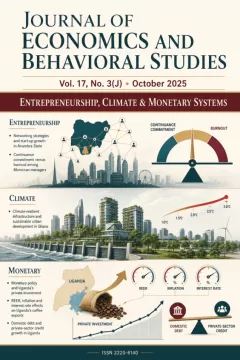 Vol. 17 No. 3(J) (2025)
Entrepreneurship, Climate & Monetary Systems
View issue contents
Published
Submissions
Have research to publish? Journal of Economics and Behavioral Studies welcomes submissions.
Make a Submission