Articles

  • Article 1 in this issue

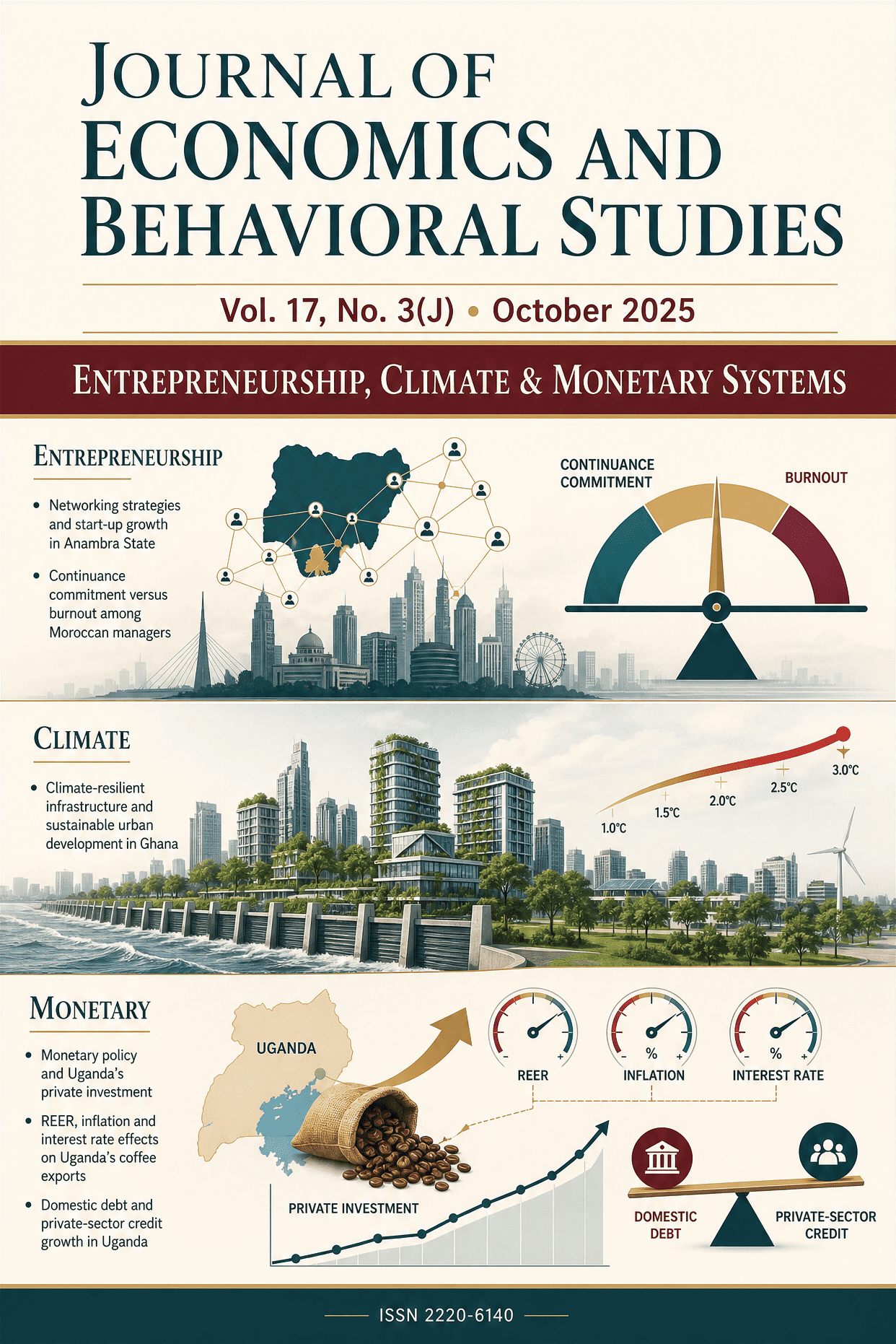
    Exploring Climate-Resilient Infrastructure and Sustainable Urban Development in Ghana

    • Author: Samuel Mensah Plange, Isaac Mensah, Stephanie Mensah Plange, Philip Appiah Djan

    The purpose of this study is to examine how climate-resilient infrastructure might support sustainable urban growth in Ghana. Rapid urbanization and climate change have posed substantial problems to Ghana's urban planning systems, resulting in frequent flooding, rising temperatures, and stressed infrastructure. This study used a mixed-methods approach, with 500 participants comprising urban planners, engineers, policymakers, and residents from various urban locations. Descriptive statistics, regression analysis, and correlation were employed to analyze quantitative data using SPSS, while thematic coding was utilized to examine qualitative insights. The findings reveal that 85% of respondents are aware of climate-resilient infrastructure, but only 16% believe that present projects adequately integrate resilience measures. Key barriers identified include weak policy enforcement, limited financial resources and a lack of technical expertise. According to regression and correlation analyses, policy efficacy, urbanization rate, and stakeholder participation are key determinants of infrastructure integration. The study emphasizes the value of targeted investments, capacity development, inclusive governance, and improved institutional frameworks. Ghana's distinct socioeconomic and environmental vulnerabilities make it an ideal case study for researching climateresilient urban infrastructure. The findings provide empirical insights to help Sub-Saharan Africa transition from reactive to proactive planning, as well as to inspire measures for enhancing urban resilience.

    Pages 1-9

    PDF - Exploring Climate-Resilient Infrastructure and Sustainable Urban Development in Ghana (opens in a new tab)
  • Article 2 in this issue

    Monetary Policy and Uganda’s Private Investment

    • Author: John Bosco Nsengiyumva, Benjamin Musiita, Frederick Nsambu Kijjambu

    Monetary policy determines the overall performance of an economy, particularly in developing countries where private investment is among the determinants of growth. Money supply, inflation, and changes in lending rates always influenced how the private sector invested in Uganda. This study aimed to examine how monetary policy influences private investment in Uganda focusing on money supply, interest rates, and inflation as the key determinants. Data for the period 1990 to 2020 were used for the study, which were secondary time series data provided by the Bank of Uganda and World Development Indicators publications. The Autoregressive Distributed Lag (ARDL) model was used to apply its application to both the short-run and long-run effects of monetary policy on private investment. The results showed that in the short run, private investment responded positively to increased money supply and inflation and negatively to higher lending rates. Although monetary policy can stimulate private investment in the short run, its effectiveness wanes in the long run unless carefully managed. This means that expansive policies can stimulate investment in the short run, but such heavy reliance could undermine the sustainability of investment. The study identifies that if Uganda could maintain an effective monetary policy, it is vital to balance encouraging private investment and maintaining macroeconomic stability. Such findings can assist in designing policies fostering sustainable private sector-driven growth.

    Pages 10-26

    PDF - Monetary Policy and Uganda’s Private Investment (opens in a new tab)
  • Article 3 in this issue

    REER, Inflation, Interest Rate and Uganda’s Coffee Exportation

    • Author: Benjamin Musiita, Frederick Nsambu Kijjambu, John Bosco Nsengiyumva

    This study examines the effect of the REER (real effective exchange rate) known as the relative currency value, inflation, and interest rate on the exportation of coffee in Uganda. To achieve the study's objectives, the study employed an Auto Regressive Distributive Lag Model using annual data from 1990-2019. It was discovered to have a beneficial effect on coffee export volumes in the long run when the relative currency value appreciates, while short-run appreciation of the effective currency rate has a negative effect that carries over to a three-year period. An increase in the rate of inflation has a positive effect on coffee exports in the twoyear short run, but in the longer term, an increase in the inflation rate has a negative effect. An increase in the lending rate has a negative effect on coffee exports in the two-year short term as well as in the first and third year, but in the long run, the effect is positive. The coffee production capacity of Uganda was captured by the estimated model through the incorporation of a variable on the volume of coffee production that was found to have a positive effect in both the short and long run periods. The study observes that the responsiveness of the volume of coffee exports to the responsiveness of IVs is low, an indicator that Ugandan coffee exports are facing inelastic demand on the global market. The study thus recommends that the government seize this golden chance with its hands by making cheap capital available to farmers, processors, and exporters, issuing more export licenses and encouraging more households to produce more coffee.

    Pages 27-43

    PDF - REER, Inflation, Interest Rate and Uganda’s Coffee Exportation (opens in a new tab)
  • Article 4 in this issue

    The Paradox of Continuance Commitment between Organizational Citizenship Behaviors and Signs of Burnout

    • Author: Hayat EL ADRAOUI

    This study examines the paradox of continuance commitment among Moroccan middle managers (N = 220), who operate under intense hierarchical pressure and demanding performance objectives. It explores how different forms of organizational commitment relate to organizational citizenship behaviors and early signs of burnout, while examining the mediating role of perceived social justice and empowering leadership. Data were collected through a structured questionnaire including validated measures of commitment, burnout, and citizenship behaviors, and analyzed using SPSS. Results show that continuance commitment is predominant, whereas affective and normative commitment remain weak. This pattern reflects constrained attachment associated with labor market conditions and is correlated with latent symptoms of burnout. Findings also demonstrate that perceived social justice and empowering leadership significantly mediate the relationship, enabling constrained commitment to evolve into more voluntary involvement and enhancing citizenship behaviors. The study highlights that high levels of continuance commitment should not be mistaken for genuine engagement. From a managerial perspective, organizations should strengthen fairness and adopt empowering leadership practices to reduce the risks of stress, disengagement, and resignation among operational managers. This research contributes to the literature by linking continuance commitment, burnout, and organizational citizenship behaviors in a non-Western context, highlighting the critical role of social justice and leadership as mediators.

    Pages 44-56

    PDF - The Paradox of Continuance Commitment between Organizational Citizenship Behaviors and Signs of Burnout (opens in a new tab)
  • Article 5 in this issue

    Domestic Debt and Growth of Credit To the Private Sector in Uganda

    • Author: Frederick Nsambu Kijjambu, Benjamin Musiita, John Bosco Nsengiyumva

    This study examines the effect of domestic debt on credit to the private sector, causality, and structural breaks in credit available for the private sector. Using the Auto Regressive Distributive Lag (ARDL) approach and two-step Granger causality test, evidence shows that domestic debt is negatively related to credit to the private sector in the short run as well as the long run. The study also finds a one-way Granger causality from private sector growth in credit to domestic debt, and it further reveals that the structural break variable significantly impacts credit to the private sector. The results indicate that, in the short run, private sector credit growth is positively influenced by its performance during the previous two quarters in that greater expansion of private lending during the previous quarters leads to greater private sector credit growth during the current period. Specifically, a one percent increase in Corporate credit in the most rerise in commercial cent past quarter increases current growth by 0.42 percentage points and by 0.2 percentage points for the second most recent quarter, while other variables are held constant. The study advises the government to monitor the amount of bank capital tied up in long-term government securities and avoid rapid policy reversals. Commercial banks should be cautious against over-investing in long-term government securities because rising domestic debt and declining growth in credit to the private sector can impose pressure on liquidity, and hence internal discipline on lending to government securities makes sense.

    Pages 57-73

    PDF - Domestic Debt and Growth of Credit To the Private Sector in Uganda (opens in a new tab)
  • Article 6 in this issue

    Evaluating The Influence of Networking Strategies on Start-Up Growth: Evidence from Anambra State, Nigeria

    • Author: Nzubechukwu Obi, Amadi Peter Onyekachi

    This study investigates the influence of networking strategies on the growth trajectory of start-ups in Anambra State, Nigeria. The research aims to determine how networking behaviours such as collaboration, partnerships, and knowledge sharing contribute to business expansion and sustainability. A quantitative research design was adopted, and data were collected from 374 start-up owners and managers across Awka, Nnewi, and Onitsha using a structured questionnaire. Descriptive and inferential statistical analyses, including correlation and regression, were employed to examine the relationship between networking strategies and start-up growth. Findings reveal that effective networking significantly enhances access to resources, knowledge, and market opportunities, which, in turn, drive innovation, visibility, and business performance. The study concludes that networking serves as a strategic mechanism for sustaining competitive advantage among start-ups. It recommends that entrepreneurs invest in professional networks and mentorship programs, while policymakers create an enabling environment that promotes collaboration and knowledge exchange among start-ups. The study contributes to entrepreneurial literature by empirically validating the role of networking in fostering start-up development in emerging economies.

    Pages 74-82

    PDF - Evaluating The Influence of Networking Strategies on Start-Up Growth: Evidence from Anambra State, Nigeria (opens in a new tab)