Abstract
In the case of Wachemo University, this paper looks into evaluating organizational communication style and how it affects employee performance. 261 sample respondents were given a standardized questionnaire as part of the study's survey methodology. The study's aims were achieved by combining the dependent variable, employee performance in the organization, with the independent variables completeness, correctness, consideration, clarity, conciseness, courtesy, and concreteness. Vice Presidents of Academic Affairs, Research and Community Service, and Administrative and Development are all involved in this investigation. The sample was chosen purposefully within each office: from the academic vice-president's office, the colleges of business and economics, social science, and agricultural science were chosen; from the research and community service vice-president office, the following institutions were chosen: Community service directorate office, Research publication office, and Research directorate office. The finance office and Student service office were chosen from the administrative and development vice-president office. Following collection, the data was analyzed using tables and graphs that use descriptive statistics. Additionally, a multiple linear regression model was employed to investigate how changes in each of the study's independent factors affected how well the employees performed. The results demonstrate that every independent variable has a favorable and significant impact on how well an organization's employees perform. Affective commitment and the communication surrounding work and organization were both favorably impacted by social and emotional subjects that were discussed between superiors and subordinates. The organization should build a fluid communication style between different departments for them to better coordinate and cooperate to achieve the overall organizational goals, according to the results and recommendations .
Keywords
References
- Admasu, A. (2012). Factors Affecting the Performance of Micro and Small Enterprises in Arada and Lideta Sub-Cities. Unpublished Master’s Thesis, Addis Ababa University.
- Ainobushoborozi, A. (June 2013). Impact of Effective Communication on Labour Productivity in Civil Engineering Projects A Case Study of Kampala Central Division.
- Antos, G. (2011). Handbook of interpersonal communication. The Hague, the Netherlands: Mouton De Gruyter.
- Beyerlein, M. M., McGee, C., Klein,G. D. Nemiro, J. E. & Broedling, L. (2003). The Collaborative Work System Fieldbook: Strategies, Tools, and Techniques. San Francisco: Pfeiffer.
- Bryman, A. & Bell, E. (2003). Business Research Methods. New York: Oxford University Press Inc.
- Creswell, J. W. (2009). Research designs: Qualitative, Quantitative and Mixed Methods Approaches (3rd Ed.) London: Sage.
- Chen, Ni. (2008). Internal/Employee Communication and Organizational Effectiveness: a study of Chinese corporations in transition. Journal of Contemporary China, 17(54), 167-189.
- David, P. (2003). The contribution of quality to business performance, International Journal of Operations & Production Management, 16(8), 44-62.
- Dwyer, J. (2005). Communication in Business. (5th ed.), Frenchs Forest: Prentice-Hall.
- Eisenberg, E. M. (2010). Organizational communication: Balancing creativity and constraint. New York, NY: Saint Martin’s.
- Greenberg, J. & Baron, R. A. (2008). Behavior in Organizations.9th ed. Upper Saddle River, NJ: Pearson Education.
- Hellweg, S. A. & Phillips, S. L. (1980). Communication and Productivity in Organizations: A State-of-the-Art Review in Proceeding soft he 40th Annual Academy of Management Conference, Detroit, Michigan, 188-192.
- Keyton, J. (2010). Case studies for organizational communication: Understanding communication processes. New York, NY: Oxford University Press.
- Keyton, J. (2011). Communication and organizational culture: A key to understanding work experience. Thousand Oaks, CA: Sage
- Kothari, C. R. (2004). Research methodology: Methods and techniques. New Age International. http://www.idjrb.com/articlepdf/idjrbjournal131.
- Koontz, H. (2001). Making theory Operational, Journal of Management Studies, 3(3), 229-4.
- Kreps, G. L. (1990). Organizational Communication: Theory and Practice. 2nd ed. NY: Longman.
- Lee, J. & Ling. (2008). Effects of leadership and leader-member exchange on innovativeness. Journal of Managerial Psychology, 23(6), 670–687. doi.org
- Lee, H. E., Park, H. S., Lee, T. S. & Lee, D. W. (2007). Relationships between lmx and subordinates’ feedbackseeking behaviors. Social Behavior and Personality: An International Journal, 35(5), 659-674.
- Muda, M., Matteson, T. and John, M. (2014). Ivancevich: Controlling Work Stress: Effective Human Resource and Management Strategies: San Francisco, London: Jossey-Bass. 378 pages
- Rafiki, A. & Harahap, M. R. (2014). Factors Influencing Employees’ Performance: A Study on the Islamic Banks in Indonesia International, Journal of Business and Social Science, 5(2).
- Mugenda, O. M. & Mugenda, A. G. (2003). Research Methods: Quantitative and Quantitative approach. Nairobi: ACTS press.
- Pauley, J. A. (2010). Communication: The key to effective leadership. Milwaukee, WI: ASQ Quality Press.
- Rajhans, K. (2012): Effective Organizational Communication; a key to Employee Motivation and Performance
- Robbins, S. P., Judge, T. A. & Campbell, T. T. (2010). Organizational Behavior. Essex, England: Pearson Education Limited.
- Saunders, M., Lewis, P. & Thorhill, A. (2009). Research Methods for Business Students (5th ed.). Harlow: Pearson Education Ltd.
- Shaw, G. B. (2011). The wit and wisdom of George Bernard Shaw. Mineola, NY; Dover Publications.
- Tubbs, S. & Moss, S. (2008). Human Communication: Principles and Contexts.11th ed. Boston, MA: McGrawHill Higher Education, cop.
- Wang. Y. K. (2005). Procedural justice, participation and power distance Information sharing in Chinese firms, Management Research Review, 33(1), 66-78.
- William, J. (2011). Job Satisfaction and Organisation Commitment. Family encyclopedia, entry http://wfnetwork.
Downloads
No downloads have been recorded for this article yet. Figures appear here once readers begin downloading the full text.
How to Cite
Share this article
License
Copyright (c) 2023 Endalkachew Desta, Zemede Chamiso (Author)

This work is licensed under a Creative Commons Attribution 4.0 International License.
Author (s) should affirm that the material has not been published previously. It has not been submitted and it is not under consideration by any other journal. At the same time author (s) need to execute a publication permission agreement to assume the responsibility of the submitted content and any omissions and errors therein. After submission of revised paper in the light of suggestions of the reviewers, the editorial team edits and formats manuscripts to bring uniformity and standardization in published material.
This work will be licensed under Creative Commons Attribution 4.0 International (CC BY 4.0) and under condition of the license, users are free to read, copy, remix, transform, redistribute, download, print, search or link to the full texts of articles and even build upon their work as long as they credit the author for the original work. Moreover, as per journal policy author (s) hold and retain copyrights without any restrictions.
Keywords
Section
Published in
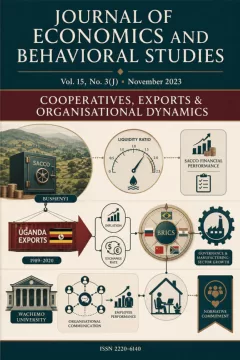 Vol. 15 No. 3(J) (2023)
Cooperatives, Exports & Organisational Dynamics
View issue contents
Published
Submissions
Have research to publish? Journal of Economics and Behavioral Studies welcomes submissions.
Make a Submission