Articles

  • Article 1 in this issue

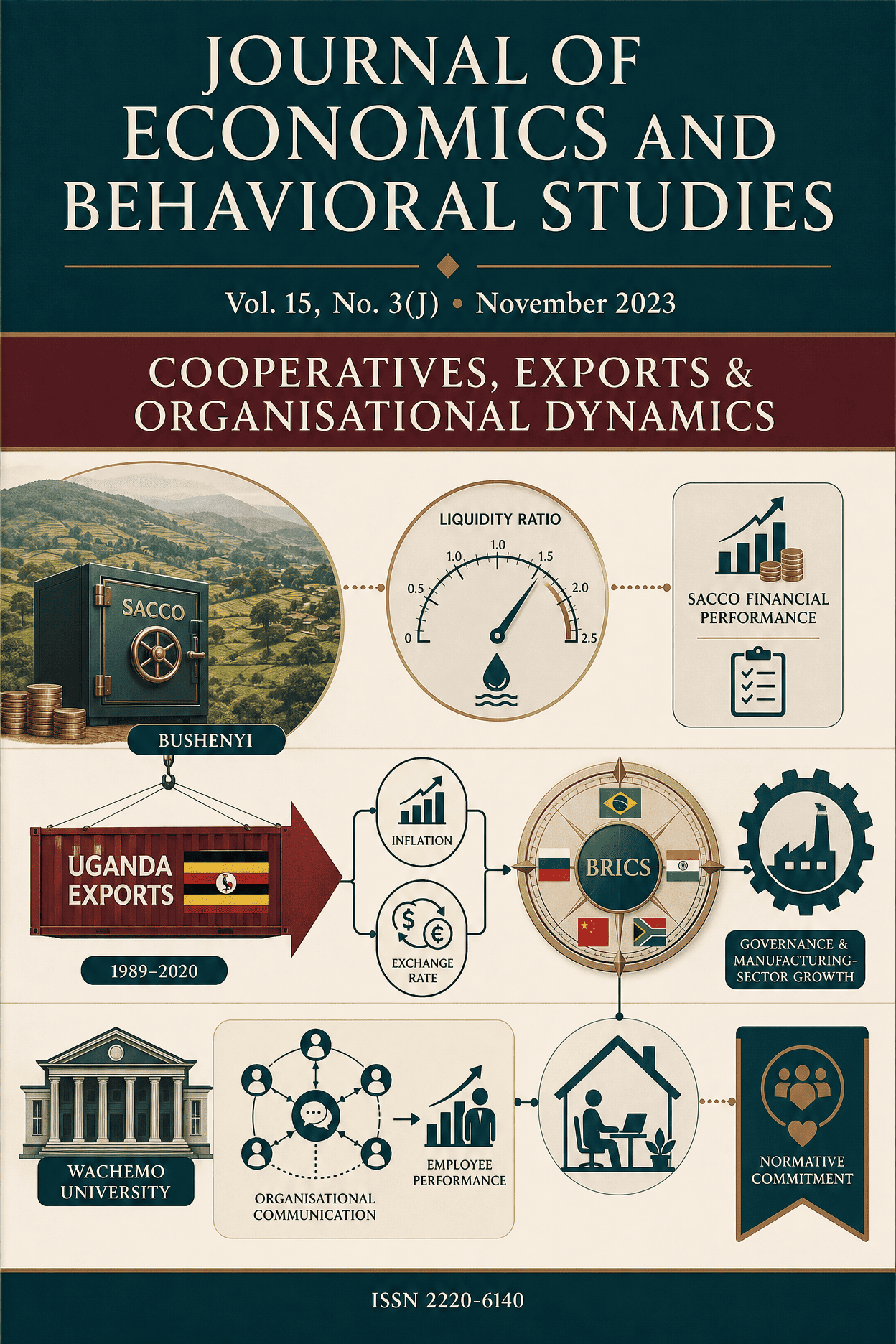
    Assessing the Organizational Communication Style and Its Effect on Employees' Performance in the Case of Wachemo University

    • Author: Endalkachew Desta, Zemede Chamiso

    In the case of Wachemo University, this paper looks into evaluating organizational communication style and how it affects employee performance. 261 sample respondents were given a standardized questionnaire as part of the study's survey methodology. The study's aims were achieved by combining the dependent variable, employee performance in the organization, with the independent variables completeness, correctness, consideration, clarity, conciseness, courtesy, and concreteness. Vice Presidents of Academic Affairs, Research and Community Service, and Administrative and Development are all involved in this investigation. The sample was chosen purposefully within each office: from the academic vice-president's office, the colleges of business and economics, social science, and agricultural science were chosen; from the research and community service vice-president office, the following institutions were chosen: Community service directorate office, Research publication office, and Research directorate office. The finance office and Student service office were chosen from the administrative and development vice-president office. Following collection, the data was analyzed using tables and graphs that use descriptive statistics. Additionally, a multiple linear regression model was employed to investigate how changes in each of the study's independent factors affected how well the employees performed. The results demonstrate that every independent variable has a favorable and significant impact on how well an organization's employees perform. Affective commitment and the communication surrounding work and organization were both favorably impacted by social and emotional subjects that were discussed between superiors and subordinates. The organization should build a fluid communication style between different departments for them to better coordinate and cooperate to achieve the overall organizational goals, according to the results and recommendations .

    Pages 1-21

    PDF - Assessing the Organizational Communication Style and Its Effect on Employees' Performance in the Case of Wachemo University (opens in a new tab)
  • Article 2 in this issue

    Governance and the Manufacturing Sector Growth among the BRICS Nations

    • Author: Benjamin Musiita, Dickson Turyareeba, Kenneth Mugambe, Anthony Wamala, Leward Jeke, Ben Boyi

    The objective of this study was to examine the relationship between selected governance factors and growth rates in the manufacturing sector's output among the member states of BRICS. This study examined the institutionalized growth theory and explored four governance factors: government effectiveness, regulatory quality, control of corruption, and voice and accountability. The study also considered factors associated with both exogenous and endogenous growth theories. The estimation process involves applying the first difference generalized method of moments (D-GMM) on a linear dynamic panel model. The data spans from 2010 to 2021. The findings of this study suggest that among the BRICS nations, government effectiveness is the most significant predictor of growth in the manufacturing sector, out of the four governance factors that were examined. The factors of voice and accountability, control of corruption, and regulatory quality did not demonstrate the capacity to exert influence on variations in the growth of the manufacturing sector within the BRICS countries. Unlike prior studies, our research incorporates a range of established growth theories in constructing the empirical model. Additionally, we employ an instrumental variable approach for dynamic panel data analysis. We utilize robust standard errors to address potential issues of endogeneity and model misspecification. Therefore, BRICS countries should devote a sizeable portion of their resources to building solid mechanisms that make it easier for the implementation, oversight, and thorough reporting of government activities inside their manufacturing sector. This strategy could increase governmental effectiveness, which would encourage overall manufacturing sector growth.

    Pages 22-33

    PDF - Governance and the Manufacturing Sector Growth among the BRICS Nations (opens in a new tab)
  • Article 3 in this issue

    Determinants of Export Performance in Uganda (1989-2020)

    • Author: Olawumi Dele Awolusi, Abdihakim Mohamed Osman

    The study is set to investigate the factors determining export performance in Uganda. The specific objectives of the study are to examine the relationship between Foreign Direct Investment net inflows, inflation, Real Exchange Rate and export performance from 1989 to 2020. The study adopted a longitudinal design and the analysis was based on stationarity tests, co-integration tests, ordinary least squares tests and finally diagnostic tests. The study results show that there is a significant relationship between foreign direct investments and export performance. Secondly, it was found that there was a relationship between inflation and export performance. The study also observed a significant relationship between inflation and export performance. Finally, it was found that the real exchange rate affects export performance. The study concludes that the development of foreign direct investments induces export performance; hence export performance can be generated through foreign direct investments. The study also concludes that the state of inflation reduction can be a general development of the export performance for the countries, while the real exchange rate is a key determinant for the export performance in Uganda from 1989 to 2020. The study recommends that there is a need for regulations and monitoring to ensure the proper form of foreign businesses in the country together with enhancing the management situation for the management of the business. Secondly, the policies intended to reduce inflation are needed to increase the capacity of businesses to operate and attain mechanisms for the reduction of inflation. Finally, the government should also embark on strong fiscal policy to reduce unnecessary money supply which can lead to inflation that negatively impacts on economy & reduces economic growth.

    Pages 34-54

    PDF - Determinants of Export Performance in Uganda (1989-2020) (opens in a new tab)
  • Article 4 in this issue

    Liquidity Management and Financial Performance of SACCOs in Bushenyi District

    • Author: Benjamin Musiita, Ben Boyi, Thomas Kisaalita, Wycliffee Mutungi, Robert Mbabazize

    The main objective of this paper is to examine the association between elements of liquidity management and the financial performance of SACCOs in Bushenyi District. This research was conducted through a cross-sectional survey involving a sample of 72 Savings and Credit Cooperative Societies (SACCOs) located in the Bushenyi District. A sample of 61 SACCOs operating in Bushenyi was determined using Krejcie and Morgan's Table, with accountants, managers, and credit officers serving as the units of analysis, resulting in a total population of 183 respondents. The research instrument's validity was assessed using the content validity index, and its reliability was evaluated through Cronbach's alpha coefficient, a measure of the consistency in obtaining similar results from the same respondents when administering the instrument at different times. In accordance with the research objectives, inferential statistics, specifically correlation and regression analyses, were conducted. The findings reveal a statistically significant positive correlation between cash ratios, liquidity ratios and financial performance. Lastly, the research outcomes demonstrate a statistically significant positive relationship between the comprehensive liquidity management elements and financial performance. This suggests that any favorable change in the management of liquidity within SACCOs is associated with a positive change in financial performance. Therefore, enhancing liquidity management can aid in maximizing the use of cash on hand, while efficient cash budgeting can guarantee good planning and resource allocation. Due to their weakly positive associations with liquidity management, debtor management, as well as bank reconciliation statements, must also be considered; this will improve the financial performance of SACCOs.

    Pages 55-69

    PDF - Liquidity Management and Financial Performance of SACCOs in Bushenyi District (opens in a new tab)
  • Article 5 in this issue

    Telecommuting and Normative Commitment of Employees in a Technology Firm: After Effects of Covid-19 Pandemic

    • Author: Sholesi, Olayinka Yusuf, Awotunde Olusegun Matthew, Kolawole Ibukun Olorunisola

    The recent trend in the world of work has made it expedient for organizations to adopt various flexible work practices such as telecommuting and this is affecting the normative commitment of employees. The study examined telecommuting and the normative commitment of employees in a technology firm. The study adopted the descriptive survey research design. The population of the study is (160) one hundred and sixty and using the Krecjie and Morgan sample size determination formula the sample size of (113) one hundred and thirteen was arrived at. One hundred and thirteen copies of the questionnaire were distributed, purposive sampling techniques were used and three hypotheses were tested using person-product moment correlation and multiple regression using S.P.S.S 27.0 version. The findings revealed that there is a 39.1% weak relationship between remote work and normative commitment and a 97.8% strong relationship between telework and normative commitment. The study further revealed that remote work and telework account for 95.6% of normative commitment. The study concluded that telework is the most significant variable driving normative commitment. However the study recommended among others that management should make it expedient for their telecommuter employees to report to their agency worksite frequently to prevent physical and psychological isolation and there should be constant engagement between the telecommuter employees by putting in place effective online tracking mechanisms to monitor them, also management should give them a sense of belonging, this will help discourage moonlighting.

    Pages 70-76

    PDF - Telecommuting and Normative Commitment of Employees in a Technology Firm: After Effects of Covid-19 Pandemic (opens in a new tab)