Articles

  • Article 1 in this issue

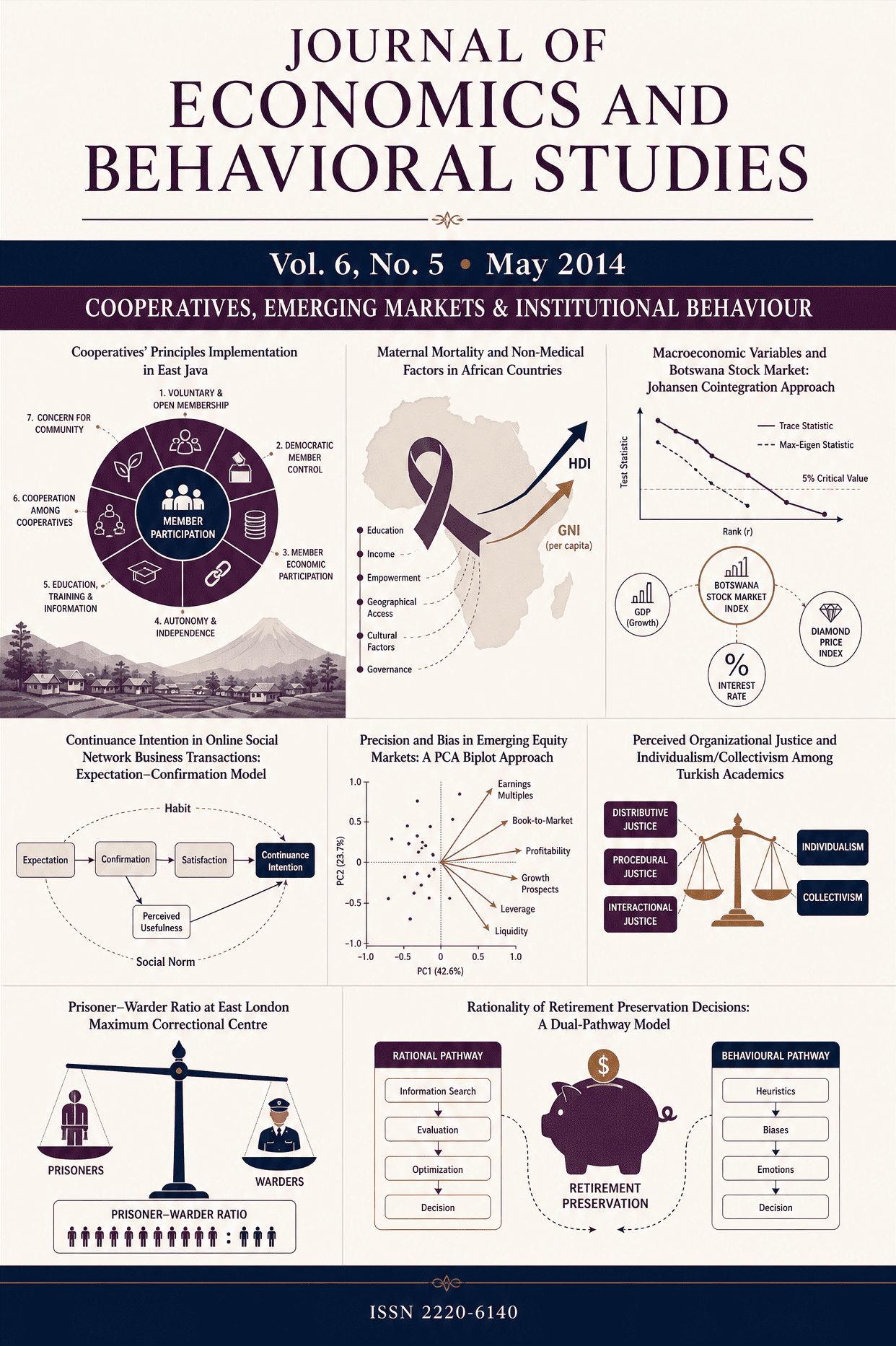
    Implementation of Cooperatives’ Principles on Ranked-Cooperatives, East Java 2012

    • Author: Wiwiek Harwiki, Ruswiati Suryasaputra

    The purposes of this research to identify of values and cooperatives’ principles on the field, to identify roles and member participation to improving cooperatives, to identify cooperatives’ performance based on cooperatives’ principles, and to identify problems in order to implementing the cooperatives’ principles. Samples were collected amount 52 cooperatives have been assessed as the accredited cooperatives by Small Medium Enterprise and Cooperatives Office East Java. Methodology supported this research were inventory, field survey, and data analysis. Data have been analyzed and evaluated on 2 steps: grading the defined instrument and checking the supported documents given by respondents. The research findings: Cooperatives’ Principles is an abstract vision which has to spell out how these Principles are to be practiced. The Success programmes as a way to implementing Cooperatives’ Principles that guiding the operation of organization. The product of all cooperatives surveyed was not specific products and need innovation products. Better service for members to survive among other cooperatives. To implement Cooperatives’ Principles, there were correlations between: Management Control and Members’ Satisfaction, Boards’ Performance and Members’ Satisfaction, Well-controlled Administration and Members’ Satisfaction, Capital Structure and Members’ Satisfaction, Unit Business and Members’ Satisfaction, Training & Education and Members’ Satisfaction, Cohesiveness and Members’ Satisfaction.

    Pages 340-350

    PDF - Implementation of Cooperatives’ Principles on Ranked-Cooperatives, East Java 2012 (opens in a new tab)
  • Article 2 in this issue

    The Association between Maternal Mortality and Non-Medical factors in African Countries

    • Author: P. Lalthapersad-Pillay, EO Udjo

    The medical expertise to treat to complications arising from pregnancy and childbirth has not spared girls and women in developing countries from dying of such conditions. Developing countries account for the bulk of the global share of maternal deaths with complications of pregnancy and childbirth being the leading cause of death in young women aged between 15 and 49. Sub-Saharan Africa is responsible for nearly three-fifths of all global maternal deaths which have saddled it with notoriously high levels of maternal mortality ratios, a concern that has been red-flagged internationally and regionally. Most studies on maternal mortality in Africa have been confined to an examination of factors impinging on maternal mortality from both medical and socioeconomic standpoints for individual country’s based on survey data. Our study differs from others as it employs logistic regression to look at the association between non-medical factors and maternal mortality nationally for all African countries. Whilst the results from the logistic regression suggests that there is no statistically significant relationship between any of the variables and maternal mortality, the odds ratio for Human Development Index (HDI) and Gross National Income per capita (GNI) imply that African countries with low HDI are about three time more likely to have high maternal mortality compared to high HDI countries. Similarly, African countries with low GNI are about five times more likely to have high maternal mortality compared to high GNI countries.

    Pages 351-362

    PDF - The Association between Maternal Mortality and Non-Medical factors in African Countries (opens in a new tab)
  • Article 3 in this issue

    Do Macroeconomic Variables Influence Domestic Stock Market Price Behaviour in Emerging Markets? A Johansen Cointegration Approach to the Botswana Stock Market

    • Author: Onneetse L. Sikalao-Lekobane, Khaufelo Raymond Lekobane

    The ability of the stock market to reflect real economic activities through fundamental macroeconomic variables in emerging markets remains paramount considering the role of stock markets in the financial system. This paper explores the long-term equilibrium relationship between the Botswana stock market price and selected domestic and global macroeconomic variables using quarterly data for the period 1998 to 2012. The selected macroeconomic variables included Gross Domestic Product (GDP), long and short-term interest rates, money supply, foreign reserves, inflation, diamond price index, exchange rate, US share price index and 10 Year US government bond yield. The paper employs VECM framework following Johansen’s cointegration technique. The analysis revealed that macroeconomic variables and the stock market price are cointegrated, hence, a long-run equilibrium relationship existed between them. The results showed that in the long run, real GDP, short-term interest rates, inflation and diamond index are positively related with stock market price. However, long-term real interest rate, money supply, foreign reserves, exchange rate, US share price index and US government bond yield are negatively related with stock market price in the long run.

    Pages 363-372

    PDF - Do Macroeconomic Variables Influence Domestic Stock Market Price Behaviour in Emerging Markets? A Johansen Cointegration Approach to the Botswana Stock Market (opens in a new tab)
  • Article 4 in this issue

    A Theoretic Extension and Empirical investigation of conducting Business Online Social Network: The Continuance Intention Phenomenon

    • Author: Akwesi Assensoh-Kodua, Lawrence Mpele LEKHANYA

    Online Social Network (OSN) is a web 2.0 enabled technology that permits OSN participants to interact with both old and new friends initially. This model of OSN ventured into conducting business activities on platforms, which resulted in many springing up but not surviving, yet the explosion of business activities on these platforms continuous to grow. It is therefore important that OSN practitioners and researchers understand the key determinants of OSN business transaction and continuance intention propellants. The purpose of this paper is to establish the factors that determine OSN participant’s continuance intention to do business on OSN platform. The research framework is grounded in an extended expectation-confirmation model (ECM). An online survey model was used to collect 300 valid responses from OSN participants who have ever conducted business using OSN. A partial least square version 2.0.M3 (PLS) and Warp PLS 4.0 were deployed to perform CFA analyses and structural equation modelling, respectively. The emerging results provide significant evidence in support of the five out of nine factors tested against the hypotheses proposed, namely: Perceived Behavioural Control (0.01), Satisfaction (0.14), Expected Benefit (0.15), Social Norms (0.24), and Habit (0.31), as the main determinants of OSN continuance intention.

    Pages 373-385

    PDF - A Theoretic Extension and Empirical investigation of conducting Business Online Social Network: The Continuance Intention Phenomenon (opens in a new tab)
  • Article 5 in this issue

    Precision, Consistency and Bias in Emerging Equity Markets

    • Author: WS Nel, BW Bruwer, NJ le Roux

    The use of multiples is a popular approach employed by analysts to perform valuations. These multiples are based on optimal value drivers, the valuation performance of which should be underpinned by empirical findings from carefully designed, unbiased research initiatives. This paper firstly investigates the risk of biasing the design of market-based studies which aim to test the valuation performance of individual value drivers. The evidence revealed that, when testing the valuation performance of value drivers, there is an inherent risk of biasing the design of a study of this kind, and therefore, its outcome. Secondly, the paper presents evidence in support of the consistency of previous research findings regarding the valuation performance of individual value drivers in the South African market over the period 2001-2010. To this end, the paper introduces a new approach for the analysis of multidimensional equity valuation research data in the form of principal component analysis (PCA)-based biplots. Thirdly, the paper provides evidence that multiples-based modeling seems to be biased to the downside, which is an important consideration for analysts who choose to adjust their valuations outside of these models.

    Pages 386-399

    PDF - Precision, Consistency and Bias in Emerging Equity Markets (opens in a new tab)
  • Article 6 in this issue

    A Study of Relatıonship between Perceived Organızational Justice and Individualism/Collectivism Values Among Academic Staff

    • Author: Şaban ESEN, Aslı ÇİLLİOĞLU KARADEMİR

    The purpose of this study is to investigate the relationship between the individuals’ perceptions of justice in the organizations they work in and the personality tendencies of individualism or collectivism they have. For that reason, firstly the concept of organizational justice and the values of collectivism and individualism were explained; their relationship was mentioned through theoretical and empirical studies in the literature. As measurement tool, survey method was used. The surveys were conducted on 133 academicians working at Bartin University which is one of the state universities in Turkey. As a result of doing reliability analysis and factor analysis, the last form of scale was given. The perceived organizational justice handled in the scale was composed of three dimensions which are distributive justice, procedural justice and interactional justice; and despite individualism and collectivism have four sub-dimensions (horizontal individualism, vertical individualism, horizontal collectivism and vertical collectivism) this was not taken into account in the study and they were discussed from only individualism and collectivism dimensions. In consequence of ANOVA analyses performed, it is found that there is a low relation between collectivism value and distributive justice as well as between individualism value and interactional justice. The findings of ANOVA analysis showed that in the demographic characteristics only the title variable groups showed significant differences between interactional justice and individualism. By multi-regression analysis, it is seen that as much as procedural justice increases the exhibited collectivism characteristic increases, in similar way as much as distributive justice increases the collectivism characteristic increases. There was no obvious significant correlation between individualism variable and justice dimensions.

    Pages 400-410

    PDF - A Study of Relatıonship between Perceived Organızational Justice and Individualism/Collectivism Values Among Academic Staff (opens in a new tab)
  • Article 7 in this issue

    Prisoner-warder ratio parity in a South African Correctional Centre: Repercussions on prison work environment and correctional security personnel

    • Author: Vuyokazi Magungxu, Willice Abuya, Philani Moyo

    South Africa has one of the highest inmate populations in the world. In order for the South African Correctional Services system to provide an environment conducive for the appropriate rehabilitation and reformation of its many inmates, it requires a balanced prisoner-warder ratio based on international standards. But is this the case in South African prisons? This is one of the questions that this article engages as it examines the prisoner-warder ratio at the East London Maximum Correctional Centre (ELMCC) in an effort to understand the effects of prison overcrowding on the prison work environment and correctional personnel. Based on empirical evidence gathered through qualitative techniques, the study finds a disproportionate prisoner-warder ratio at the ELMCC. This disproportion has a number of negative effects on the prison work environment and direct security personnel on duty. For example, high absenteeism is rife with warders frequently on sick leave while others are regularly on temporary incapacity leave. High stress levels are also a major problem pushing many warders into alcohol abuse. Cognitive job satisfaction and organizational commitment are also negatively affected by this disproportion with the majority of warders indicating poor work performance due to low morale and lack of motivation.

    Pages 411-417

    PDF - Prisoner-warder ratio parity in a South African Correctional Centre: Repercussions on prison work environment and correctional security personnel (opens in a new tab)
  • Article 8 in this issue

    The rationality of retirement preservation decisions: A conceptual model

    • Author: Michelle Reyers, Cornelis Hendrik Van Schalkwyk, Daniël Gerhardus Gouws

    Low retirement savings rates, coupled with a lack of preservation of retirement funds when individuals move jobs, could have adverse repercussions on a person’s ability to retire with sufficient funds. The traditional response to low preservation levels has been to impose taxes on cash withdrawals and in some cases to mandate preservation. However, without a complete understanding of the factors that drive low levels of preservation, these policy interventions might do more harm than good. This study carries out a critical, interdisciplinary literature review to construct a conceptual model of the factors which potentially lead to low preservation levels and outlines proposed interventions. The resultant model highlights the distinct differences in the drivers of rational and irrational behaviour and therefore, the distinctly different interventions required. Little is known about the rationality or otherwise of the decision making process of individuals in the retirement preservation context, however current interventions only assist if individuals display bounded willpower. It is essential that a better understanding of the decision making process is obtained to determine whether existing solutions address the problem adequately.

    Pages 418-431

    PDF - The rationality of retirement preservation decisions: A conceptual model (opens in a new tab)