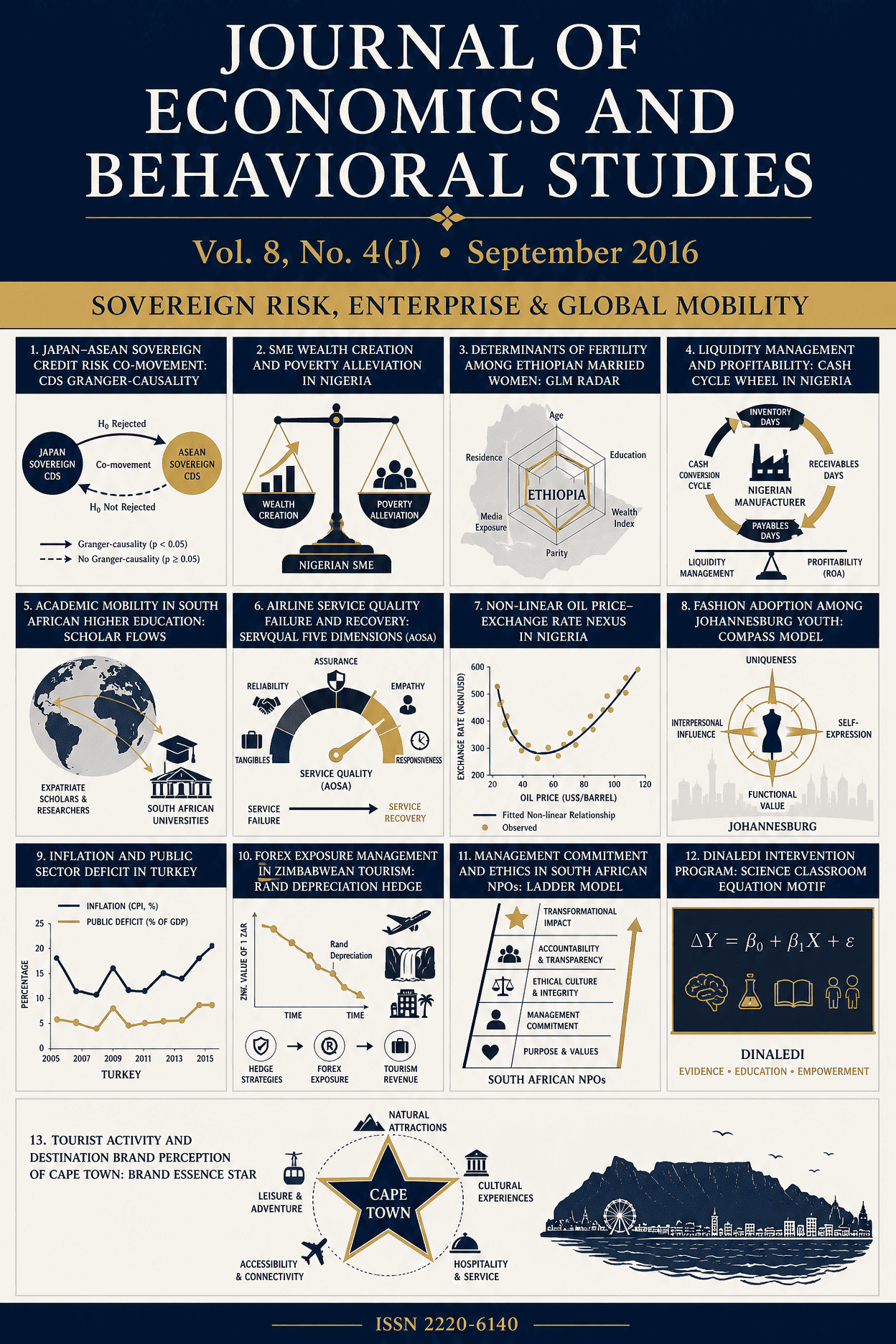
Articles 1–10 of 13

  • Article 1 in this issue

    An Empirical Analysis of Sovereign Credit Risk Co-movement between Japan and ASEAN Countries

    • Author: Boonlert Jitmaneeroj, John Ogwang

    Japan is the most developed economy in Asia. However, it has been on record for being the most heavily indebted country among OECD countries. In many circumstances, the high sovereign debt level indicates a high possibility of sovereign credit risks associated with investment in government bond. The high sovereign credit risk may also generate a number of negative externalities for private businesses operating in the host country. This paper investigates whether sovereign credit risk of Japan as measured by its sovereign credit default swap (SCDS) can better predict and commove with sovereign credit risk of selected ASEAN countries. The bivariate VAR model was used to test for Granger Causalities among these countries SCDS premiums and correlation analysis to investigate co-movements between SCDS of these countries. The results indicate that Japan’s sovereign credit risks do not co-move with those of ASEAN countries, Furthermore, Sovereign credit risks of ASEAN countries tend to lead those of Japan as evidenced by unidirectional causalities from these countries to Japan. The overall suggestion is that sovereign credit risk of Japan is not likely to influence those of ASEAN. The paper concludes with some implications for businesses.

    Pages 6-16

    PDF - An Empirical Analysis of Sovereign Credit Risk Co-movement between Japan and ASEAN Countries (opens in a new tab)
  • Article 2 in this issue

    SMEs, Wealth Creation and Poverty Alleviation in Nigeria

    • Author: Olalekan Usiobaifo Asikhia

    Most developing countries see small and medium-scale enterprises (SMEs) as engines of development, and as such formulate policies that could encourage their establishment and survival. However, in spite of the enormous number of such firms established and operating, the Nigerian economy is still far from being buoyant. This article reports on research testing the wealth creation model applicable to SMEs and investigated the contribution of SMEs to poverty alleviation in Nigeria. A survey of 581 SMEs was conducted and the findings revealed that only 15% of wealth created that contributed to alleviating poverty was traceable to SMEs. This increased to 24% when moderated with wealth distribution, but by only one percent when moderated by wealth motivation. This implies that although most SME operators in Nigeria have personal motivations to acquire wealth, they are not distributing it, hence the low percentage of wealth that SMEs contribute to poverty alleviation. Policy implications and recommendations were made.

    Pages 17-31

    PDF - SMEs, Wealth Creation and Poverty Alleviation in Nigeria (opens in a new tab)
  • Article 3 in this issue

    Fertility Status of Married Women and Its Determinants in Ethiopia

    • Author: Essey Kebede Muluneh, Temesgen Zewotir, Tilaye Matebe Yayeh

    This study investigates determinant factors of fertility among married women in Ethiopia, the second most populous country in Africa with rapid population growth. The data used for the analysis was obtained from the 2014 Ethiopia Mini Demographic and Health Survey which was carried out by the Central Statistical Agency. A generalized linear model (GLM) analysis was carried out to investigate the effect of socioeconomic and demographic factors on the number of children ever born by a married woman of age 1549 years. High fertility was independently associated with residing in urban areas, increased household economic status, younger age at first birth and not using contraceptives. Current age and media exposure, household head gender and media exposure, household head gender and regional state, mother’s education and, regional state and media exposure and regional state were found to jointly affect fertility level.

    Pages 32-40

    PDF - Fertility Status of Married Women and Its Determinants in Ethiopia (opens in a new tab)
  • Article 4 in this issue

    Does Liquidity Management Affect Profitability in Selected Nigerian-Quoted Manufacturing Firms?

    • Author: Matthew Adeolu Abata, Stephen Oseko Migiro

    This study examined the nexus between liquidity management and profitability in selected Nigerian-quoted manufacturing firms. Many business failures have been recorded over the years due to inability to balance the link between liquidity and profitability. Descriptive research design was employed to analyze the data gathered from 2004 to 2014. The study found a positive relationship between credit policy, return on equity and return on capital employed. It equally found that operating cash flow and cash conversion cycle are negatively related to all the metrics of profitability. The study therefore recommends among others, that managers should strive to achieve a reasonable level of profit to optimize shareholders’ wealth and keep the firms in business. Also, managers should effectively manage account receivables and inventory at optimal level to avoid tie down liquid assets unnecessarily. Investors should pay close attention to firms’ operational cash flow in order to access their true state before committing their funds.

    Pages 41-51

    PDF - Does Liquidity Management Affect Profitability in Selected Nigerian-Quoted Manufacturing Firms? (opens in a new tab)
  • Article 5 in this issue

    Academic Mobility and Immigration Trends in South African Higher Education Institutions

    • Author: Ashika Maharaj

    This paper seeks to offer an insighton the subject of academic mobility into South African Higher Education Institutions (HEI’s). This is done by examining the current academic landscape in South Africavia a comparisonbetween the profile of South African (SA) academics andexpatriate academics. Currently, SA is facing major skills and staffing shortages locally in terms of Science, Engineering and Agriculture. The Departmentof Higher Education and Training as well as SA universities have advocated to run programmes in scarce skills disciplines through the recruitment of expatriate academics. The research reported in this paper adopted a non-experimental research design of ex post facto type, using a correlational approach. The data used are the statistical records of all academics in South African higher education for the 2005/2010/2014 academic years as provided by the Higher Education Management Information Systems (HEMIS) of SA. Descriptive statistics as well as inferential statistics were also used to analyze the data. The results revealed that there were no significant differences in age between SA and expatriate academics nationally over the three years. A comparison of the academic qualifications of SA and expatriate academics over the three years indicates that expatriate academics are more highly qualified than their SA colleagues, as the majority of the former hold a doctoral degree. The majority of expatriate academics are recruited from SADC countries as well as other African countries. Interestingly enough, the next most frequent major supply region of expatriate academics to South Africa is Europe. WITS and UCT were consistently ranked first and second in terms of the number of expatriate academics employed over the three years. Both are among the leading five higher education institutions in South Africa in terms of their research outputs as well as the number of PhDs per member of staff.

    Pages 52-66

    PDF - Academic Mobility and Immigration Trends in South African Higher Education Institutions (opens in a new tab)
  • Article 6 in this issue

    Service Quality Failure and Recovery Imperatives: Implications for Airlines Owned by South Africa

    • Author: Nicholas O. Mantey, Vannie Naidoo

    This article reports on a study that examined service quality and recovery among South African airlines. Service quality is pivotal in the airline industry as service failures could negatively affect operations. The authors created the acronym “AOSA” which stands for “airlines owned by South Africa” for the purposes of anonymity and confidentiality in order to protect the airlines’ identity. A quantitative research approach was used with a cross-sectional analysis (sample survey) conducted with passengers of South African-owned airlines. The questionnaire was designed using a Likert scale tool, adapted to the SERVQUAL model. A nonprobability convenient sampling method was used to collect primary data from 684 passengers at O.R.Tambo International Airport in Johannesburg and King Shaka International Airport in Durban. The key findings were that: (1) significant statistical gaps exist between passengers’ expectations and perceptions of AOSA’s service quality and that unsatisfactory service quality is antecedent to service failure. (2) Unsatisfactory service quality is tantamount to service failure in the provision of services by AOSA. (3) A significant positive correlation exists between service quality and the dimensional variables of tangibility, reliability, responsiveness, assurance, and empathy of AOSA. In conclusion, AOSA service quality is unsatisfactory, and management should take steps to empower and train staff in service recovery techniques in other to avoid service failures.

    Pages 67-78

    PDF - Service Quality Failure and Recovery Imperatives: Implications for Airlines Owned by South Africa (opens in a new tab)
  • Article 7 in this issue

    A Non-Linear Analysis of the Oil Price-Exchange Rate Nexus in Nigeria

    • Author: Olagbaju Ifeolu O., Akinbobola Temidayo O.

    This paper studies the effect of oil price shocks on the Nigerian exchange rate on the basis of monthly data over the period January, 2008 to October, 2015. In order to explore the effects of oil prices on the competitiveness of the Nigerian currency, which had hitherto attracted little attention in literature, the paper adopts the real effective exchange rate measure within a five-variable VAR model, analysed using both linear and non-linear approaches. We find evidence of a non-linear impact of oil prices on real effective exchange rate. Specifically, decreases in oil price are found to have an appreciating impact on real effective exchange rate, implying a loss of competitiveness of the Naira, while increases in oil price are found to be irrelevant for movements in the real effective exchange rate. Our study also suggests a link between Naira depreciation and the real effective exchange rate appreciation through a pass-through effect on rising domestic prices.

    Pages 79-91

    PDF - A Non-Linear Analysis of the Oil Price-Exchange Rate Nexus in Nigeria (opens in a new tab)
  • Article 8 in this issue

    Factors Influencing Fashion Adoption among the Youth in Johannesburg, South Africa

    • Author: Marike Venter, Richard Chinomona, Tinashe Chuchu

    Fashion in Africa has undergone a tremendous transformation process due to an increase in international trade. As a result, African consumerism has surfaced. Through being part of the global community, the youth in Africa capitalizes on the wide variety of fashions available, and they view fashion as a medium for expressing their identity. More specifically, in South Africa, fashion is used as the ideal vehicle for the youth to re-map previously fixed racial identities. Although a number of studies have explored this subject in an array of contexts, limited research has focused on factors that drive fashion adoption among the youth in Johannesburg. In view of this identified research gap, the present study aims to investigate the impact of fashion consciousness, the need for uniqueness, interpersonal influence, individualism/collectivism, and masculinity/femininity on fashion adoption. A Field study was conducted in Johannesburg and research data were collected from 400 respondents aged between 18 to 29 years. Linear regression analysis was performed to explore the relationship between the quantitative outcome variable and the predictor variables of the study by use of the SPSS 22 and the AMOS 22 software program. The results reveal that two of the five variables positively influence fashion adoption, while individualism/collectivism has an inverse relationship with fashion adoption. The significance of gaining insight into such factors, draw from the rich political history of South Africa and how the youth’s conflicting identities may influence the modern concept of adopting global fashion trends.

    Pages 92-108

    PDF - Factors Influencing Fashion Adoption among the Youth in Johannesburg, South Africa (opens in a new tab)
  • Article 9 in this issue

    Long-Term Relationship between Inflation and Public Sector Deficit in the Turkish Economy and its Macroeconomic Implications (1975–2014)

    • Author: AtillaGökçe, UmutÇakmak

    The process of deterioration in the fundamentals, in particular those related to inflation and the public sector deficits, that had started in the 1980’s have accelerated in the 1990’s. Meanwhile two way causative relations seem to have appeared between the fluctuations of some fundamentals. In this context, this paper examines the long term relationship between inflation and the public sector deficit and provides an analysis of the macro dynamics that derive from this relationship. Following a summary of the theoretical literature on the relationship between inflation and the public sector deficit, the behavior of these two variables in the 1975-2014 periods are delineated and an analysis of their relationship to some selected macro-variables is presented. T he most important result of this article is that high and chronic inflation rates are one of the responsible of deterioration which appeared on the main economic variables particularly in the public sector balance. Similarly, in the 2000’s, on the basis of positive developments in the public balance lies in falling inflation rates quickly and permanently.

    Pages 109-122

    PDF - Long-Term Relationship between Inflation and Public Sector Deficit in the Turkish Economy and its Macroeconomic Implications (1975–2014) (opens in a new tab)
  • Article 10 in this issue

    Foreign Exchange Exposure Management Practices by Zimbabwe’s Tourism and Hospitality Companies: A Case for the Depreciation of Rand (2014-2016)

    • Author: Wilford Mawanza

    One of the key challenges for tourism and hospitality in the Sub-Sahara Africa (SSA) region is currency behaviours and Exchange rate regime choices. When a company engages in international business foreign currency risk management becomes a crucial part of doing business and the tourism industry of Zimbabwe was not spared on this issue. The objective of this research was to assess the foreign exchange (forex) Exposure Management Practices by Zimbabwe’s tourism and hospitality companies. The study was done through a survey on 28 operators in Zimbabwe. A qualitative research approach was adopted in analysis of the data It was found out that the most commonly used ways of reducing the exposure by Zimbabwe’s tourism companies were the amicable and mixed-method approaches, of receiving the currency and use it in the country of origin to import materials, matching receipts and payments in foreign currency, risk shifting though it come with low volumes and compromised repeat business. The study recommended that companies and the entire economy must consider invoicing products and services in Rands and even use the rand as a reporting currency. If for example tourism and hospitality players would price regional tourists especially from South Africa and other Rand countries, ignoring the impact of rand depreciation, it would mean that Zimbabwe’s tourism and hospitality providers will be in direct competition with the former’s own local service providers based on rand priced packages.

    Pages 123-132

    PDF - Foreign Exchange Exposure Management Practices by Zimbabwe’s Tourism and Hospitality Companies: A Case for the Depreciation of Rand (2014-2016) (opens in a new tab)