Articles 11–13 of 13

  • Article 11 in this issue

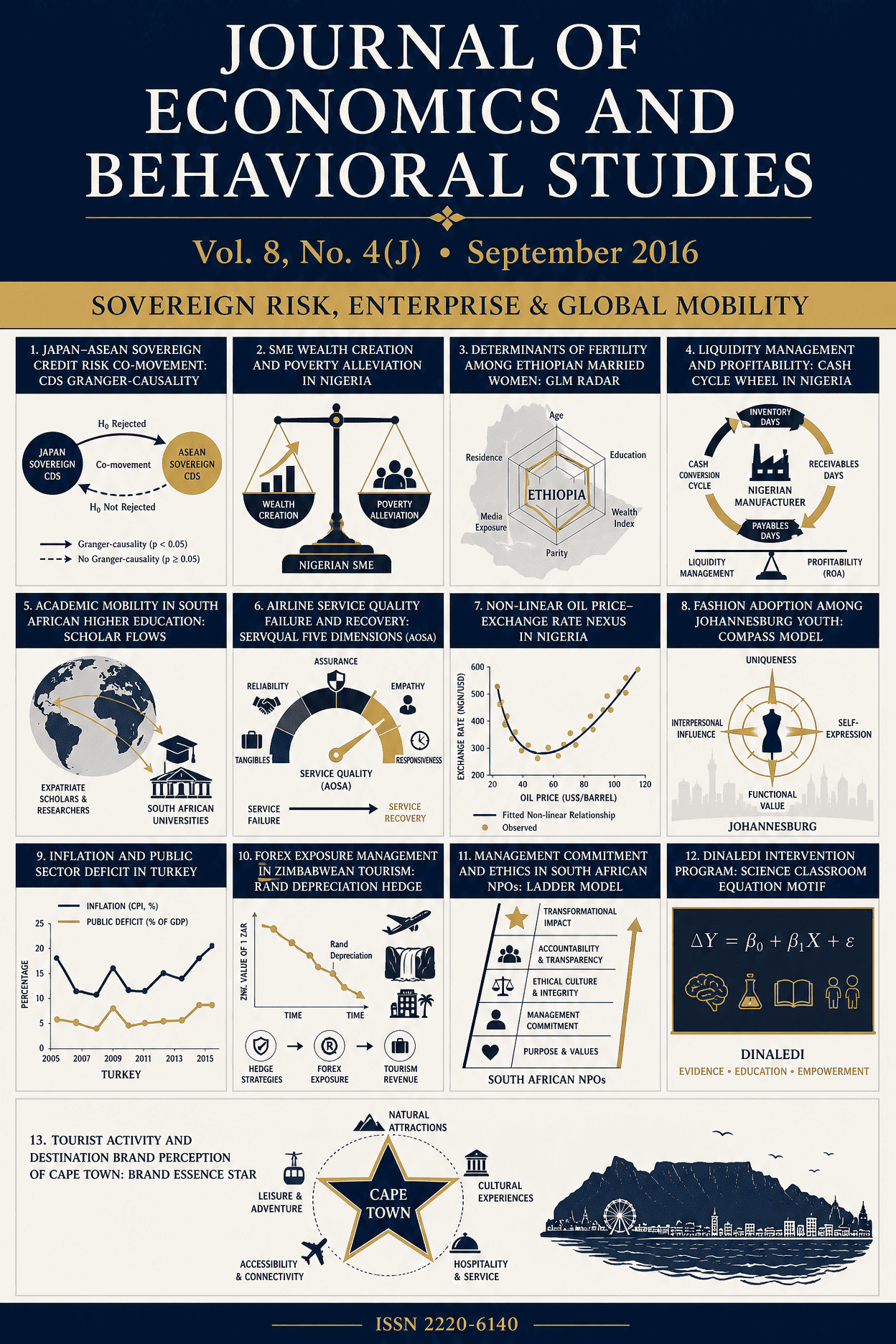
    Management’s Commitment, Education and Ethics on Organisational Entrepreneurship: The Case of South African Non-Profit Organisations

    • Author: Rukudzo Pamacheche, Richard Chinomona, Tinashe Chuchu

    The objectives of the study were to explore the management characteristics that are related to organisational entrepreneurship in not-for-profit organisations (NPOs) in Gauteng, South Africa as well as the relationship between organisational entrepreneurship and the organisational performance. The methodology involved a quantitative approach of collecting and analysing research data. A field study was conducted in Johannesburg, South Africa whereby research data were collected from 257 NPO managers from voluntary organizations. Using the SPSS 22 and the AMOS 22 software program, Structural Equation Modeling (SEM) was performed to analyze the research data. The study noted implications for NPO management teams, including the renovation of business model structures to incorporate continuous learning and constructive risk-taking in order to take advantage of the performance benefits derived from organisational entrepreneurship. The study also recommends further research into potential citizenship bodies for NPO management teams to foster commitment to their occupation in the non-profit sector. The research makes a significant contribution by providing a framework in which management’s commitment to NPOs can be measured and analysed.

    Pages 133-143

    PDF - Management’s Commitment, Education and Ethics on Organisational Entrepreneurship: The Case of South African Non-Profit Organisations (opens in a new tab)
  • Article 12 in this issue

    The Dinaledi Intervention Program

    • Author: T. Ncanywa

    The study seeks to examine the relationship between educational inputs, primarily the Dinaledi intervention program and schooling outcomes. The Dinaledi program is one of the government’s intervention programs to redress the inequalities and provided education resources to the previously disadvantaged communities in South Africa. The study employed a pseudo panel analysis on the attempt to answer the question of interest. Considering the random effect regression, Dinaledi schools were less likely to increase dropout rate by 0.099% with reference to non-Dinaledi schools. The pseudo panel analysis indicated a positive and significant association of the Dinaledi schools to pass rates. Further extensions of the analysis were looking at the distribution of the Dinaledi program on racial and gender issues by using the DiNardoFortin-Lemieux (DFL) estimation. It can be concluded that schooling outcomes can be strongly influenced by the Dinaledi intervention program with females and Blacks becoming more responsive to dropping out than their counterparts. Looking at the nature of resources and support provided to Dinaledi schools, it is recommended that the entire schooling system adopt the model to eradicate the legacy of inequality and improve schooling outcomes.

    Pages 144-155

    PDF - The Dinaledi Intervention Program (opens in a new tab)
  • Article 13 in this issue

    Tourist Activity and Destination Brand Perception: The Case of Cape Town, South Africa

    • Author: Ikechukwu O. Ezeuduji, Kirsti Lee November, Chelsea Haupt

    A respondent-completed questionnaire in Cape Town, South Africa was used to check how the activities that tourists enjoyed in Cape Town relate to how they perceive this destination using brand descriptive variables (brand essence, brand image and brand loyalty). 200 questionnaires were received for bivariate and multivariate analyses. This study finds that although tourists found most activities in Cape Town enjoyable; nature and outdoor, food and wine, and shopping enjoyment have more impact in determining the general experience satisfaction of tourists, than beach, and surprisingly, history and cultural activities. Nonetheless, tourists generally perceive Cape Town quite positively. From analyses, this study strongly suggests that the brand position statement for Cape Town should revolve around unique and diverse tourists’ attractions in Cape Town, and the memorable experience with which tourists go home from Cape Town. The brand position statement should be linked to Cape Town tourism’s integrated marketing communications. This study can assist tourism business owners in Cape Town to evaluate and improve tourism offerings to meet the expectations of visitors, contributing to visitors forming a positive perception towards Cape Town. The findings have implications for similar destinations in the developing economies.

    Pages 156-168

    PDF - Tourist Activity and Destination Brand Perception: The Case of Cape Town, South Africa (opens in a new tab)