Articles 11–20 of 20

  • Article 11 in this issue

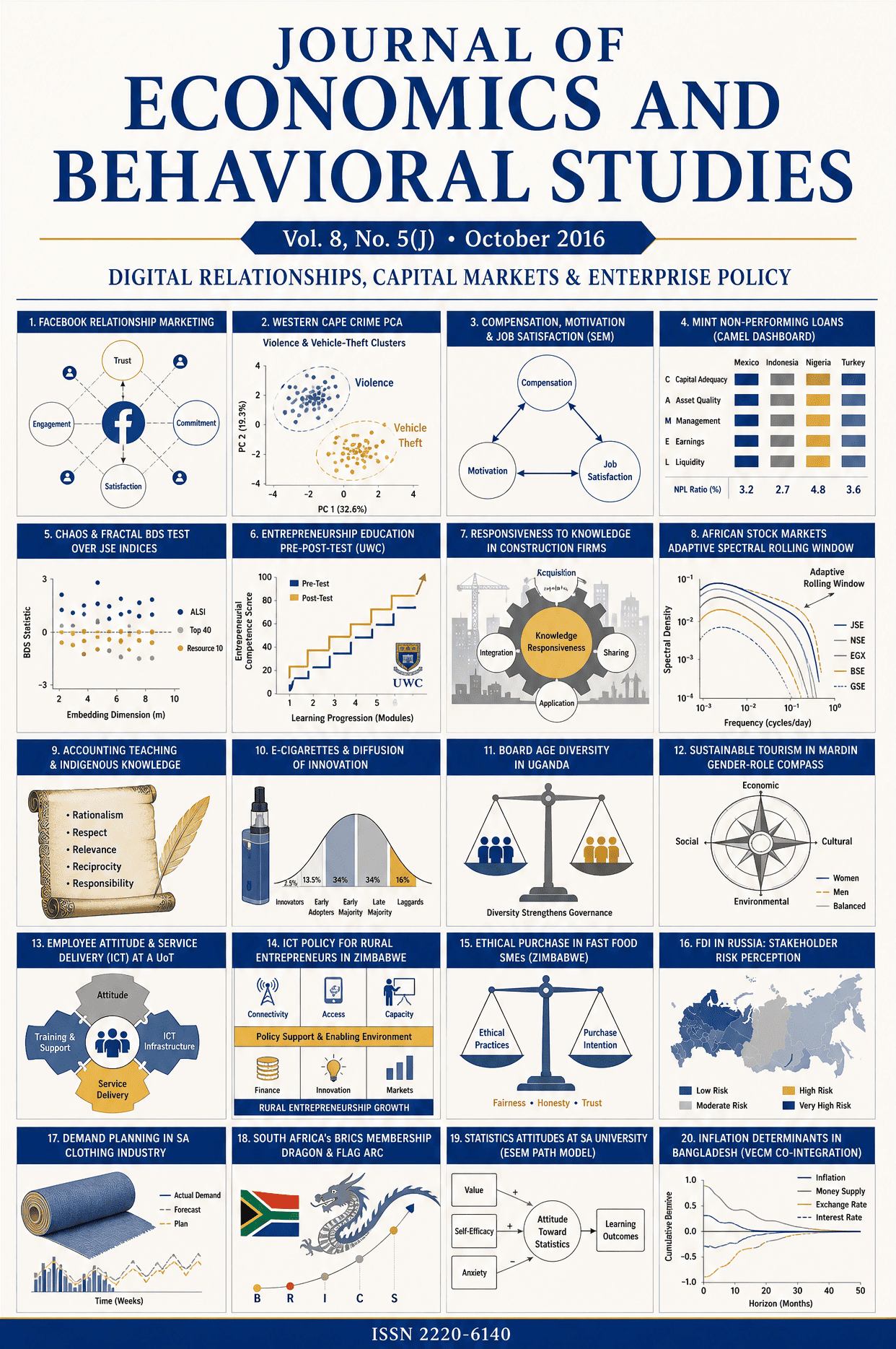
    Board Member Age Diversity and Financial Performance of Manufacturing Firms: A Developing Economy Perspective

    • Author: Richard Akisimire, Muhsin Salim Masoud, Mutahyoba D. Baisi, Laura A. Orobia

    This paper examines the relationship between board member age diversity and financial performance of manufacturing firms in Uganda. A cross section survey research design was employed using 78 manufacturing firms across the country. Data was analysed using descriptive statistics, chi-square analysis and point bi-serial correlation. The results showed that majority of the boards had members with an average age of 35-44years, followed by 25-34 years. In addition, boards comprising of majorly young board members registered low performance level, compared to the boards comprising of majorly older members. Further, the results indicated that board member age diversity is significantly associated with financial performance of manufacturing firms. Like any other research study, this study is limited in the following ways. Since only a single research methodological approach was employed, future research could undertake a mixed approach and triangulate to validate the current findings. Further, a longitudinal approach should be employed to study financial performance trends among manufacturing firms over years. Finally, board member age diversity was studied and by virtual of the results, there are other factors that explain the financial performance of the Uganda’s manufacturing sector that were not part of this study.

    Pages 120-132

    PDF - Board Member Age Diversity and Financial Performance of Manufacturing Firms: A Developing Economy Perspective (opens in a new tab)
  • Article 12 in this issue

    The Factors of Residents’ Support for Sustainable Tourism Development

    • Author: Musallam Abedtalas, Lokman Tobrak, Sadık Sercek

    In this paper we examined the factors of residents’ support for sustainable tourism development in Mardin city-Turkey, in the context of gender as social structure. We found that people are sensitive about positive and negative effects of tourism, in association with society attachment and involvement, with bigger role for the later. And the perceptions of positive effects reduce their evaluation of the negative effects. Also we found that women are less active in transforming their attitude toward the effects of tourism to behavior toward sustainable tourism. But they are ready, more than men, to support sustainable tourism and ignore its negative effects, in spite of their higher sensitivity for the negative effects. So we recommend raising the role of local community and giving women more chances in the different levels of tourism activities.

    Pages 133-145

    PDF - The Factors of Residents’ Support for Sustainable Tourism Development (opens in a new tab)
  • Article 13 in this issue

    Modeling the Factors that Influence Employee Attitude and Service Delivery Behavior among Higher Education Professionals

    • Author: Omoruyi O., Chinomona E

    Good and well calculated service delivery is very essential for the smooth running of institutions and for life long learning of students. Looking at factors that lead to employee attitude and service delivery bevaviour helps the higher education professionals to build a strong positive relationships with peers, students, staff and university leaders. This paper will look at remuneration, professional development and Information Communication Technology (ICT) efficiency as factors that contribute to positive employee attitude and good service delivery behaviour. Efforts by higher education institutions to improve the quality and standards of education professionals have progressed through the use of various forms of student feedback and methods of evaluation in an attempt to understand what matters to students’ and educational professionals regarding their educational experience. Structured questionnaires were distributed to university professionals, which include all university staff like Deans of faculties, Heads of departments and lecturers at one University of Technology (UoT). A quantitative method using Smart PLS was employed to test the relationships among the four hypotheses. The positive relationship between the four proposed hypotheses validatesthat remuneration; professional Development and ICT efficiencyare instrumental strategy to stimulating employee attitude and service delivery behavior of employees.Practically, the study build on a new direction towards research based on consumer behaviour by opening up a discussion on the importance of marketing practices in the development and improvement of service delivery behaviours in one UoTs in South Africa. Based on the findings, recommendations will be made to both the university policy makers and the university professionals for efficacy reasons. The proposed study is expected to have practical and theoretical implications to policy makers for the university and university professionals. In addition, it will provide added insights and added new knowledge to the existing body of literature hitherto not studied extensively in South Africa and UoT in particular.

    Pages 146-158

    PDF - Modeling the Factors that Influence Employee Attitude and Service Delivery Behavior among Higher Education Professionals (opens in a new tab)
  • Article 14 in this issue

    The Prospects of the ICT Policy Framework for Rural Entrepreneurs: an analysis of the Relationship between ICT and Entrepreneurial Development

    • Author: Maramura Tafadzwa Clementine, Elvin Shava

    Entrepreneurs hold the keys to rapid technological development by offering the means to creating employment opportunities even in remote rural areas. Small entrepreneurs do not only provide livelihood for themselves, but they also create employment thereby easing up socio-economic tensions in an atmosphere where so many are deprived. This article introduces the concept of entrepreneurship and how it propagates development and advances human living conditions. The underlying assumption is that Information and Communication Technology (ICT) has a causal effect on human livelihoods of rural entrepreneurs. Thus, a sturdy relationship exists between ICT and entrepreneurial development for rural entrepreneurial economic growth. In the same manner the Government of Zimbabwe commenced on a comprehensive policy framework in order to harness the power of ICT. Through a documentary review analysis, the paper envisages how ICT can sustain rural entrepreneurial development in Zimbabwe at a time where it is suffering from harsh socio-economic and political turmoil. The paper observes that lack of financial services, corruption, political interference, poor planning and the desire to maintain status quo have been discouraging rural entrepreneurship to harness the benefits of ICT. The paper recommends that the government should implement policies that promote the development of ICT in rural entrepreneurship and the provision of training and development for entrepreneurs to bridge the knowledge gap on the use of ICT to enhance the livelihoods of entrepreneurs.

    Pages 159-168

    PDF - The Prospects of the ICT Policy Framework for Rural Entrepreneurs: an analysis of the Relationship between ICT and Entrepreneurial Development (opens in a new tab)
  • Article 15 in this issue

    Influence of Small Business Ethics on Buying Decisions of Customers: A case of Indigenous Owned Fast-Food Outlets in Zimbabwe

    • Author: Patient Rambe, Takawira Munyaradzi Ndofirepi

    While the prevalence of ethical consumerism has pressured small businesses to embrace ethical behaviour, in ethically precarious business conditions the relentless pursuit for profit by small businesses may compel them to compromise their moral values. As such, a tacit struggle may persist between such businesses’ strategic orientations (e.g. profitability, improved performance) and demands of ethically conscious consumers. Drawing on ethics theory, this study explored the influence of the ethical conduct of small fast food outlets on buying intentions of customers. A survey was conducted on 116 probabilistically sampled customers of an indigenous owned fast-food outlet in two cities in Zimbabwe. Findings suggest that customers considered ethical conduct of business ventures when making their purchase decisions although it was unclear whether ethical consumers persistently maintained their buying decisions (i.e. purchasing ethically made products). Ethical business practices, however, remained an enduring feature of enterprises striving to optimise their profit motives.

    Pages 169-183

    PDF - Influence of Small Business Ethics on Buying Decisions of Customers: A case of Indigenous Owned Fast-Food Outlets in Zimbabwe (opens in a new tab)
  • Article 16 in this issue

    Foreign Direct Investment in Russia: Stakeholders’ Views and Perceptions

    • Author: Nadejda Komendantova, Leena Ilmola, Anastasia Stepanova

    Volumes of foreign direct investments (FDI) are growing steadily, however, transition economies, such as Russia, are attracting only a minor share of FDI despite of available potentials. Risk aversion is one of the reasons influencing decision-making processes of FDI investors. This paper reviews existing objective and subjective risks, which impact decisions regarding FDI. The results of the paper are based on the extensive dialogue with stakeholders from Austria, Germany and Japan on the risks for FDI in Russia as well as on the outcomes of the discussions on barriers for trade in frames of the workshop, which brought together Russian and European stakeholders. The results show that political, regulatory, revenue, currency and operational risks within the economy of Russia are perceived by FDI investors from different sectors such as construction, financing, automotive and other industries as being the most likely and probable risks for FDI in Russia. The majority of investors perceive political risks as a greater barrier for investment in Russia. These perceptions are influenced by existing asymmetries on the market and the political decision-making dominance over business environment. Our results support existing evidence on impacts of uncertainties connected with political and regulatory risks for FDI in Russia. However, we did not find evidence that these risk perceptions were affected by creation of the Eurasian Customs Union, neither in positive nor in a negative way. The results suggest that significant progress was already done by improving investment climate in Russia but further efforts are also needed on addressing regulatory risks such as dealing with construction permits, protecting minority investors or simplifying customs regulations, as well as addressing existing market asymmetries.

    Pages 184-193

    PDF - Foreign Direct Investment in Russia: Stakeholders’ Views and Perceptions (opens in a new tab)
  • Article 17 in this issue

    Factors Affecting Demand Planning in the South African Clothing Industry

    • Author: NJ Matsoma, IM Ambe

    The decline in the number of clothing manufacturers and the effect of globalisation have contributed to complexities in estimations and the scheduling of demand, as well as lead time management in the South African clothing industry. This article explores demand planning factors affecting the South African clothing industry, with specific reference to Gauteng. The study was necessitated due to demand planning challenges facing the South African clothing industry as well as economic factors which contribute to inaccuracies in clothing demand planning. The study makes an impact in the garment production factories of Gauteng in South Africa and adds to the philosophy of demand planning practices. It uncovers key factors affecting demand planning practices in the Gauteng clothing industry, South Africa. The study is explorative and descriptive in nature and it uses SPSS to analyse data. The findings revealed that there were factors affecting how demand planning practices were conducted in the clothing industry. The factors that have a significant influence on clothing demand planning include the scheduling of the manufacturing of customers’ orders, planning for fashion clothes, the use of the POS system, clothing imports, estimating future clothing requirements, recession and the effect of the late arrival of clothes. Therefore, clothing industry stakeholders should take these factors into consideration when planning for their demand to ensure customer needs can be fully met, thus improving the performance of the clothing industry.

    Pages 194-210

    PDF - Factors Affecting Demand Planning in the South African Clothing Industry (opens in a new tab)
  • Article 18 in this issue

    Counting the Cost? A Cautionary Analysis of South Africa’s BRICS Membership

    • Author: Samuel Augustine Umezurike, Olusola Ogunnubi

    BRICS is a grouping of five major developing countries that includes Brazil, Russia, India, China and South Africa, all with the ambition of changing the governance architecture of international political-economy but with claims to speedy industrialization, fast growing economies and relatively strong regional and global influence. South Africa joined BRICS at the invitation of China in 2010 and has shown commitment to the group through friendly relations with other member countries. The country’s extensive economic links with China and the other BRICS states underpinned its strategy of diversifying its external trade especially with regard to looking away from West. This article employs content analysis to reflect on South Africa’s membership of BRICS, focusing specifically on the country’s relations with China. It argues that, while South Africa’s economic indicators do not fit well with the BRICS grouping, China is promoting this relationship in order to counter the West’s neo-imperialism and neo-liberal rhetoric. South Africa’s willingness to accept Chinese superiority in the African market and to act as a junior partner in the global power configuration makes the country the perfect choice for this project.

    Pages 211-221

    PDF - Counting the Cost? A Cautionary Analysis of South Africa’s BRICS Membership (opens in a new tab)
  • Article 19 in this issue

    Structural Equation Modelling applied to proposed Statistics Attitudes-Outcomes Model: A case of a University in South Africa

    • Author: Bokang Ncube, Ntebogang Dinah Moroke

    The purpose of the study is to investigate the structural relationships among constructs of the statistics attitudes-outcomes model (SA-OM) using exploratory structural equation modelling (ESEM) methodology. The sample consists of 583 first-year undergraduate students enrolled for statistics courses at the university in South Africa. ESEM reveal that all but two of the nine constructs have well to excellent reliability. To enhance the model, we deleted the eight variables. All other indicators have a significant loading into a construct. Congruency of the SA-OM and expectancy value model (EVM) is noted. The SRMR for all modified models are less than 0.10 suggesting that all these models have acceptable fit. Moreover, all the modified models have RMSE values within the ranges of adequate fit. On the contrary, all the models have unacceptable fit according to PCF, CFI, AGFI and PGFI statistics, i.e. according to all parsimony fit indices except the RMSE. The results also reveal that all incremental fit indices but the BBNFI approve the modified models as acceptable since most of these indices are almost equal to a cut-off point of 0.9. However, BBNNI disapprove the ML3 and ML5 models as being acceptable. A host of inconsistencies in fit indices are noted.

    Pages 222-239

    PDF - Structural Equation Modelling applied to proposed Statistics Attitudes-Outcomes Model: A case of a University in South Africa (opens in a new tab)
  • Article 20 in this issue

    Multivariate Dynamic Co-integration and Causality Analysis between Inflation and its Determinants

    • Author: Md. Sharif Hossain, Md. Thasinul Abedin

    This paper investigates the impacts of money supply, government expenditure, velocity, industry value addition and economic growth on inflation of Bangladesh using time series data from 1978-2014. The ADF test results suggest that the variables are of I(1). It is found that there exist five co-integration equations. The outcome of the Granger Causality test suggests the short-run unidirectional causality running from industrial value addition to money supply, from inflation, money supply, velocity, industrial value addition and economic growth to government spending. Bidirectional causality has been found between economic growth and industrial value addition. Finally, short-run and long-run effects of money supply, government spending, velocity, industry value addition and economic growth on inflation are estimated. It is found that the speed of adjustment for short-run to approach to the long-run equilibrium level is significant at any significance level. It has been found that it will take about 1.25 years for a complete convergence process to approach its equilibrium. Therefore, in case of any shock to the inflation equation, the speed of adjustment is significantly faster. It has also been found that the long-run effects of money supply and velocity have positive significant effects while the economic growth has significant negative effect on inflation in Bangladesh economy. It has been found that the long-run effects of money supply and velocity are more than short-run effects meaning that over the time more money supply and velocity increase the more and more inflation in Bangladesh but economic growth decreases the inflation.

    Pages 240-250

    PDF - Multivariate Dynamic Co-integration and Causality Analysis between Inflation and its Determinants (opens in a new tab)