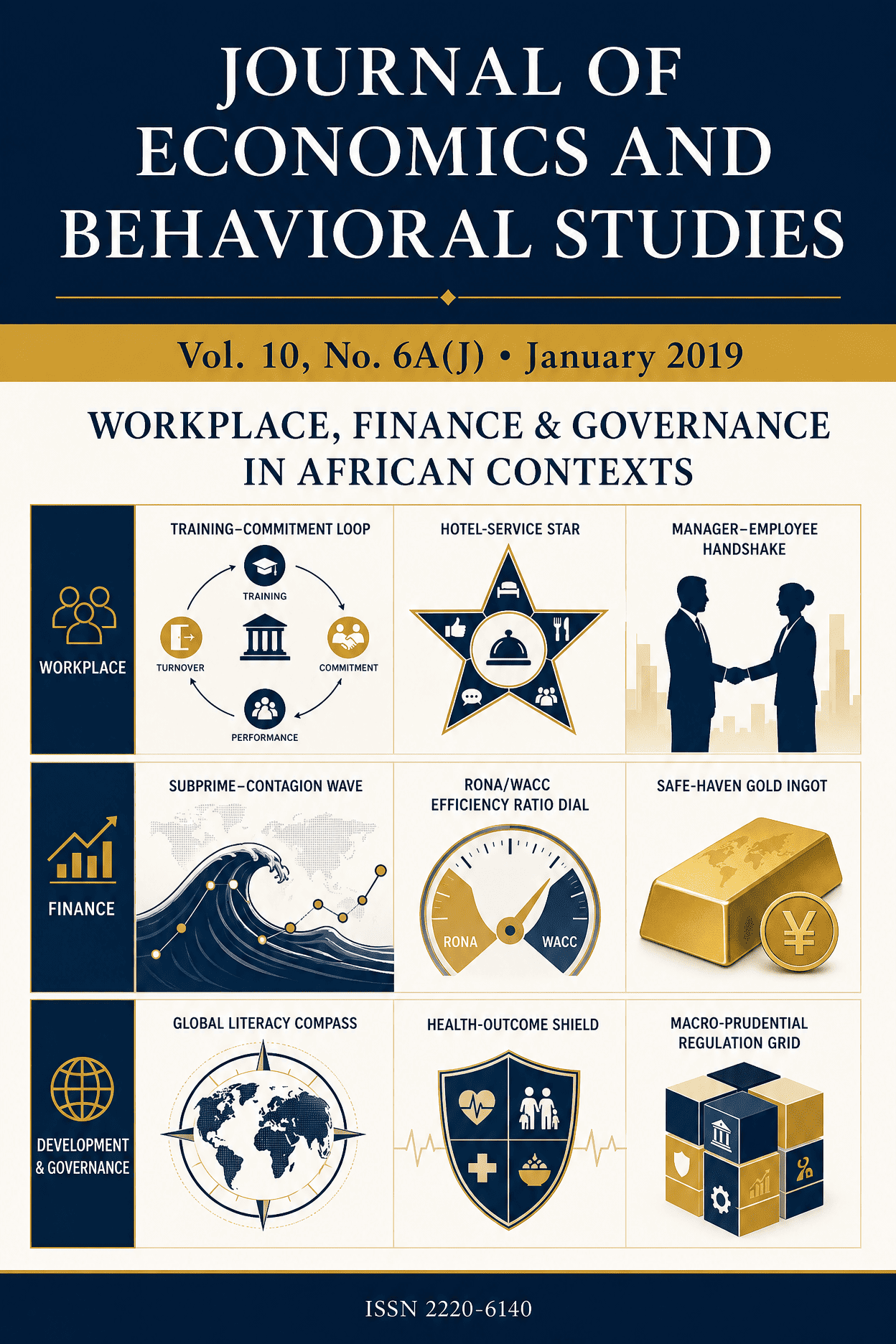
Articles 1–10 of 17

  • Article 1 in this issue

    Training, Organisational Commitment and Turnover Intention among Nigerian Civil Servants

    • Author: Nwokeiwu Johnson, Ziska Fields, Nwali Anthony Chukwuma

    This article reports on a study that focused on analysing the impact of training and development (T&D) on organizational commitment and turnover intention among Nigerian public workers. The main objective of the study was to determine whether T&D influences employees’ commitment to the organization and the intention to stay or to leave the organization. Using a survey questionnaire and personal interview, data was collected from 297 civil servants and 8 departmental heads in Nigeria. Statistical analytical methods such as regression analysis were used to test the two hypotheses formulated, which were focused on determining the relationship between T&D and turnover intention; as well as T&D and the perceived impacts on employees’ commitment. The result suggests a positive correlation between T&D and organizational commitment and turnover intention. The result implies that investing in human capital is a critical strategic initiative for contemporary organizations because the ability of any organization to compete successfully is a function of the ability to retain their skilful and committed employees. The study contributes to knowledge in the field, as not much research has been done on the effects of T&D on public servants in Nigeria. Most of the studies have been carried out in Europe, America, Asia and largely in the manufacturing and service sectors.

    Pages 1-15

    PDF - Training, Organisational Commitment and Turnover Intention among Nigerian Civil Servants (opens in a new tab)
  • Article 2 in this issue

    The Relationship amongst Customer Satisfaction, Loyalty, Demographic and Tripographic1 Attributes: A Case of Star Rated Hotel Guests in Ethiopia

    • Author: Orthodox Tefera, Stephen Migiro

    The hospitality industry in general and hotels in particular attend to diverse guests and their expectations. The satisfaction of all hotels guests and retaining them as a loyal customer, given their different profiles, is imperative but challenging to the sector. This study aims to address this very issue by trying to establish the relationship amongst, customer satisfaction, loyalty, demographic and tripographic attributes by focusing on the hotel guests who stayed in star rated hotels in Ethiopia. Satisfaction was measured as satisfaction with the product, satisfaction with the employees and overall satisfaction. Likewise, customer loyalty was measured with the likelihood of customers to return to the same hotel in the future. “A total of 1200 questionnaires distributed to 40 hotels out of which 415 hotel guests responded, by completing the questionnaires”. “The result of inferential statistical techniques reveals that there were significant positive relationships between the customer satisfaction variables” (products .488; p<0.001; staff .460; p<0.001), and the customer’s willingness to stay in the same hotel again.” Though all variables of “customer satisfaction affected customer loyalty, the overall satisfaction variable had the highest standardized coefficient (0.328) with a statistical significance (p < 0.01), followed by satisfaction with the product (.227, p<.01), and satisfaction with employees (.190, p<.01). There was also no statistically significant difference (p>.05) in the mean scores of the customer satisfaction and loyalty across the gender, age, marital status and employment type groups of respondents. With regards to the tripographic variables, there was a statistically significant difference (P<.05) in the mean scores of both the customer satisfaction and loyalty across the staying preference of rated hotel types of customers. Additionally, there was a statistically significant difference (p>.05) in the mean scores of customer loyalty across a source of information on the hotel group of respondents. Hotel managers in Ethiopia need to look at the importance of segmentation of guest based on their demographics and tripographic factors so that they provide personalized service to enhance their customers’ satisfaction that could lead to their loyalty.

    Pages 16-29

    PDF - The Relationship amongst Customer Satisfaction, Loyalty, Demographic and Tripographic1 Attributes: A Case of Star Rated Hotel Guests in Ethiopia (opens in a new tab)
  • Article 3 in this issue

    Examining the Impact of Antecedents of Firm Performance on Companies in South Africa

    • Author: Elizabeth Chinomona

    The aim of this study is to establish the impact of social media, information sharing and knowledge sharing on firm performance among companies in South Africa, Gauteng province in particular. In as much as the issue of social media communication has received great benefits and growth within organisations, little has been researched about the impact of social media on job performance, knowledge sharing and information sharing among companies in the Gauteng province, South Africa. Social Identity Theory (SIT) has been used to explain the associations in the model. Questionnaires were distributed to both management staff and lower level employees in the companies in Gauteng province of South Africa. This study used a quantitative research methodology using Smart PLS software. This software was employed to test the relationships among the four hypotheses. The results showed that there is a positive and significant relationship among the four proposed hypotheses. Basing on the findings of this research, recommendations were made to both the top-level employees and lower level employees in the companies in South Africa. This study is expected to have real-world and academic implications to policymakers for the companies in South Africa. On top of this, the study will provide new insights and added first-hand knowledge to the existing body of literature which is meagre in South African companies.

    Pages 30-42

    PDF - Examining the Impact of Antecedents of Firm Performance on Companies in South Africa (opens in a new tab)
  • Article 4 in this issue

    Financial Inclusion and the Trade-Growth Nexus: Evidence from the Emerging Zimbabwean Economy

    • Author: Alexander Maune

    This study examined the effect of financial inclusion in the trade-growth nexus in Zimbabwe using time series data collected from the World Bank databases from 1980 to 2016. The study precisely examined whether financial inclusion is a passage within which trade openness impacts growth in Zimbabwe. Also examined was the complementarity effect of financial inclusion and trade openness on growth. The effect of financial inclusion and trade openness on growth has received much attention from researchers across the globe and literature is awash with theoretical and empirical evidence of such studies. What is yet to be examined is whether financial inclusion is a passage within which trade openness influences growth. The study finds a negative significant effect of financial inclusion and trade openness on growth in Zimbabwe. Moreover, the findings show a complementary, strong and positive nexus linking financial inclusion and trade openness on growth in Zimbabwe. Policy-makers are, however, implored to formulate policies meant to deepen financial inclusion in order to enhance growth through trade openness. The article will help expand the academic knowledge and as such contribute in filling the gap that exists within the body of knowledge. The article is important to policy-makers, the academia, private sector and researchers at large.

    Pages 43-55

    PDF - Financial Inclusion and the Trade-Growth Nexus: Evidence from the Emerging Zimbabwean Economy (opens in a new tab)
  • Article 5 in this issue

    The Impact of Environmental Turbulence on Product Innovation in Small to Medium Enterprises in Harare, Zimbabwe

    • Author: Caroline Zimuto, Maxwell Sandada, Tinashe Chuchu, Tinashe Ndoro

    The purpose of the research was to examine the impact of environmental turbulence on product innovations in small to medium enterprises (SMEs). In the study environmental turbulence consisted of five dimensions namely, supplier turbulence, technological turbulence, market turbulence, regulatory turbulence and competitive intensity. A cross-sectional quantitative research design was adopted in the study. The study sample was drawn from a pool of 3,000 SMEs both unregistered and registered with the Ministry of Small and Medium Enterprises in Harare, Zimbabwe. In the study, a total of 200 completed surveys were obtained and analysed. To analyse the research data SPSS23 was utilised. Regression analysis was carried out to establish the cause-and-effect relationship between the independent and dependent variables in the study. The findings of the study showed that technology turbulence and competitive intensity had a statistically significant positive impact on product innovation. Market turbulence was noted as having a statistically significant negative impact on product innovativeness. The main implications established in the study were that SMEs should introduce mechanisms to manage and mitigate market, supplier and regulatory turbulence to ensure that their levels of product innovativeness remain positive.

    Pages 56-63

    PDF - The Impact of Environmental Turbulence on Product Innovation in Small to Medium Enterprises in Harare, Zimbabwe (opens in a new tab)
  • Article 6 in this issue

    The Use of Modern Technology for Rural Industrialization and Its Implications on the Rural SMEs Economic Growth

    • Author: Lawrence Mpele LEKHANYA

    Hence technology delivery is perceived to be an essential catalyst for rural development. This paper intends to present an empirical study on the use of modern technology for rural industrialization and its theoretical and practical implication on the rural SMEs economic growth. The idea of rural industrialization and how it can enhance the rural SMEs economic growth still the issue of concern of many policy-makers. The study seeks to establish understanding, knowledge and awareness about how the use of modern technology would assist in building strong rural industrialization that will have a positive change in the rural SMEs economy. In this research 127 participants consist with business managers/owners running SMEs in the province of KwaZulu-Natal were chosen for empirical data collection from both South and Northern parts of the Province. SPSS (24.0) version was used for the analysis of data. A quantitative questionnaire was used and distributed to the respondents. The findings revealed that in many cases there is no specific rural industrialization policy does not exist or somehow fall short, government attitudes towards rural industrialization as well as rural infrastructure development were also identified by respondents as areas of concern for rural industrialization. The exploratory and quantitative nature limited the survey. Hence, the application of this result should be made with utmost care. Further investigation which may include large and other parts of the country is therefore recommended.

    Pages 64-71

    PDF - The Use of Modern Technology for Rural Industrialization and Its Implications on the Rural SMEs Economic Growth (opens in a new tab)
  • Article 7 in this issue

    Determinants of Social Entrepreneurial Intentions of University Students in South Africa

    • Author: Olawale Fatoki

    Entrepreneurial behaviour can be predicted by intentions. The study investigated the determinants of social entrepreneurial intentions (SEI) of university students in South Africa. The study adopted a quantitative research design that involved the use of a survey. The self-administered questionnaire method was used to collect data from the survey participants. The participants in the survey were final year undergraduate students of the Department of Business Management of two South African universities. Reliability was measured using the Cronbach’s alpha. The data analysis methods for the study were descriptive statistics, principal component analysis and regression analysis. The results indicated that empathy, moral obligation, entrepreneurial self-efficacy and perceived social support are predictors of social entrepreneurial intentions. The recommendations to improve the SEI of university students focus on passive and active entrepreneurship teaching methods.

    Pages 72-80

    PDF - Determinants of Social Entrepreneurial Intentions of University Students in South Africa (opens in a new tab)
  • Article 8 in this issue

    Manager-Employee Relationships during Turbulent Times at a Gold Mine in South Africa

    • Author: Cecile Schultz, Reulene Küsel

    This article aims to provide new conceptual insights into the responsibilities of an engineer who acts as a plant manager and who has to deal with employee relations during a turbulent time at a gold mining plant in South Africa. A qualitative research approach was used to gather the data in this study. Trustworthiness of the research was ensured by applying various reasoning strategies, such as content analysis, inductive reasoning, blending, bracketing and understanding in order to interpret the data. The first group interview comprised managers as well as engineers who were appointed as managers, the second, administrative employees from the service departments, and the third, artisans and foremen employed at the mine. Qualitative content analysis was used to analyse the transcripts. The recurring themes from the group interviews were ‘employee empowerment’, ‘trust building’, ‘employee voice’ and ‘development of skills’. A conceptual framework for manager-employee relations during troubled times was developed from the findings. The essential responsibilities of a gold mining plant manager during periods of turbulence were described.

    Pages 81-88

    PDF - Manager-Employee Relationships during Turbulent Times at a Gold Mine in South Africa (opens in a new tab)
  • Article 9 in this issue

    The Relationship between Health Outcomes and Household Socio-Economics Characteristics

    • Author: Steven Henry Dunga

    The economic circumstance of a household is in most cases linked to the varied situations a household may find itself income is to a greater extent linked to the housing and food that a household is exposed to. Income among other socio-economic factors may also affect the demand structure of the household in terms of what the household may consider necessary or not. The level of household demand for health services and its preventive level may also be associated with other household characteristics especially those associated with the head of the household. This paper analysed the relationship between the morbidity rate in a household and the household characteristics and the characteristics of the head of household. The paper uses data collected in the South African general household survey published in 2017 conducted by Statistics South Africa. Based on a sample of 21601 households, the study employs a multinomial logistic model with the level of morbidity rate categorised into a high level, mild, and low. The results of the empirical analysis show that Household size, the gender of head of household, housing insecurity status age of head of household and income were significant determinants of morbidity rate at the household level. The contribution of the paper is therefore a proposal for preventive mitigation as opposed to treatment which tends to be more expensive on government. The fact that housing insecurity is a competing need with health demand calls for better alignment in terms of government, provision of health services in South Africa. This paper is motivated by the initiative of the introduction of a national health Insurance (NHI) is South Africa.

    Pages 89-96

    PDF - The Relationship between Health Outcomes and Household Socio-Economics Characteristics (opens in a new tab)
  • Article 10 in this issue

    Investor Sentiment and Crash Risk in Safe Havens

    • Author: Adnen Ben Nasr, Matteo Bonato, Riza Demirer, Rangan Gupta

    This study examines the relationship between investor sentiment and intraday return dynamics for safe haven assets, with a particular focus on crash risk in these assets. Examining intraday returns for a wide range of safe havens proposed in the literature, we find that shocks to investor sentiment have a significant effect on safest havens, while the sentiment is heterogeneous both in terms of its size and direction. While the strongest effects of sentiment shocks are observed in the case of Gold, Swiss Francs and Japanese Yen, interestingly, we find that oil stands out from the rest of the pack, responding negatively to sentiment shocks, suggesting that positive shocks to sentiment (i.e. high fear) increase crash risk for this asset. Our findings also point to intra-safe haven spillover effects, with oil exhibiting a markedly different pattern. Investment and hedging implications are discussed next.

    Pages 97-108

    PDF - Investor Sentiment and Crash Risk in Safe Havens (opens in a new tab)