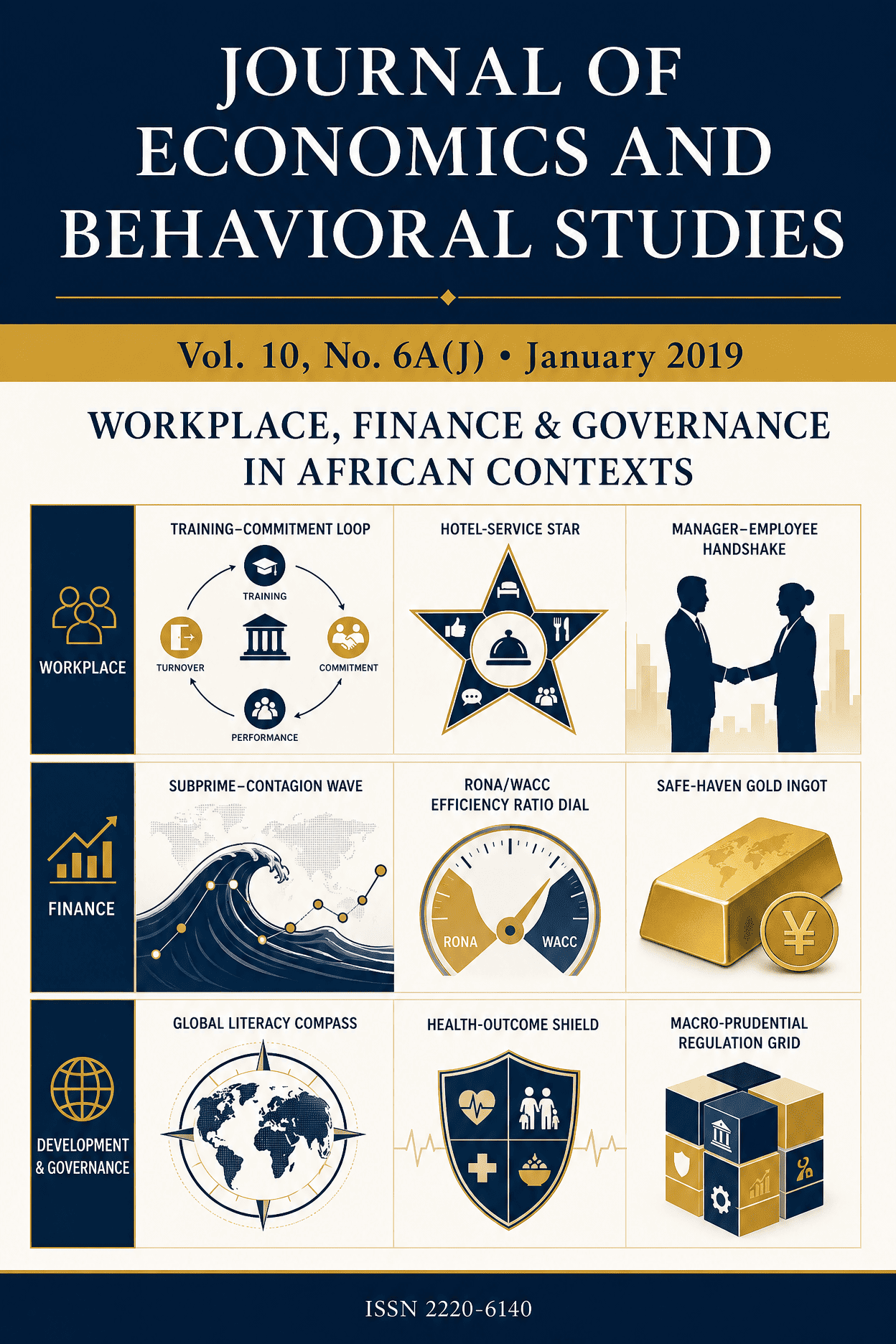
Articles 11–17 of 17

  • Article 11 in this issue

    Organisational Commitment and Job Satisfaction as Antecedents of Organisational Citizenship Behaviour

    • Author: Thembi Laura Motaung, Patrick Qena Radebe

    Contemporary challenges facing organisations emphasise the need for a calibre of employees who exude organisational citizenship behaviour (OCB) and organisational commitment (OC), including a satisfactory level of job satisfaction (JS). Research is replete with supporting evidence that OCB is triggered by JS and that JS is positively related with OC. Although the relationship between these constructs is considered important, research exploring the relationship between these three constructs in the context of a water utility remains scarce. The primary objective of this research was to examine the impact of OC and JS on OCB at a water utility company in Gauteng. A survey was utilised to elicit responses from 400 sampled participants. A quantitative approach was adopted by which exploratory factor analysis (EFA), correlation and regression analyses were performed to analyse data. Using EFA, three factors of OC were extracted. The results further showed a positive correlation between affective commitment and normative commitment; JS and OCB; and no predictive relationship was observed between continuance commitment and OCB. Based on the findings, it was recommended that JS, OC and OCB should be improved through mechanisms such as job-fit, job enrichment career advancement performance-related pay and mentorship programmes.

    Pages 109-122

    PDF - Organisational Commitment and Job Satisfaction as Antecedents of Organisational Citizenship Behaviour (opens in a new tab)
  • Article 12 in this issue

    Measuring Literacy Gap in the World for Economic and Social Development: Evidence from Selected Countries and the Lessons Learned

    • Author: Gbolahan S. Osho, Arinola C. Ebalunode

    Literacy rate is a major indicator of economic and social development, the campaign for growth and improvement in this area by several international organizations have caused significant growth in all major regions of the world. The persistent theme to these various programs is that illiteracy is nonetheless prevalent in the world and more study needed to eradicate it, thus generates a significant interest in this issue. Therefore, the primary goal of this current study is to compare five major regions in the world as classified by the World Bank in regards to the differences which exist in literacy. The study concludes that literacy rates of male and female across the regions are different for Youth literacy between the age of 15 and 24. The vast conclusion is that that there is a no significant difference in male literacy among the regions in the world except for Africa. While no significant difference in female literacy among the regions in the world.

    Pages 123-130

    PDF - Measuring Literacy Gap in the World for Economic and Social Development: Evidence from Selected Countries and the Lessons Learned (opens in a new tab)
  • Article 13 in this issue

    When Performance Management Fails: Attitudes and Perceptions of Staff at a Higher Education Institution

    • Author: Odwa Mntonintshi, Vuyokazi Mtembu

    The implementation of Performance Management (PM) in an institution can come with barriers that affect its success rate. The aim of the study was to assess the perceptions and attitudes of staff towards the implementation of PM at a higher education institution. The research was undertaken at a higher education institution (HEI) in South Africa where employee performance suffered as a result of PM implementation challenges within the institution. The research study was exploratory and employed mixed methods, that is; quantitative and qualitative research methods. A survey questionnaire was administered to groups of university employees drawn through stratified random sampling. The strata groups were academics, administrators, and senior executive managers. Hundred questionnaires were distributed with eighty-three questionnaires returned. In qualitative research, a heterogeneous focus group interview was scheduled which involved twelve people. Results from the questionnaires indicated that respondents perceived PM process as lacking transparency, unaligned to employee rewards and development lacks objectivity from appraisers and poorly implemented due to lack of training for its users. Key themes that emerged from the focus group interviews revealed that the majority of participants perceived PM as a management punitive tool that is not developmental in orientation, a political tool that lacks objectivity and benefits only the employer. Furthermore, they articulated that it was not aligned with their rewards and development. It was therefore recommended that; proper design and implementation of the PM system is vital, fairness, training of all parties involved, moderation of results and providing effective feedback should be employed in PM, effective communication, transparency, consultation and shared benefits for all participants are key to ensuring a broadly supported PM within the institution.

    Pages 131-140

    PDF - When Performance Management Fails: Attitudes and Perceptions of Staff at a Higher Education Institution (opens in a new tab)
  • Article 14 in this issue

    The Nexus between Macro-Prudential Banking Regulation, Interest Rate Spread and Monetary Policy in South Africa

    • Author: Shayanewako Varaidzo Batsirai, Asrat Tsegaye, Yohane Khamfula

    This study is an empirical attempt to investigate the nexus between macro-prudential banking regulation, interest rate spread and monetary policy in South Africa. The effectiveness of monetary policy and alarmingly wide interest rate spread has been a contentious issue in the corridors of central banks across the globe in this lifetime. This has been largely because monetary policy alone proved to be less efficient in mitigating the effects of systemic risk, particularly during the 2007 financial crisis, necessitating the need for macro-prudential banking regulation. Time series dataset spanning from 1994Q1 to 2016Q4 is employed to carry out this study using the restricted Vector Autoregressive (VAR) model, that is, the Vector Error Correctional Model (VECM). The results show that there is no long-run causality running from trade openness, real exchange rate financial depth interest rate spread and credit growth to the repo rate in South Africa. A short run causality running from credit growth to the repo rate exists from the estimated model. In addition, the empirical results exhibited evidence that interest rate spread has a dampening effect on monetary policy but in the long-run this effect seems reversible in South Africa. Therefore, in order to ensure financial stability, care has to be taken by the South African Reserve Bank and government in choosing the best tool-kit of macro-prudential banking regulation as it can be used to disguise the symptoms of a lax monetary policy framework.

    Pages 141-151

    PDF - The Nexus between Macro-Prudential Banking Regulation, Interest Rate Spread and Monetary Policy in South Africa (opens in a new tab)
  • Article 15 in this issue

    Emotional Intelligence as a Moderator in the Relationship between Occupational Stress and Organizational Citizenship Behavior among Nigerian Graduate Employees

    • Author: John K. Aderibigbe, Themba Q. Mjoli

    The study investigated emotional intelligence as a moderator in the relationship between occupational stress and organizational citizenship behavior among graduate employees in Nigeria. The purpose of the study was in twofold: firstly, to empirically examine the relationship between occupational stress and organizational citizenship behavior. Secondly, to empirically investigate if emotional intelligence would moderate the relationship between occupational stress and organizational citizenship behavior. The study was conducted to demonstrate whether the presence of emotional intelligence could result in a better level of employee performance, even as employees experience a certain level of occupational stress. In view of the above, the study has contributed to the formation of a new model of psychological intervention for occupational stress and organizational citizenship behavior. The study adopted the positivist explanatory cross-sectional (survey) research design to systematically sample opinions of 1,532 male and female graduate employees across. The various sectors of the Nigerian economy, using a structured and validated questionnaire and version 20 of the Statistical Package for the Social Sciences (SPSS), two hypotheses were stated and analyzed using Pearson Correlation Analysis and Multiple Regression Analysis while the percentage, mean, standard deviation and the frequency of the biographical and occupational data were also determined by the descriptive statistics. The results showed that there was a weak positive relationship between occupational stress and organizational citizenship behavior. Emotional intelligence significantly moderated the relationship between occupational stress and organizational citizenship behavior. Human resource managers should develop emotional intelligence in employees in order to increase the level of organizational performance, and reduce the negative impact of occupational stress. This could be achieved through training and seminar participation. Recommendations of the study could assist in training and developing effective manpower capacity towards improving the economy of the nation.

    Pages 152-163

    PDF - Emotional Intelligence as a Moderator in the Relationship between Occupational Stress and Organizational Citizenship Behavior among Nigerian Graduate Employees (opens in a new tab)
  • Article 16 in this issue

    Modelling Financial Contagion in the South African Equity Markets Following the Subprime Crisis

    • Author: Olivier Niyitegeka, Dev D. Tewari

    This paper used wavelet analysis and Dynamic Conditional Correlations model derived from the Multivariate Autoregressive Conditional Heteroskedasticity (MGARCH-DCC) to investigate the possible presence of financial contagion in the South African equity market in the wake of the subprime crisis that occurred in the United States. The study uses Dornbusch, Park and Claessens’s (2000) broader definition which asserts that financial contagion only takes place if cross-correlation between two markets is relatively low during the tranquil period, and that a crisis in one market results in a substantial increase cross-market correlation. Using wavelet analysis, the study found high levels of correlation during the subprime financial crisis in both smaller and longer timescales. In the former, high correlation was identified as financial contagion, whereas in the latter it was found to indicate co-movement due to financial fundamentals. The high correlation was identified for small scales 3, 4 and 5 that range from a week to one month indicates the presence of contagion. The study also used the MGARCH-DCC model to compare the cross-market correlation between the SA and the US markets, during a ‘pre-crisis’ and ‘crisis’ period. The study used data for the period between January 2005 and December 2007 for the ‘pre-crisis’ period and that for the period from January 2008 to December 2014 for the ‘crisis’ period. The results indicate cross-market linkages only during the crisis period; hence, it was concluded that cross-market correlation during the period of financial turmoil in the US was the result of financial contagion.

    Pages 164-176

    PDF - Modelling Financial Contagion in the South African Equity Markets Following the Subprime Crisis (opens in a new tab)
  • Article 17 in this issue

    The Use of RONA/WACC as a Proxy for Investment Quality

    • Author: Martin Wichlinski, Rajendra Rajaram

    Proxies for stock investment quality have varied from multi-factor models such as the Piotroski F- Score to simple one-factor return on capital measures. Economic value added, measured as the ratio of return on net assets relative to the weighted average cost of capital, has not been used as a proxy for stock quality. The aim of this study was to demonstrate that economic value added can be used effectively as a proxy for stock quality. Industrial stocks listed on the JSE ALSI between 31 January 2006 and 31 December 2015 comprised the population of this study. Three portfolios (comprising 33% of the population each) were formed monthly and were held for 12 months leading to the creation of 360 portfolios. The portfolios were formed on the basis of the RONA/WACC ratio; stocks with the highest ratios comprised HEV portfolios, stocks with the lowest ratios comprised LEV portfolios and stocks with median ratios comprised MEV portfolios. HEV portfolios earned a mean return of 19.52% relative to 13.09% for MEV portfolios, 16.31% for LEV portfolios and 13.73% for the overall equity market. The maximum cumulative value of R1 invested in HEV portfolios was equal to R5.30 as at the end of the study period. The maximum cumulative value of R1 invested in MEV and LEV portfolios was equal to R4.14 and R4.40 respectively. The maximum corresponding value of R1 invested in the general equity market was, R3.50. The superior returns of HEV portfolios were observed to be more risk efficient relative to both MEV and LEV portfolios and relative to the market portfolio on the basis of higher Sharpe Ratios. The RONA/WACC ratio has thus been shown to have been an effective proxy for stock quality.

    Pages 177-185

    PDF - The Use of RONA/WACC as a Proxy for Investment Quality (opens in a new tab)