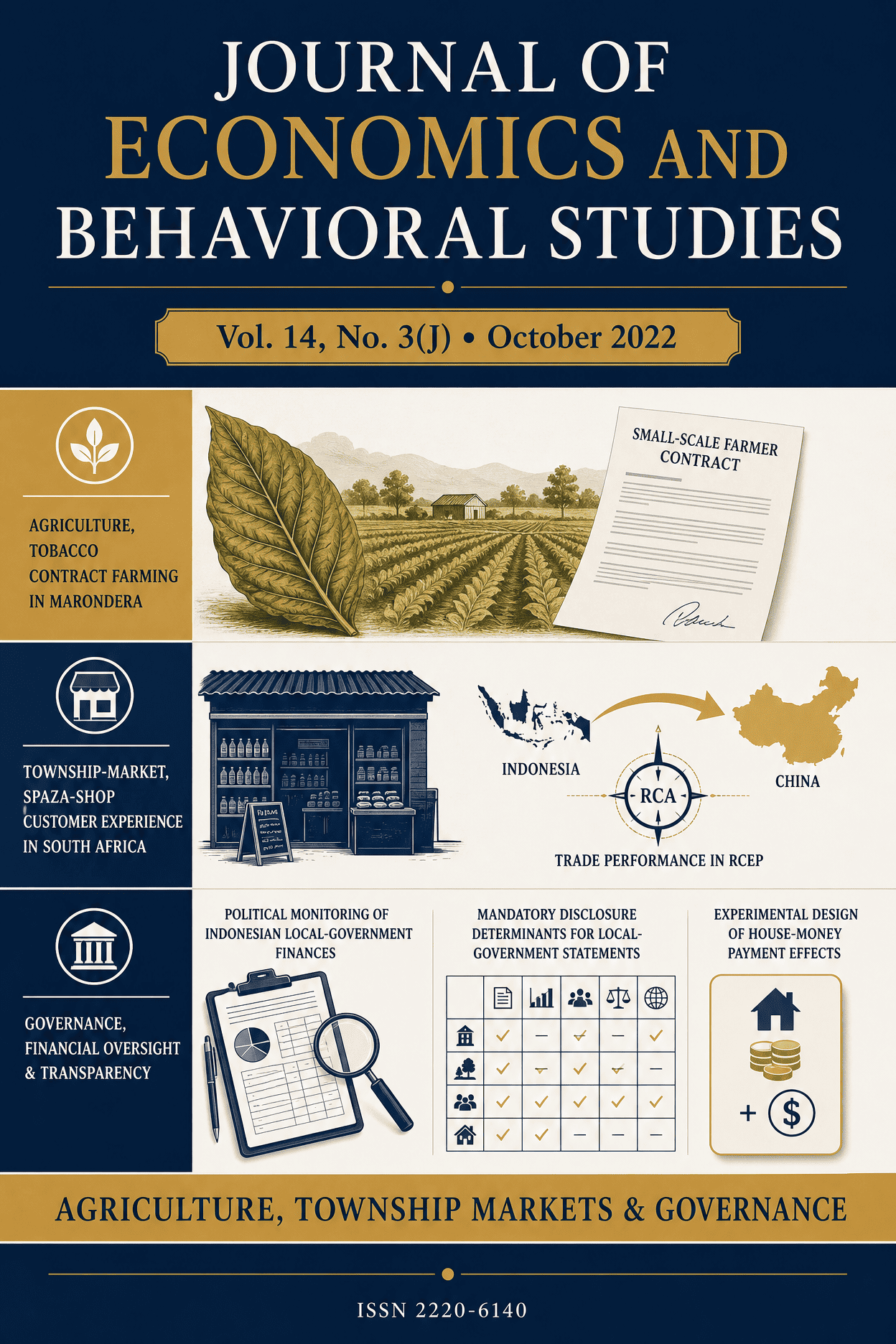
Articles

  • Article 1 in this issue

    Perceptions of Small-Scale Farmers on Tobacco Contract Farming: The Case of Marondera Rural District, Zimbabwe

    • Author: Ruzhani Freddy, Mushunje Abbyssinia

    Small-scale farmers’ perceptions of tobacco contract farming schemes in the Marondera rural district of Zimbabwe were critically assessed in this paper. The multi-stage sampling design was used to select five wards with the highest number of tobacco contracted farmers from where 60 contract and 60 noncontract tobacco farmers were randomly selected. A 5-point Likert scale was used to rank farmers’ perceptions. The paper established that small-scale farmers in Marondera rural district strongly believe contract farming makes it possible for the majority of farmers to venture into the production of high-value crops as it provides access to the much-needed markets while reducing the risk of price fluctuations. However, the majority of the respondents believed that contract farming is not profitable and there is a manipulation of farmers in contract farming arrangements. The independent samples t-test indicated a significant difference in perception score between participants and non-participants of tobacco contract farming schemes (p<0.05). The farmers who were not participating in tobacco contract farming schemes had a more positive perception of these schemes while those who participated had a more negative perception. The major implication is that gains associated with tobacco contract arrangements are not always apparent to farmers while the disincentives may be more visible. It is therefore fundamental that contract companies address some of the shortcomings existing in these contractual arrangements as well as change the perception of the farmers to develop mutually beneficial lasting relationships with their major stakeholders.

    Pages 1-10

    PDF - Perceptions of Small-Scale Farmers on Tobacco Contract Farming: The Case of Marondera Rural District, Zimbabwe (opens in a new tab)
  • Article 2 in this issue

    Determinants of Mandatory Disclosure for Local Government Financial Statements

    • Author: Afifah Muawanah, Ermawati

    This study sought to objectively investigate the impact of local government financial disclosure levels on the amount of income in the municipality, general allocation fund, number of local parliaments, and human development index (LKPD). All financial accounts from local governments in Indonesia make up the study's population. 455 district/city administrations across the island of Sumatra were used as the purposive selection sample for this study from 2017 to 2019. In this work, multiple linear regression analysis with STATA version 16 is used for hypothesis testing. The level of disclosure of LKPD is unaffected by the income level of the municipality or general allocation funds, according to the examination of the data. While having an impact on the level of disclosure of local government financial statements (LKPD) are the number of local parliaments and the human development index. This study offers data on variables that will impact the amount of disclosure in financial statements for local governments. A higher level of disclosure will signify that local governments are managing their finances with a high degree of accountability and openness.

    Pages 11-19

    PDF - Determinants of Mandatory Disclosure for Local Government Financial Statements (opens in a new tab)
  • Article 3 in this issue

    Sustaining the Township Economy: An Investigation into the Factors Influencing the Shopping Experience of Spaza Shop Customers in South Africa

    • Author: Marlé van Eyk, Felix Amoah, Thembelihle Yase

    The township economy supports many South Africans by creating employment and reducing the socio-economic challenges facing the country. To ensure sustainable growth of the sector, research is required on key businesses within the informal economy. This study empirically investigated the factors influencing the shopping experience of spaza shop customers in South Africa. Spaza shops, an underresearched South African context, continue to expand in various townships and serves as retail outlet where consumers purchase their daily products and services. The study embraced a quantitative research design. A self-administered questionnaire was employed to collect the data for the study. The target respondents include customers who were older than 18 years and had previously purchased from spaza shops. Respondents were selected using convenience sampling. The questionnaires were distributed to six townships in South Africa. 185 usable questionnaires were included in the data analysis. The empirical results provided evidence that supports the existence of statistically significant positive correlations between five independent experience factors, namely: esthetic, distinctiveness, cognitive, affective and social; with customer experience (dependent variable). Additionally, three of the five experience factors (social, affective and cognitive) are significant predictors of customer experience in the context of this study. Based on the identified factors, several recommendations are made for improving customer experience in a spaza shop context. Recommendations made are expected to enhance the competitiveness of spaza shops thereby enabling them to increase their contribution to employment creation and national Gross Domestic Product.

    Pages 20-32

    PDF - Sustaining the Township Economy: An Investigation into the Factors Influencing the Shopping Experience of Spaza Shop Customers in South Africa (opens in a new tab)
  • Article 4 in this issue

    Indonesia-China Trade Performance in the RCEP Forum

    • Author: Ragimun, Mutaqin, R. Nurhidayat, Akhmad Yasin

    This study aims to map out Indonesia's export performance, the competitiveness of its commodities, and the position of some of Indonesia's flagship commodities in China. The research method used in this study is the Revealed Comparative Advantage (RCA) and the Constant Market Share Analysis (CMSA). The data is from the Indonesia Central Statistics Agency (BPS) and UN Comtrade for 4-digit HS products. The finding from this study indicates that Indonesia's trade balance with China for the last three years (2018-2020) has widened the deficit. Intense negotiations with China are necessary to open up trade access to overcome the trade deficit. The Government is encouraged to launch the development of flagship products with high market values, such as chemicals, machinery, electricity, and textiles. In addition, the national downstream program for mineral and metal products is encouraged to do more robust plans, including considering attracting new industrial investment from China.

    Pages 33-41

    PDF - Indonesia-China Trade Performance in the RCEP Forum (opens in a new tab)
  • Article 5 in this issue

    Local Government Financial Performance: The Role of Political Monitoring

    • Author: Miranti Putri, Khoirul Aswar

    This study intends to investigate and demonstrate the impact of local government financial performance as influenced by political oversight, regional wealth, intergovernmental revenue, and capital spending. In Indonesia in 2019, the district/city local governments were the subject of this study. The Report on Local Government Finances (LKPD) accessible at the Audit Board of the Republic of Indonesia was used as secondary data (BPK RI). The data used in this study included 491 data samples chosen using the purposive selection approach from 507 districts/cities across Indonesia. The analytical method used in this study was path analysis with Smart PLS software and a significance level of 5%. Structural Equation Modeling was used for data analysis (SEM). The findings of this investigation showed that regional wealth, intergovernmental revenue, and capital expenditures have an impact on local government's financial performance. Political supervision, however, does not mitigate the association between intergovernmental revenues and capital expenditures on the financial performance of local governments, which reduces the relationship between regional wealth and local government financial performance. The results of this study are anticipated to be used as source material for studies on the factors affecting local government financial performance and to help local governments by providing information on the monitoring activities carried out by numerous Regional People's Representative Council (DPRD) members. As a result, local governments will be encouraged to increase legislative oversight to improve their financial performance.

    Pages 42-50

    PDF - Local Government Financial Performance: The Role of Political Monitoring (opens in a new tab)
  • Article 6 in this issue

    An Analysis of the Experimental Design of “My Money or Yours: House Money Payment Effects''

    • Author: Abilio Henrique Berticelli De Freitas

    Considering the expanding usage of experiments in Economics, the present article chooses one published paper in the area, dealing with the house money effect, and analyzes it in a didactic way as concepts relating to the experimental design of lab experiments are evoked and discussed. In order to do so, three sections are outlined. First of all, the house money effect is explained and the article under scrutiny is placed in the context of what had already been done before; secondly, some of the experimental design concepts are summarised and then applied to soundly describe the experimental design of their experiment. Finally, after briefly presenting their results, there is an analytical overview of what has been done after their work and a personal take on possible lines for further research.

    Pages 51-56

    PDF - An Analysis of the Experimental Design of “My Money or Yours: House Money Payment Effects'' (opens in a new tab)