Articles

  • Article 1 in this issue

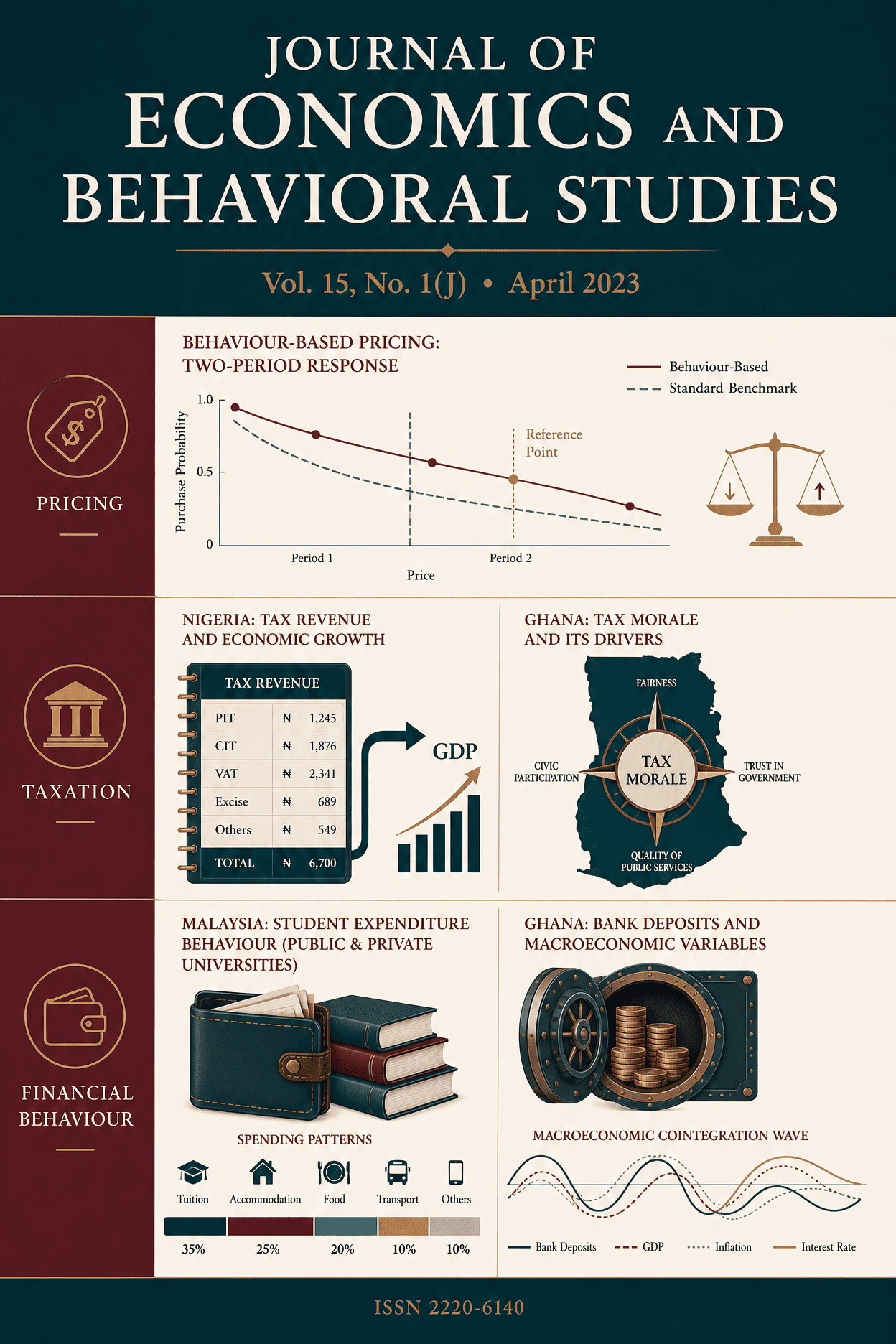
    On Point Predictions and Reference Dependence in Behavior-Based Pricing Experiments

    • Author: Michel Tolksdorf

    It has been shown that the comparative static results of two-period behavior-based pricing models hold in laboratory experiments, while point predictions do not. This study aims to check whether these findings replicate and to evaluate why observed prices deviate from point predictions. We report observed prices in conformity with point predictions through: (1.) a uniform pricing benchmark, (2.) a replication of a behavior-based pricing experiment, and (3.) a follow-up experiment in which we consider the second period disjointed from the first period. By disjoining the two periods, we show that reference dependence toward first-period prices shifts the second-period pricing behavior of participants upwards. In a post hoc analysis, we show that considering consumers' myopic instead of strategic explains a downward shift in first-period prices and rationalizes prior experimental findings. Volatile price levels affect price-based welfare measures – such as seller profits and total customer costs. We show that transport costs are a robust welfare measure that alleviates the impact of distorted prices. Ultimately, our findings are relevant for the design and assessment of multi-period pricing experiments.

    Pages 1-14

    PDF - On Point Predictions and Reference Dependence in Behavior-Based Pricing Experiments (opens in a new tab)
  • Article 2 in this issue

    Tax Revenue and Economic Growth: Empirical Evidence from Nigeria

    • Author: Ifeoma Patricia Osamor, Godwin Omoregbee, Fadekemi Zainab Ajasa-Adeoye, Josephine Mawuyon Olumuyiwa-Loko

    Organizations reduced their tax revenue through tax evasion and avoidance, thereby affecting the economic growth of the country. In an attempt to further stress this assertion, this study aims to empirically examine the effects of tax revenue on economic growth in Nigeria. Tax revenue was a proxy with PPT, CIT, VAT and CTD, while economic growth was proxy with GDP. Ex post facto research design was employed, while time series quarterly data were collected from the statistical bulletins of CBN and FIRS for 10 years (2011-2020). Data collated were analyzed using descriptive analysis, unit root test, bounds cointegration test and ARDL. The findings revealed that PPT, CIT, VAT and CTD had positive insignificant effects on economic growth. The study concluded that tax revenue had insignificant effects on the economic growth of Nigeria and therefore, recommended that proper tax audit should constantly be carried out to reduce tax evasion and avoidance.

    Pages 15-26

    PDF - Tax Revenue and Economic Growth: Empirical Evidence from Nigeria (opens in a new tab)
  • Article 3 in this issue

    A Quantitative Study on Expenditure Behavior among Public and Private University Students in Malaysia

    • Author: Kavithanjali Sandrasegaran, Norimah Rambeli

    The principal point of this study is to examine the relationship between the spending pattern and consumer behavior, especially as it relates to income and financial literacy, among public and private university students in Malaysia. This study adopts Keynes's Psychological Law of Consumption theory. The foremost objective of this theoretical paper was to determine whether there is any difference in spending patterns among public and private university students and the association between parental incomes and spending behavior among public and private university students, as well as to examine the relationship between financial literacy and spending behavior among public and private university students. In addition, this study seeks to determine how well students comprehend the idea of needs and desires. The association between students’ degree of financial literacy as well as their income and their spending habits will next be examined using the data. The link between endogenous and exogenous variables will be determined over both the long and short terms using the Statistical Package for the Social Sciences (SPSS) version 23. The study includes the findings from earlier investigations. The study contributed to a new understanding for the researcher of financial behavior under the categories of needs and wants which outline the importance of financial literacy, parents’ income, and demographic factors. The study also contributes to a new idea for policymakers: adapt financial literacy programs among parents and children.

    Pages 27-34

    PDF - A Quantitative Study on Expenditure Behavior among Public and Private University Students in Malaysia (opens in a new tab)
  • Article 4 in this issue

    The Relationship between Bank Deposits and Macroeconomic Variables in Ghana: A Co-Integration Approach

    • Author: Opoku-Asante Kofi, Owusu Kwaning Collins, Arhenful Peter, Ntiamoah Adjei Jones, Gretel Asigbe-Tsriku

    This study examined the linkages between macroeconomic variables and how those relationships affect the total deposits of Ghanaian banks. The macroeconomic variables included in this study were Inflation (I), Monetary Policy Rate (MPR), Gross International Reserve (GIR), Public Debt (PD), Gross Domestic Product (GDP), GSE All share Index (GASI), Rate of change in Total Money Supply (M2+), deposits in the banking sector (TD). The study employed monthly data over the period (2015–2020); obtained from the Bank of Ghana monthly time series database. The data were analyzed using Gretl. The cointegration technique was employed in this study to gauge the long-term and short-term responsiveness of the connections. The ADF results indicated that the study variables were non-stationary. The econometric analysis suggested that the study variables, inflation (I), Gross Domestic Product (GDP), Public Debt level (PD), and Total Deposits (TD) in banks operating in Ghana, exhibited a significant positive long-run cointegration relationship. This suggested that the identified variables play a crucial role in explaining the fluctuations in total deposit levels within the Ghanaian banking industry. Bank deposit is strongly exogenous and moves to restore equilibrium through several short-run partial adjustments in the short-run. Also, in the short-run, only the GSE All-share index (GASI) significantly influenced bank deposits, but not in the long-run. In the long run, the relationship was still positive but insignificant.

    Pages 35-44

    PDF - The Relationship between Bank Deposits and Macroeconomic Variables in Ghana: A Co-Integration Approach (opens in a new tab)
  • Article 5 in this issue

    Tax Morale and its Drivers: Empirical Evidence from Ghana

    • Author: Jones Adjei Ntiamoah, Peter Arhenful, Collins Owusu Kwaning, Joseph Asare

    Using the binary logistic regression model, this study analyzes the statistical relationships between tax morale and its drivers as developed by the World Values Survey (WVS) on 1,552 respondents in Ghana between 2010 and 2014. The findings show that age has a significant positive relationship with tax morale, whereas participation in national-level elections also has a significant positive relationship with tax morale. Secondary education and above have a positive relationship with tax morale, but the relationship is negative below secondary education. One's employment status has a positive but insignificant relationship with tax morale, but income factors have a negative relationship. Confidence in government and parliament has a positive but insignificant relationship with tax morale. Finally, preference for the redistribution of wealth has a significant positive relationship with tax morale, while trust in others has an insignificant positive relationship with tax morale. The study provides country-specific drivers of tax morale (with expanded variables) and their relationships with tax morale in direct response to a suggestion by Daude, Gutiérrez, & Melguizo in their study in 2012 and as an improvement upon a similar study conducted in Ghana by Ibrahim, Musah, & Abdul-Hanan in 2015.

    Pages 45-55

    PDF - Tax Morale and its Drivers: Empirical Evidence from Ghana (opens in a new tab)