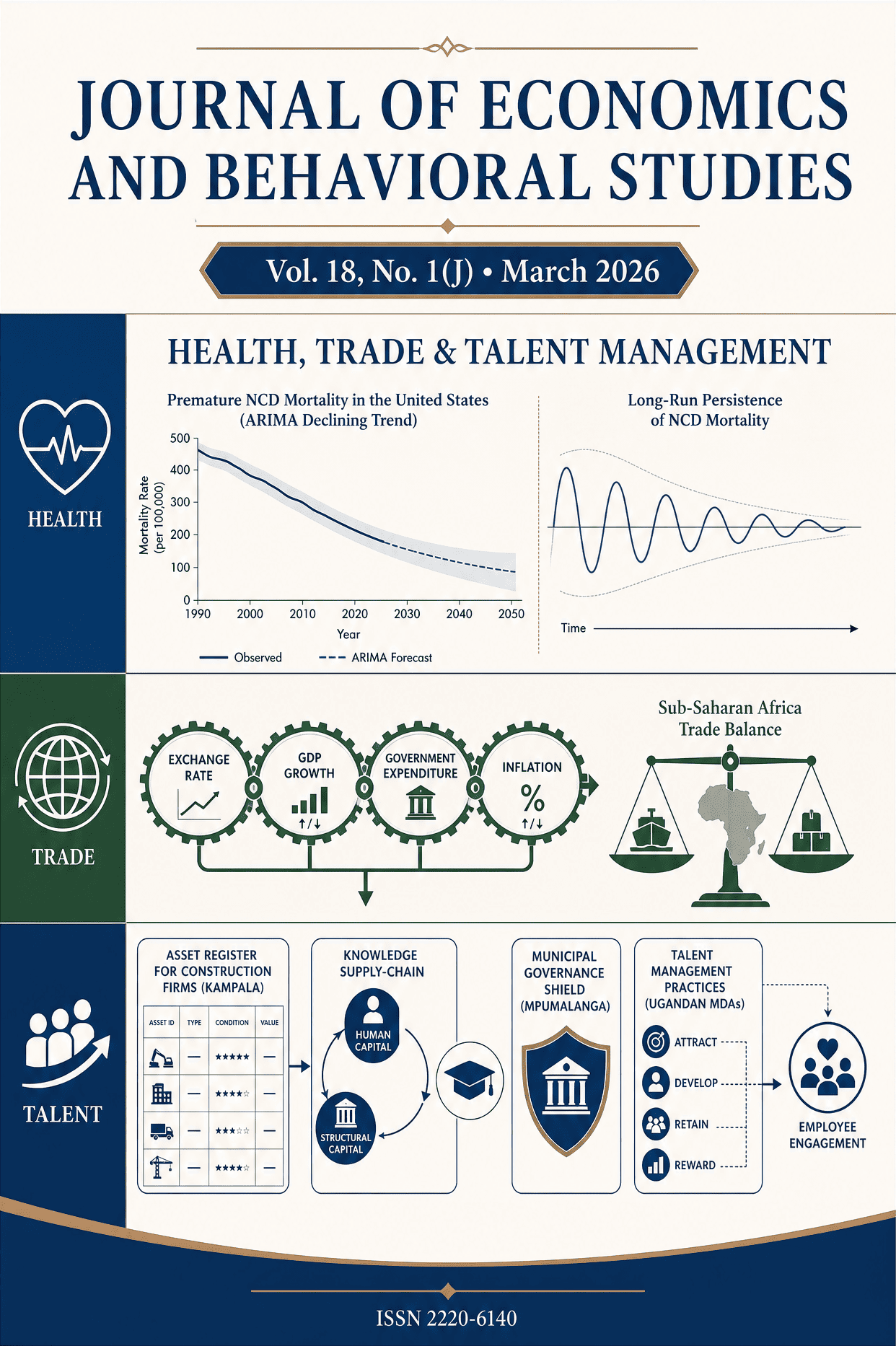
Articles

  • Article 1 in this issue

    Asset Management and Financial Performance of Construction Companies in Greater Kampala Metropolitan Area

    • Author: Benjamin Musiita, Frederick Nsambu Kijjambu

    The financial performance of construction companies is increasingly dependent on effective asset management practices that enhance operational efficiency, reduce project delays, and strengthen long-term sustainability. Despite the construction sector’s significant contribution to Uganda’s economic development, firms within the Greater Kampala Metropolitan Area continue to experience weak profitability, high debt ratios, and cost overruns, partly attributed to poor asset management systems. This study examined the effect of asset management on the financial performance of construction companies in the region, focusing on three key dimensions: asset register accessibility, repair and maintenance scheduling, and budget tracking and forecasting. Guided by the Dynamic Capabilities Theory, the study adopted a cross-sectional survey design and collected data from 191 construction companies selected through proportionate sampling. Structured questionnaires were used to gather quantitative data, and instrument validity and reliability were confirmed through expert review and Cronbach’s Alpha. Data were analyzed using descriptive statistics, correlation analysis, and hierarchical regression. Findings revealed that all three asset management practices were positively associated with financial performance. Asset register accessibility showed a moderate significant relationship with financial performance (r = .313, p < .01), while repair and maintenance scheduling demonstrated a weaker but significant association (r = .273, p < .01). Budget tracking and forecasting also exhibited a positive relationship (r = .168, p < .01). Hierarchical regression results further indicated that asset register accessibility contributed the largest increase in explained variance (9.4%), followed by budget tracking and forecasting (2.7%), while the contribution of repair and maintenance scheduling was positive but minimal and statistically insignificant in the final model. Overall, the models explained 15% of the variance in financial performance. The study concludes that effective asset management enhances financial performance, particularly when firms maintain accessible and up-to-date asset registers and implement robust budgeting and forecasting systems. It recommends that construction firms strengthen digital asset management systems, adopt preventive maintenance schedules, and integrate data-driven financial planning tools to improve profitability, ensure timely project delivery, and enhance financial resilience in an increasingly competitive construction environment.

    Pages 1-11

    PDF - Asset Management and Financial Performance of Construction Companies in Greater Kampala Metropolitan Area (opens in a new tab)
  • Article 2 in this issue

    Modeling Premature Adult Mortality From Non-Communicable Diseases in The United States

    • Author: Willy Rwamparagi Kagarura, Patrick Kagambo John Nahabwe

    We model mortality from cardiovascular diseases (CVD), cancer, diabetes, and chronic respiratory diseases (CRD) among individuals aged 30–70 years in the United States using quarterly time-series data covering the period 2000 to 2024. We adopt an autoregressive integrated moving average (ARIMA) framework to examine both the long-run trajectory and short-run fluctuations in premature adult mortality. Quarterly data obtained from the World Bank are employed, with mortality from CVD, cancer, diabetes, or CRD specified as the dependent variable, while autoregressive (AR) and moving average (MA) terms capture the inherent temporal dependence in mortality dynamics. Parameter estimation is conducted using the conditional least squares (CLS) technique. Results reveal a positive and statistically significant AR(1) coefficient of 0.987144, indicating strong persistence and inertia in mortality patterns, whereby current mortality outcomes are heavily influenced by their past realizations. In contrast, the MA(4) coefficient is negative and statistically significant at –0.697195, suggesting that short-run shocks to mortality, such as transitory health crises or policy interventions are gradually corrected over time. This dynamic adjustment mechanism reinforces the tendency of the series to revert toward its long-run path. The estimated ARIMA(1,1,4) model satisfies both covariance stationarity and invertibility conditions, confirming its econometric soundness and suitability for forecasting. The adjusted R-squared value of 0.835857 indicates that approximately 83.6% of the variation in premature adult mortality is explained by the model’s dynamic structure, underscoring its strong explanatory power. Outof-sample forecasts extending to 2050 project a sustained and gradual decline in mortality rates, with levels converging toward approximately 4% by mid-century. These projections are consistent with ongoing improvements in healthcare access, disease prevention strategies, medical technology, and public health interventions in the United States. The study recommends sustained and targeted investments in noncommunicable disease prevention, early diagnosis, and health system resilience to consolidate and accelerate the observed long-term decline in premature adult mortality.

    Pages 12-27

    PDF - Modeling Premature Adult Mortality From Non-Communicable Diseases in The United States (opens in a new tab)
  • Article 3 in this issue

    Foreign Exchange Rate and GDP Growth Vis-À-Vis Trade Balance in Sub-Saharan Africa

    • Author: Patrick Kagambo John Nahabwe, Willy Rwamparagi Kagarura

    We investigate the interaction effect of foreign exchange rate and economic growth on the trade balance in Sub-Saharan Africa (SSA). We utilize balanced annual panel data for 20 SSA countries covering the period 2005 to 2024. We source the data from the World Development Indicators. We employ the Generalized Method of Moments (GMM) estimator to address endogeneity, dynamic effects, and unobserved countryspecific heterogeneity. Empirical results reveal a negative and statistically significant interaction between foreign exchange rate and GDP growth. Specifically, the estimated coefficient of the interaction term (FER*GDP) of -0.190271 implies that a simultaneous 10 percent increase in exchange rate and GDP growth is associated with a deterioration of the trade balance by approximately 1.9 percent. These findings indicate that economic growth occurring alongside exchange rate depreciation is linked to weaker trade balance outcomes, consistent with import-intensive growth structures and limited export supply responsiveness in SSA economies. These results highlight the importance of accounting for structural characteristics when assessing trade balance effects of exchange rate movements and growth dynamics.

    Pages 28-41

    PDF - Foreign Exchange Rate and GDP Growth Vis-À-Vis Trade Balance in Sub-Saharan Africa (opens in a new tab)
  • Article 4 in this issue

    Managing the Knowledge Supply Chain: Human capital, Structural Capital and Graduate Employability: Testing Interaction Effects

    • Author: Alex Twinomuhwezi, Nixon Kamukama, Charles Tushabomwe-Kazooba

    This study examines the interaction effect of human and structural capital on graduate employability in public universities in South-Western Uganda, exploring how their combination enhances labor-market outcomes. The study adopted a positivist research paradigm with a quantitative, cross-sectional design. Data were collected from 377 graduates and 122 academic and administrative staff across Mbarara University of Science and Technology, Kabale University, and Mountains of the Moon University using self-administered questionnaires. Human capital was measured through professional competence, social competence, employee motivation, and leadership, while structural capital comprised institutional systems, infrastructure, and culture. Graduate employability was assessed through job acquisition, employment quality, career adaptability, and entrepreneurial success. Data were analyzed using SPSS and Structural Equation Modeling, with interaction effects tested using Hayes’ Process Macro. Human and structural capital both significantly predict graduate employability, accounting for 42.7% of the variance. Inclusion of the interaction term revealed a significant multiplicative effect, indicating that human capital’s impact on employability strengthens as structural capital increases. The results confirm that neither capital alone suffices; their synergy optimizes graduate outcomes, consistent with the knowledge supply chain perspective. Universities should jointly invest in faculty expertise and institutional infrastructure, embed employability skills into curricula, and institutionalize industry partnerships. Policymakers should implement performance-based funding, revise quality assurance frameworks to emphasize employability, and promote university-industry collaboration. This study is the first to empirically test the interactive effects of human and structural capital on graduate employability in Ugandan public universities.

    Pages 42-58

    PDF - Managing the Knowledge Supply Chain: Human capital, Structural Capital and Graduate Employability: Testing Interaction Effects (opens in a new tab)
  • Article 5 in this issue

    Government Expenditure and Inflation Vis-À-Vis Trade Balance in Sub-Saharan Africa

    • Author: Patrick Kagambo John Nahabwe, Willy Rwamparagi Kagarura

    We investigate the interaction effect of government expenditure and inflation on the trade balance in Sub-Saharan Africa (SSA). We utilize balanced annual panel data for 20 SSA countries over the period 2005 to 2024 sourced from the World Development Indicators. We apply the Generalized Method of Moments (GMM) estimator to control for endogeneity, unobserved heterogeneity, and the dynamic nature of trade balance adjustment. Empirical results indicate a positive and statistically significant interaction between government expenditure and inflation. The estimated coefficient of the interaction term (GEX*INF) is 0.033026, implying that a simultaneous 10 percent increase in government expenditure and inflation improves trade balance by approximately 0.33 percent. This suggests that, in SSA, expansionary fiscal policy combined with moderate inflation can enhance trade balance performance, likely through increased domestic output, improved competitiveness, and reduced import dependence. We recommend coordinated fiscal-monetary policy frameworks that emphasize productive public spending and inflation control to strengthen external sector sustainability.

    Pages 59-74

    PDF - Government Expenditure and Inflation Vis-À-Vis Trade Balance in Sub-Saharan Africa (opens in a new tab)
  • Article 6 in this issue

    Talent Management Practices and Performance of MDAs in Uganda

    • Author: Asaph Kaburura Katarangi, Nixon Kamukama, Adrian Mwesigye

    This study therefore aimed at examining the effect of talent management practices on the performance of Ministries, Departments, and Agencies (MDAs) in Uganda with four objectives which were designed to examine talent acquisition, talent development, performance management, and succession planning in MDAs in Uganda. This study used a positivism paradigm and applied a sequential mixed-methods explanatory research design in which data was collected through cross-sectional survey research design and analyzed using Pearson correlation and hierarchical regression analysis, with thematic data analysis used in analyzing data collected in the quantitative section of this research. Regression results indicate that talent acquisition significantly and positively affects MDA performance in Uganda (B = 0.246, p < .01), as do talent development (B = 0.142, p < .01) and performance management (B = 0.414, p < .01), which is the highest of all factors. However, succession planning has a slight negative effect but is not statistically significant (B = −0.003, p > .05). Overall, the results indicate that the model is statistically significant and explains 37.6 percent of the changes in MDA performance in Uganda (Adjusted R² = .376, F = 71.657, p < .01). Based on the results, the importance of merit recruitment, staff development, and performance management is highlighted, as is the importance of succession planning and its potential to support MDA performance in Uganda. The results of the present study provide solid support to inform HR policy interventions geared towards improving the efficiency, effectiveness, accountability, and sound financial management of MDAs in Uganda’s public sector.

    Pages 75-86

    PDF - Talent Management Practices and Performance of MDAs in Uganda (opens in a new tab)
  • Article 7 in this issue

    The Role of Corporate Governance in Municipal Risk Management: A Case Study of the Ehlanzeni District Municipality, Mpumalanga

    • Author: Andreas Bheki Ngcobo, Dr. S. Govender, Dr. S.S. Pillay

    Municipalities in South Africa continue to face criticism for weak governance systems and poor service delivery to communities. Many district and local municipalities struggle with financial management challenges, limited institutional capacity, and ineffective risk management practices. This study examines the relationship between corporate governance and municipal risk management in the Ehlanzeni District Municipality in Mpumalanga Province. The research focuses on four local municipalities within the district and explores how governance practices influence municipal performance and accountability. A mixed-methods approach was adopted to generate both quantitative and qualitative insights. Quantitative data were collected through a structured questionnaire administered to 216 municipal officials, while qualitative data were obtained through semi-structured interviews with 45 purposively selected participants. The quantitative data were analysed using the Statistical Package for the Social Sciences (SPSS) version 27, applying descriptive statistics, correlation analysis, ANOVA, and regression techniques. Qualitative data were analysed through thematic analysis to identify patterns related to governance roles, risk management processes, and institutional accountability. The findings reveal notable gaps in corporate governance knowledge and implementation across the municipalities. However, the principle of fairness emerged as a critical factor influencing municipal performance and stakeholder trust. The study recommends strengthening governance capacity through continuous training, improved stakeholder engagement, and better integration of corporate governance principles into municipal decision-making processes.

    Pages 87-102

    PDF - The Role of Corporate Governance in Municipal Risk Management: A Case Study of the Ehlanzeni District Municipality, Mpumalanga (opens in a new tab)
  • Article 8 in this issue

    The Mediating Effect of Employee Engagement on the Relationship Between Talent Management Practices and the Performance of MDAs in Uganda

    • Author: Asaph Kaburura Katarangi, Nixon Kamukama, Adrian Mwesigye

    The study aimed to investigate the role of Employee Engagement as a mediator variable between Talent Management Practices and the performance of Ministries, Departments, and Agencies in Uganda. The study used a quantitative study approach based on the Person-Job Fit Theory by Edwards (1991) and the Social Exchange Theory by Homans (1958). The study used a sample of 103 Ministries, Departments, and Agencies out of which 93 responses were obtained, representing 90 percent of the total population. The study used a cross-sectional study approach and ordinary least squares regression analysis based on the Baron and Kenny (1986) approach for mediation effects. The study established that Talent Management Practices have a positive and significant direct effect on MDA performance (β = .545, p < .001) and also have a significant effect on Employee Engagement (β = .440, p < .001). Furthermore, the study established that Employee Engagement has a strong predictive effect on MDA performance (β = .595, p < .001). However, when both variables are used, the study established that Talent Management Practice's direct effect on MDA performance was reduced to β = .352 (p < .001), whereas Employee Engagement was still significant (β = .440, p < .001). The indirect effect via Employee Engagement explained about 48 percent of the total effect, while the model explained 45.4 percent of the variation in MDA performance, R² = .454, N = 95. The results indicate that Talent Management Practices have a positive impact on MDA performance, both directly and indirectly via Employee Engagement, which is a critical mediator linking Talent Management Practices to MDA performance. The study recommends that MDAs in Uganda adopt a holistic and merit-based approach to talent management, employee engagement should be a strategic imperative, transformational leadership at the supervisory level should be enhanced, and supportive organizational environments should be developed to allow the returns from talent management to lead to consistent improvements in service delivery, accountability, and overall institutional effectiveness in Uganda’s public sector.

    Pages 103-115

    PDF - The Mediating Effect of Employee Engagement on the Relationship Between Talent Management Practices and the Performance of MDAs in Uganda (opens in a new tab)