Articles 31–40 of 66

  • Article 31 in this issue

    Marketing Orientation, Customer Orientation, Entrepreneurship Education and Women Entrepreneurship Sustainability in Small and Medium-Sized Enterprises (SMEs) in Malaysia

    • Author: Nor Hamiza Mohd Noor, Intan Maizura Abd Rashid, Noraishah Kamarolzaman, Nor Azmawati Husain, Hamidah Binti Norman

    The focal point of the examination included investigating the achievement factors among women entrepreneurs in the province of Malaysia. This paper additionally explored to what degree a few particular factors, for example, entrepreneurship education management, customer orientation and marketing orientation can clarify its commitment towards turning out to be effective women entrepreneurship visionary. Women entrepreneurs have been progressively mainstreamed into advancement forms, and by assuming an assortment of jobs at the family, network and society levels, they have had the option to add to national improvement and thriving. Reflecting dynamically expanded political will, progressive Malaysian advancement plans have put a more prominent accentuation on mainstreaming women entrepreneurs in national improvement through certifiable multi-sectoral approaches and projects. Gender orientation as an advancement center was first referenced in the Third Malaysia Plan (1976–1980), which supported the dynamic interest of women entrepreneurs being developed and their commitment to the economy. The job of Women entrepreneurs in neediness destruction was given acknowledgment under the Fifth Malaysia Plan when social projects to elevate the state of women were supplanted by monetary projects. The results show that the regression analysis on entrepreneurship education management, customer orientation and market strategy affect the sustainability of SMEs. Numerous studies have been undertaken to evaluate the effects of various elements on women's entrepreneurial success, but our study looked into several entrepreneurship education management, customer orientation and market strategy factors towards women's entrepreneurship sustainability that have largely gone unexplored, particularly in Malaysia. The current study further adds to the previous literature by providing empirical evidence.

    Pages 299-305

    PDF - Marketing Orientation, Customer Orientation, Entrepreneurship Education and Women Entrepreneurship Sustainability in Small and Medium-Sized Enterprises (SMEs) in Malaysia (opens in a new tab)
  • Article 32 in this issue

    Enhancing Social Sustainability via Branding Strategies among Personal Care and Cosmetics Customers: The Moderating Role of Brand Visibility

    • Author: Al Amirul Eimer Ramdzan Ali, Abdul Kadir Othman, Ahmad Syahmi Ahmad Fadzil, Nur Nabilah Abdullah, Fatin Husna Suib

    Sustainability has existed since the day it was originated by the Brundtland Commission in the year of 1987. The term sustainability has been vaguely defined and it creates different interpretations. In line with today’s economic situation, organizations increasingly perceive sustainability as an opportunity for them to gain a competitive advantage. In the current era, most of the powerful brands aspire to achieve the same social goal; hence business leaders and marketers are now facing a problem in maintaining its social sustainability. Most studies investigate social sustainability goals from the perspective of business operations. Results from the field study involving 420 customers from six (6) premier shopping malls across Kuala Lumpur demonstrated evidence for construct validity and reliability based on the multiple regression analysis, the result of the study of this study shows that only the Branded House strategy and Halal strategy were proven to have significant relationship with social sustainability. In terms of testing the hypotheses involving the moderating roles of the relationship between independent variable and dependent variable, 2 out of 4 hypotheses were supported in which brand visibility moderates the relationship between Halal branding and social sustainability, whereas brand visibility moderates the relationship between stand-alone strategy and social sustainability The implications of this research are, the organization needs to consider corporate dominant strategy and Halal strategy to ensure long-term business operation and this research also provides additional insight on social sustainability model by investigating the branding strategies namely corporate dominant, brand dominant, mixed branding and Halal branding.

    Pages 306-315

    PDF - Enhancing Social Sustainability via Branding Strategies among Personal Care and Cosmetics Customers: The Moderating Role of Brand Visibility (opens in a new tab)
  • Article 33 in this issue

    Non-linear Panel Data Liquidity Model of Islamic and Conventional Banks

    • Author: Wahida Ahmad, Nur Hazimah Amran

    Banks and liquidity risk are synonymous with each other due to inevitable asset-liability mismatches derived from deposit and lending activities. The study aims to investigate this issue by highlighting a new insight into the non-linear function between profitability and liquidity risk. With the aspiration to include both Islamic and conventional banks from nine Asia-Pacific countries, this study involves the unbalanced panel data of a 10-year period that covers from 2011 to 2020. The final sample ends with 285 banks and 2,116 observations. The study employs a quadratic random effect model with clusters adjusted errors comprised of five interest predictors namely profitability, credit risk, bank capital, income diversification and bank size. The findings discover profitability, bank capital, income diversification, size and economic condition play vital roles in managing banks liquidity. The findings reveal the existence of moral hazard for larger and highly capitalized banks with greater exposure to liquidity risk. High-margin banks are also prone to maintain lower liquidity levels, thus exposed to greater risk. Banks are advocated to elevate higher earnings and maintain adequate levels of capital and assets with the caution of moral hazard issues. Therefore, the regulatory body in each country is proposed to intervene and monitor especially the higher margin banks to lessen the moral hazard issue.

    Pages 316-325

    PDF - Non-linear Panel Data Liquidity Model of Islamic and Conventional Banks (opens in a new tab)
  • Article 34 in this issue

    The Determinants of Customer Satisfaction towards Muslim-Friendly Healthcare Service Deliveries: A Conceptual Model

    • Author: Shariff Harun, Azhan Rashid Senawi

    The global need for hospitals that adhere to Islamic principles and accommodate the specific needs of Muslim patients is increasing. Hence, in highly competitive landscape of the healthcare industry it’s imperative for hospitals to be profitable while delivering sufficient and excellent healthcare services to the community, management must exhibit prudence in addressing this evolving attitude. This study intends to identify the appropriate determinants of customer satisfaction pertaining to the service deliveries offered by healthcare providers that are desired by Muslim patients, while adhering to Islamic medical ethics and Shariah requirements. A systematic literature review approach was utilized to examine the appropriate features of Muslim-friendly healthcare practices and their mechanisms. The thematic analysis of the reviewed papers revealed eight potential determinants of customer satisfaction which are Halal pharmaceuticals and medical equipment, Islamic facilities and amenities, proficient personnel, empathy and supportive staff, compliance and supportive hospital policy, welcoming Islamic settings, reasonable and suitable pricing, and Islamic work culture. The results are anticipated to stimulate policymakers in Malaysia and other nations with an interest in the matter, to implement the suggested practices through the enactment of favorable legislative measures. This study contributes to the body of knowledge by illuminating the antecedents of customer satisfaction model that can be used by Muslim-friendly healthcare providers to formulate strategies and policies to reduce the financial and business risk due to unsatisfied customers’ reactions. Subsequently, achieving the United Nations Sustainable Development Goals of good health and well-being (Goal 3) and peace, justice and strong institutions (Goal 16).

    Pages 326-330

    PDF - The Determinants of Customer Satisfaction towards Muslim-Friendly Healthcare Service Deliveries: A Conceptual Model (opens in a new tab)
  • Article 35 in this issue

    Nisab of Zakat and Zakat Contribution: A Conceptual Model

    • Author: Azhan Rashid Senawi, Heizal Hezry Omar, Amirul Afif Muhamat, Shariff Harun, Husna Husain, Tika Widiastuti, Nazri Chik

    Zakat distribution has a positive correlation with its collection. Thus, a higher collection of zakat will positively impact the distribution amount and reach a bigger pool of zakat recipients. However, some external constraints in its collection could likely have an adverse impact on its collection, especially the effect of the macroeconomic factors. It becomes crucial when the increase in the price of gold (one of the primary commodities used as a nisab benchmark for zakat in Islam) is claimed to negatively influence the collection and allocation of zakat to the respective recipients. Therefore, this study aims to investigate whether the high and low value of nisab due to the fluctuating price of gold in the world market could negatively influence the zakat collection and indirectly affect all the recipients, especially the poor and needy. In achieving this aim, this study will utilize a structured self-administered questionnaire to study the awareness of Muslims on the nisab of zakat and its influence on their zakat payments. It is still relatively rare to find any research on the awareness of the nisab of zakat and its relation to the zakat contribution. One past econometric study concluded that a higher nisab leads to a lower zakat collection. The findings of this proposed study could complement that previous study and hence be justifiable due to its significant impact on the recipients of zakat ( asnaf ) as the main stakeholders.

    Pages 331-336

    PDF - Nisab of Zakat and Zakat Contribution: A Conceptual Model (opens in a new tab)
  • Article 36 in this issue

    Determinants of Non-Performing Loans: Evidence from Malaysia

    • Author: Che Wan Nabilah Che W Mohd Amil, Balkis Haris, Nor Akila Mohd Kassim

    Financial institutions worldwide have huge dangers in non-performing loans. Hence, they are required to review their lending policies. The default loans also lead to massive losses on banks and decreased economic growth. Therefore, non-performing loans are a predominant concern that affects financial markets and banking industry suitability. The rise in non-performing loans has an adverse impact on the banking sector. Therefore, understanding the determinants of non-performing loans is critical to safeguard the overall economy's productivity. Motivated by this scenario, this study investigates the determinants of Non-Performing Loans in Malaysia's banking system. Inflation Rates, Lending Interest Rates, Real Interest Rates, Gross Domestic Product, Gross Domestic Saving and Unemployment Rates are the variables used and collected yearly from 1988 to 2020, consisting of 33 observations for each variable. The method used for data analysis in this study is multiple regression analysis. The research results revealed that Gross Domestic Product, Gross Domestic Saving, and Unemployment significantly explained Non-Performing Loans in Malaysia. The findings have important implications for policymaking, besides adding new knowledge to the existing literature.

    Pages 337-351

    PDF - Determinants of Non-Performing Loans: Evidence from Malaysia (opens in a new tab)
  • Article 37 in this issue

    Vaccination Acceptance among Indigenous Community: The Moderating Role of Tribal Leader Information Management and Business Review (ISSN 2220-3796) Vol. XX, No. X, pp. XX, Special Issue 2023Endorsement

    • Author: Zarina Denan, Nor Azairiah Fatimah Othman, Zarina Abdul Munir, Dilla Syadia Ab Latiff, Norol Hamiza Zamzuri

    Coronavirus disease 2019 cases are showing a downward trend in Malaysia but with active cases still present, the virus remains a persistent public health threat. Amid vaccination at no cost, some of the populace is refusing to get vaccinated. As getting indigenous communities vaccinated are much more difficult due to contextual and cultural difference, this study investigated whether tribal leader endorsement moderates the relationship between attitude and intention towards vaccination. Drawing from a survey of 312 indigenous from various generations of Millennials, Generation X and Generation Z, this study found that endorsement of tribal leaders does not act as a moderating factor in the association between attitude and intention to accept vaccination across generations. This study contributes to understanding whether indigenous communities require cultural-based approaches to support vaccination uptake. This study would be beneficial in supporting initiatives to curb COVID-19 disease and the right to good health among indigenous communities.

    Pages 352-361

    PDF - Vaccination Acceptance among Indigenous Community: The Moderating Role of Tribal Leader Information Management and Business Review (ISSN 2220-3796) Vol. XX, No. X, pp. XX, Special Issue 2023Endorsement (opens in a new tab)
  • Article 38 in this issue

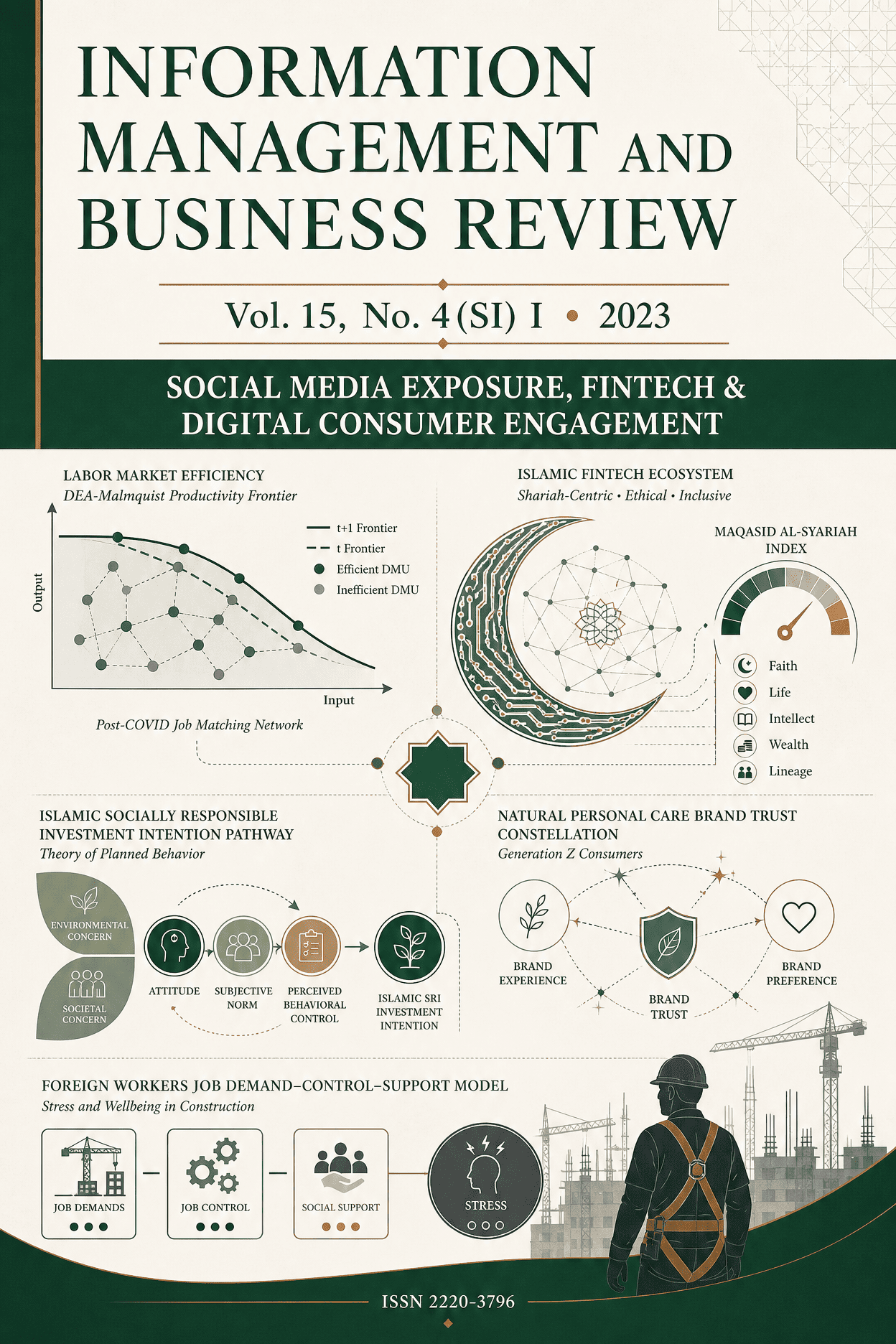
    Factors Affecting the Intention to Invest in Islamic SRI in Malaysia

    • Author: Adleen Farish, Norzitah Karim, Azlul Kalilah Zaghlol

    Islamic SRI has shown a flourishing expansion over the last three decades. This demonstrates that there will be a significant opportunity to enhance the Islamic SRI in the Islamic Finance sector. Islamic SRI is a type of investment that facilitates the creation of the ecosystem and promotes responsible investing. The study attempts to look at the factors affecting the intention to invest in Islamic SRI. The theoretical framework is built on the Theories of Planned Behavior (TPB) and Theory of Reasoned Action (TRA). Since the study focuses on the desire to engage in Islamic SRI, the theories are expanded to include three more antecedents: environmental and societal concern, knowledge, and religion. Due to the study’s emphasis on Islamic SRI perspectives, these variables ought to be included. According to the multiple regression analysis, four components, namely attitude, subjective norm, environmental and social factors, were revealed to be positively significant on the intention to invest in Islamic SRI. The study employs quantitative research through an online survey questionnaire. The sampling technique for this study is non-probability sampling by applying the convenience sampling technique. Besides, the targeted population of this study is the potential private investors who reside in the states of Kuala Lumpur and Selangor, while the total sample size of the study is 380.

    Pages 362-368

    PDF - Factors Affecting the Intention to Invest in Islamic SRI in Malaysia (opens in a new tab)
  • Article 39 in this issue

    Mosque Tourism Satisfaction: A Comparative Study of Malaysia, Thailand, and Indonesia

    • Author: Muhammad Azizan, Adie Zulkeflli, Zafirah Khadar, Syed Noor, Eni Syafina Roslan

    Islamic tourism encompasses the exploration of Islamic history, culture, and religion. One form of Islamic travel is mosque tourism, which involves visiting mosques to appreciate their beauty, history, and culture. Mosque tourism can facilitate cultural exchange, economic growth, historical preservation, and promote respect and understanding between civilizations, leading to a higher level of mosque tourism satisfaction. Understanding the historical, aesthetic, architectural, religious, and cultural significance of a mosque, as well as its accessibility and tourist amenities, are essential components of mosque tourism. This type of tourism encourages intercultural harmony by offering individuals from diverse backgrounds the opportunity to comprehend and respect each other's cultures and religious beliefs. Nonetheless, the growing number of Muslim tourists also poses challenges to the travel industry's efforts to promote mosque tourism, which are explored in this comparative study of Malaysia, Thailand, and Indonesia. These nations have made significant efforts to promote mosque tourism.

    Pages 369-380

    PDF - Mosque Tourism Satisfaction: A Comparative Study of Malaysia, Thailand, and Indonesia (opens in a new tab)
  • Article 40 in this issue

    The Factors Affecting Consumer Purchase Intention through Social Commerce – A Concept Paper

    • Author: Juliana Norizan, Syukrina Alini Mat Ali, Mohd Fikri Ishak

    Emerging economies are not excluded, where the emergence of e-commerce has now advanced towards a new branch of social commerce as a platform for business transactions as well as in attracting, creating, and maintaining customer relationships. E-commerce on social media platforms offers a practical means for businesses to connect with and sell to consumers. Major social networking sites have been actively developing their e-commerce features, allowing users to make purchases without leaving the site. Major social networking sites have been actively developing their e-commerce features, allowing users to make purchases without leaving the site. Social commerce has become popular due to its importance in e- commerce. The research in this area is still limited, especially on the factors that influence purchase intentions when using social commerce platforms. The purpose of this study is to examine the contribution and significance of affordance and trust theories among Malaysian users that underpin purchase intentions on social commerce platforms. This paper establishes a conceptual framework for consumers' purchase intentions based on the SOR model. Social media platforms can be used by businesses to interact with customers and increase sales once they recognize their potential. PLS-SEM (Partial Least Squares Structural Equation Modeling) will be used to examine the data.

    Pages 381-386

    PDF - The Factors Affecting Consumer Purchase Intention through Social Commerce – A Concept Paper (opens in a new tab)