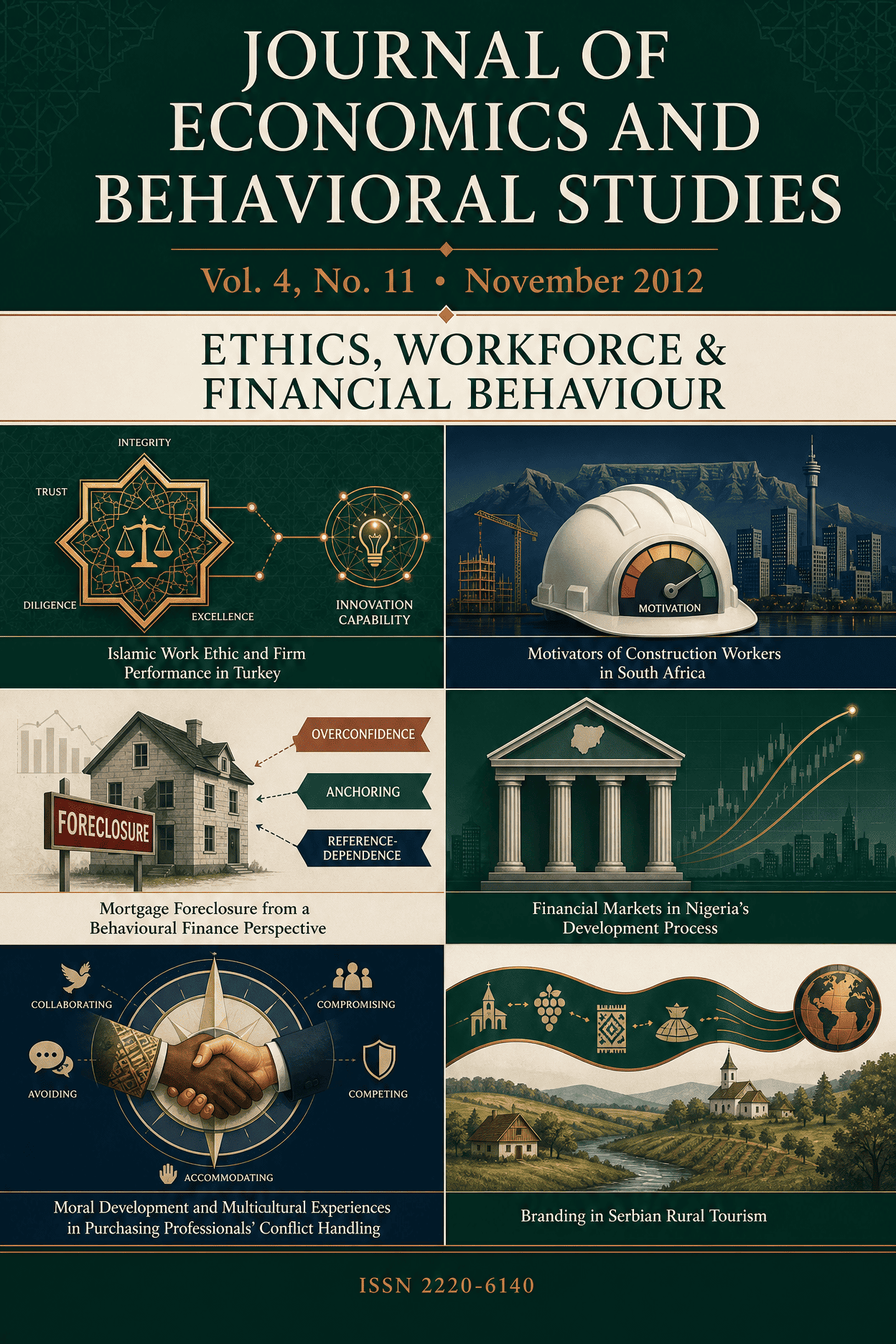
Articles

  • Article 1 in this issue

    An Investigation into the Implications of Islamic Work Ethic (IWE) in the Workplace

    • Author: Salih Yesil, Zumrut Hatice Sekkeli, Ozkan Dogan

    There has been an increasing interest on the work ethics and its various aspects among the academicians and practitioners. This is partly because of the ethical scandals that have occurred in the recent years and got attention from media and public and therefore raised the questions regarding ethical standards of companies and its practical use in the business life. This interest has prompted several research into the topic both theoretical and practical levels. Although the studies have accumulated in the Western World, the studies coming from the developing countries are limited and thus call for the studies to further investigate the dynamics and implications of the work ethics. This study particularly pays attention to Islamic work ethic and aims to identify whether Islamic work ethic values differ across various demographic variables and firm characteristics. The study also investigates the relationship between the Islamic work ethic and innovation capability and firm performance. The study is supported with a field study conducted on the firms operating in Kahramanmaraş in Turkey. The obtained data was analyzed by using Correlation, ANOVA, T-test and Regression in SPSS. The results showed that IWE values differ across some characteristic of the respondents and firms. The results also indicate the positive influence of IWE values on innovation capability and firm performance.

    Pages 612-624

    PDF - An Investigation into the Implications of Islamic Work Ethic (IWE) in the Workplace (opens in a new tab)
  • Article 2 in this issue

    Motivators of Construction Workers in the South African Construction Sites: A Case Study

    • Author: Thwala, W. D, Monese, L.

    Construction industry involves laborious and hazard work because of its demands it requires energetic and enthusiastic people and this are the attributes that in most cases young people poses. Construction industry stakeholder should shift their attention and prioritize the motivation of its workers since the industry has a way of cubing poverty and uplifting the county’s economy. This study used data from both primary and secondary sources a special focus on leadership and human resource management context. A survey was conducted with managers and employees regarding motivation on construction site were conducted at different parts of Gauteng. Furthermore, employees work because they obtain something that they need from work and that something obtained from work impacts morale, employee motivation, and the quality of life. Workforce motivation affects productivity. Because most of the activities are done under difficult conditions including harsh weather conditions, to make it attractive employees should be motivated to carry out different activities. Motivators should be in place to improve the chances of the industry’s competitiveness both locally and internationally.

    Pages 625-634

    PDF - Motivators of Construction Workers in the South African Construction Sites: A Case Study (opens in a new tab)
  • Article 3 in this issue

    The Mortgage Foreclosure Rage: A Behavioral Perspective

    • Author: Beryl Y. Chang, John R. Nofsinger, Caroline E. W. Glackin

    Residential real estate foreclosures reached historic records since the 2008 recession in the United States. While other studies on mortgage defaults and foreclosures focus primarily on individual causal factors leading to the outcome, this paper explores the nature and origins underlying these factors from a behavioral perspective. We argue that: (i) failures in mortgage risk management were due to overconfidence, anchoring, and reference-dependence given constraints in quantitative measurements in inter-temporal terms in a reductionist system; (ii) mortgage derivatives with outsized volume made the lending system dependent on a wider range of externalities with significant ramifications, and thereby more fragile given its misleading assumptions of uncorrelated rather than correlated market behavior; (iii) residential mortgage-backedsecurities (MBS) created illusions of control among market participants due to mental framing, myopia, and other limitations of human cognition; (iv) psychological biases were influenced by product design and lending procedures that promote short-term profits unsuited for a home mortgage; (v) product complexity reduces transparency, intensifies ambiguity aversion, self-serving biases, and default contagion that ultimately led to market breakdown and massive foreclosures. This study contributes to the theories in finance and economics through applications of behavioral measures to current market dynamics. It aims to reveal an idealized but biased system given human characteristics leading to failures in the financial and related industries and to inform policymakers on involuntary consequences in the development of home mortgage products that demand more profound reflections in the regulatory reform process.

    Pages 635-648

    PDF - The Mortgage Foreclosure Rage: A Behavioral Perspective (opens in a new tab)
  • Article 4 in this issue

    The Place of Financial Markets in the Development Process: Evidence from Nigeria

    • Author: Ehigiamusoe Uyi Kizito

    The paper examines the place of financial markets in the development process in Nigeria . The paper used descriptive approach and discovered that financial markets play fundamental role in the development process. However, the overall performance of the Nigeria’s financial market despite some expansion in recent times has been below its potential. In particular, as propellers of economic development, the markets have not been able to meet their goals such as accelerating industrial development, promoting the rate of investment, generating employment opportunities, providing services that help accelerate poverty reduction, promoting human capital development, and accelerating agricultural productivity. Some of the challenges confronting the Nigeria’s financial markets include; dearth of instruments and lack of market breadth and depth, the oligopolistic structure of the markets, dependence on government, slow growth of the secondary market and information gap and asymmetry. It was therefore recommended that the financial markets should be reformed and effectively harnessed as tools of economic development, and policy makers should create the enabling environment for financial markets to thrive to propel Nigeria to the path of development with a view to achieving Vision 20:2020.

    Pages 649-659

    PDF - The Place of Financial Markets in the Development Process: Evidence from Nigeria (opens in a new tab)
  • Article 5 in this issue

    A Review on Moral Development, Multicultural Experiences and Conflict Handling Styles of Purchasing Professionals

    • Author: Yi-Hui Ho, Chieh-Yu Lin

    Conflicts between the buyers and sellers are often inevitable during the progress of purchasing activities. It is essential to understand the conflict handling styles of purchasing professionals for those who want to build reciprocal buyer-supplier relationships. Nevertheless, only little attention was paid on the study of purchasing professionals’ conflict handling styles. While ethical purchasing is often considered essential in maintaining the relationships with suppliers, purchasing professionals’ moral development may influence their conflict handling. Furthermore, because of the growing numbers of global suppliers, purchasing professionals who are often exposed to multicultural occasions are expected to be capable to communicate and negotiate with their suppliers to prevent possible conflicts. There is no research analyzing the association between multicultural experiences, moral development and conflict handling styles of purchasing professionals. Accordingly, based on a review of related literature, this paper attempts to explore the impact of multicultural experiences and moral development on conflict handling styles of purchasing professionals, and provide some research suggestions. The findings of this paper can contribute to the research on conflict handling of purchasing professionals.

    Pages 660-670

    PDF - A Review on Moral Development, Multicultural Experiences and Conflict Handling Styles of Purchasing Professionals (opens in a new tab)
  • Article 6 in this issue

    Branding in Serbian Rural Tourism

    • Author: Milena Vukić, Milena Popović, Marija Kuzmanović

    To become competitive in the global world market, as a relatively new destination for rural tourism, we need to know how to use existing resources and to prove capable of coping with new challenges. The road to this great accomplishment goes through branding, because only with the help of branding it is possible to achieve recognition of Serbian rural product. That, first, implies a reformatory process of searching for our renewed that is redesigned identity, networking of various industries, as well as their integration. In such a context, rural tourism of Serbia should not be isolated within a particular segment of the whole, rather it should master those universal principles upon which the world is organized today, which is a unique and dynamic tourist product, and should be gradually turned into a brand thanks to its added value.

    Pages 671-676

    PDF - Branding in Serbian Rural Tourism (opens in a new tab)