Articles

  • Article 1 in this issue

    Retailer’s Perspective on Support Services Offered by Vembanad White Cement

    • Author: Satya S

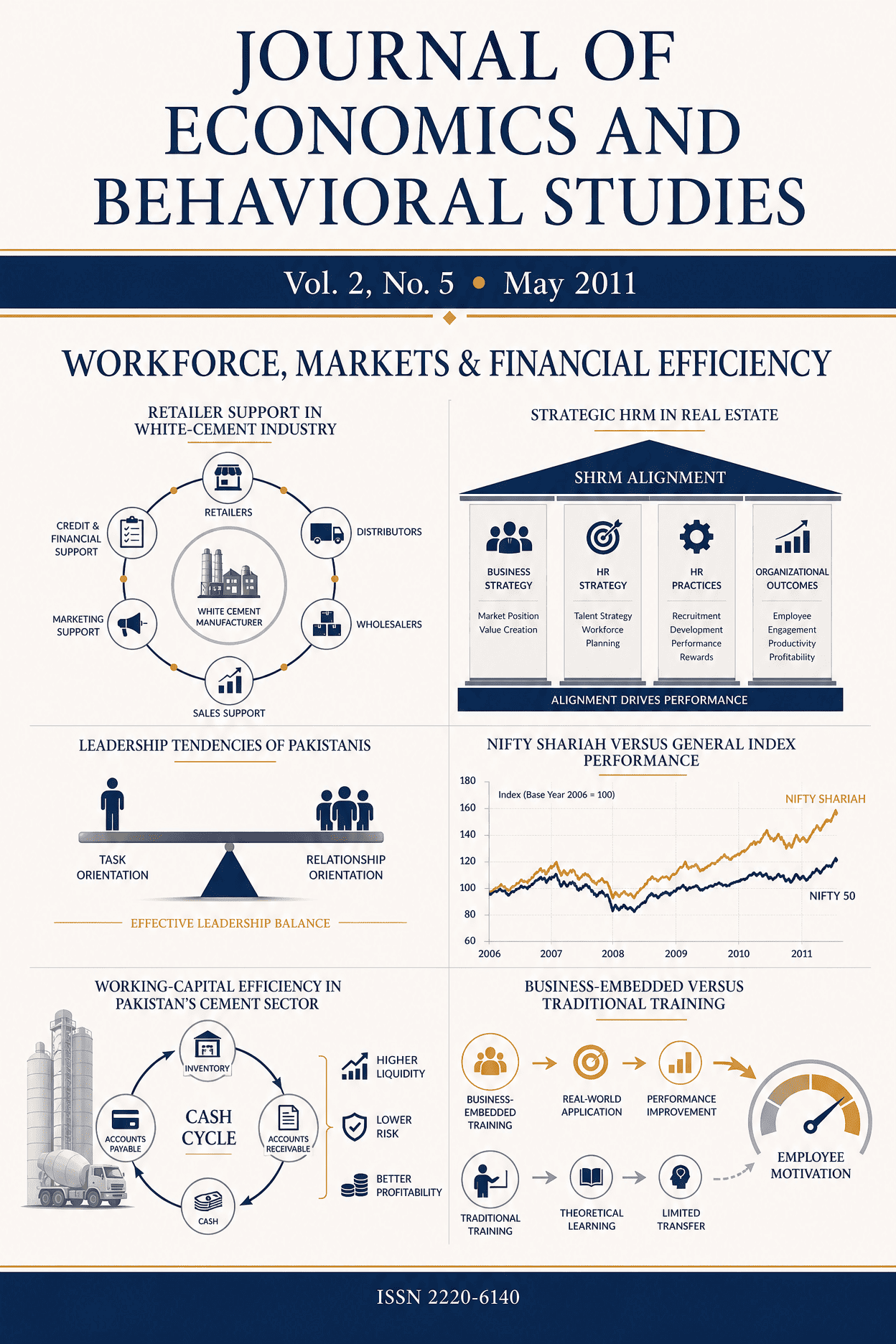
    Buying behavior of consumers in Cement industry is greatly influenced by retailers as they are the last point in the distribution channel and have a direct understanding of consumer’s requirements. The retailers experience firsthand reactions of customers on product, services and quality assessments. In practice, it is very easy for a retailer to impress on the customer with a change in brand even at the very last moment. Because cement retailing is not exclusive and variety of competitive brands is available in the same outlet, it is important that the manufacturing company take great efforts to satisfy the retailers and keep their “support service levels” very high. The research through a field survey explores retailer’s perspective on support services offered by Vembanad White Cement. Suggestions are given to the company on increasing support services to the retailers through efficient complaint handling, credits and processing speed to enable smooth transactions between the retailers and the customers. Retailer’s satisfaction would influence buying behavior of end customers in a positive way. Proactive and personal approach from the company will make the retailers take interest to pass positive feedbacks to the consumers on product and its quality. In the buying process, recommendations from the retailers are the final step in sealing sales with the customers. Hence it is important to understand the retailer’s suggestions for improvements in service levels. Implementing these improvements will not only promote positive attitude of the retailers, in turn, it will also pass on as positive word of mouth to the customers encouraging larger client base and profits to the company.

    Pages 186-190

    PDF - Retailer’s Perspective on Support Services Offered by Vembanad White Cement (opens in a new tab)
  • Article 2 in this issue

    A Comparative Study of Strategic Human Resource Management Practices by Linking People with Strategic Needs of Business

    • Author: AKM Mominul Haque Talukder

    The purpose of this research is to test and contrast whether or not strategic human resource management (SHRM) can be used to predict economic development i.e., efficiency and organizational development of two real estate company located in Dhaka, Bangladesh. Convenience sampling method was applied to obtain data from 100 employees. The study reveals no relationship of SHRM with economic development and organizational development. HR policies is negatively related with economic development while no relationship with organizational development in case of Oriental Ltd (OL) while for Suvastu Ltd (SL), it is negatively related with organizational development but has no relationship with economic development. Correspondingly, HR process is negatively related with economic development but positively related with organizational development in case of OL while HR processes have no relationship in case of SL. HR development has no relationship with economic development and organizational development for both the firms. HR practices have less or no strategic significance for the given organizations. HR outsourcing has no relationship with economic development and organizational development either. The findings suggest that using these dimensions may provide organizations with the potential to improve existing level of efficiency and development of the firms.

    Pages 191-198

    PDF - A Comparative Study of Strategic Human Resource Management Practices by Linking People with Strategic Needs of Business (opens in a new tab)
  • Article 3 in this issue

    Leadership Tendencies of Pakistanis: Exploring Similarities and Differences based on Age and Gender

    • Author: Bahaudin G. Mujtaba, Talat Afza, Naseem Habib

    The management styles of people are influenced by their cultural contexts and urgency of completing tasks. For example, it is expected that people will get things done in a speedy manner when their jobs are on the line, but they will still try to minimize the negative impact to their relationships. To explore the leadership tendencies of working adults in the Pakistani workplace, this paper focused on comparing the leadership orientation of 232 respondents based on their age and gender. Pakistanis have a significantly higher score on task orientation. Their relationship orientation score is also on the moderately high range. The high score on both leadership dimensions reflects on their cultural orientation. Practical suggestions for expatriates and implications for future studies are presented.

    Pages 199-212

    PDF - Leadership Tendencies of Pakistanis: Exploring Similarities and Differences based on Age and Gender (opens in a new tab)
  • Article 4 in this issue

    Equanimity of Risk and Return Relationship between Shariah Index and General Index in India

    • Author: M. Dharani, P. Natarajan

    The present study empirically examines the risk and return of the Nifty Shariah index and Nifty index during the period 2nd January 2007 to 31st December 2010. The sample period is further divided into bull market period and bear market period based on the movement of the both indices during the study period. The objective of the study is to analyse the performance of the Islamic index and common index and to test whether any significant difference between both indices in India. Based on the previous studies, the present paper employs Risk adjusted measurement such as Sharpe index, Treynor Index and Jensen alpha. The t- test is used to test the mean returns difference between both indices. The study found that Nifty Shariah has been underperformed during the sample and sub sample period. According to t- test, the mean difference between both indices has not been significant which reveals both are consistent. The risk adjusted returns for the both indices reveals that both were underperforming with respect to risk free rate of return. The study has also disclosed the low volatile nature of Nifty Shariah than Nifty index. Finally, the study concludes that Nifty Shariah and Nifty indices in India are performing in a similar manner.

    Pages 213-222

    PDF - Equanimity of Risk and Return Relationship between Shariah Index and General Index in India (opens in a new tab)
  • Article 5 in this issue

    Working Capital Management Efficiency of Cement Sector of Pakistan

    • Author: Talat Afza, Mian Sajid Nazir

    The corporate finance literature has traditionally focused on the study of long-term financial decisions. Researchers have particularly examined investments, capital structure, dividends or company valuation decisions, among other topics. However, short-term assets and liabilities are important components of total assets and needs to be carefully analyzed. Management of these short-term assets and liabilities warrants a careful investigation since the working capital management plays an important role for the firm’s profitability and risk as well as its value. It requires continuous management to maintain proper level in various components of working capital i.e. cash, receivables, inventory and payables etc. The present study is an attempt to evaluate the efficiency of the working capital management of cement sector of Pakistan for the period 1988-2008. Instead of employing the traditional ratios; working capital efficiency has been measured in terms of utilization index, performance index and total efficiency index as suggested by Bhattacharya (1997). This paper also tests the speed of achieving the target level of efficiency by an individual firm during the period of study using industry norms as the target level of efficiency. Findings of the study indicate that the cement sector as a whole did perform well during the study period.

    Pages 223-235

    PDF - Working Capital Management Efficiency of Cement Sector of Pakistan (opens in a new tab)
  • Article 6 in this issue

    Effects of Business Embedded & Traditional Training Models on Motivation

    • Author: Syed Akif Hasan, Omer Rahat Jameel, Muhammad Imtiaz Subhani

    Service industry is now focusing more and more on providing valuable training opportunities to its employees in order to improve the quality of its services and benchmarking them as its competitive advantage. This research has attempted to understand the effects of the Business Embedded Training Model and the Traditional Training Model on employees’ job motivation. A sample of 80 organizations and 1000 respondents was taken and Group t-Test and Log Linear Logit techniques were used to evaluate that which training model is preferred over the other by the service industry and which training model has more positive effects on employees’ job motivation. The study revealed that Business Embedded Training Model has more positive effects on employees’ motivation than the Traditional Training Model.

    Pages 236-244

    PDF - Effects of Business Embedded & Traditional Training Models on Motivation (opens in a new tab)