Articles

  • Article 1 in this issue

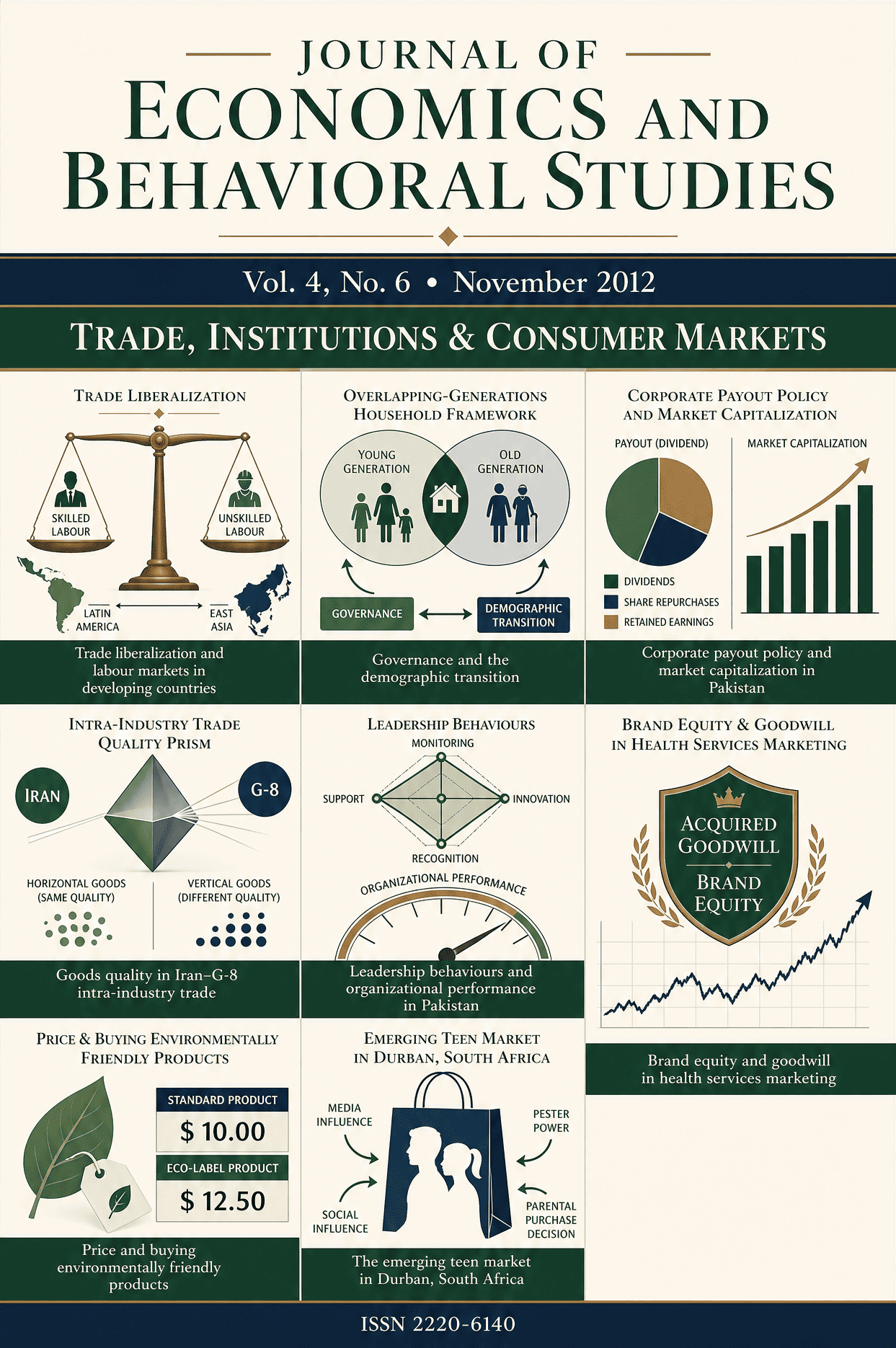
    The Impact of Trade Liberalization on Labor Market of Developing Countries: What can Literature tell us?

    • Author: Zouhair Mrabet, Charfeddine Lanouar

    This paper reviews recent developments of the impact of trade liberalization on labor market in developing countries (henceforth DC). Many studies suggest that there is a benefit impact of trade liberalization on abandon factor of production (unskilled labor in the case of DC). However, several others works show a reversal trend in these countries such as increased in relative employment and relative’s wages of skilled labor. These later results contradict the prediction of Heckscher Ohlin Stolper-Samuelson model (HOSS) model. To reconcile theory with this empirical controversy some authors have tried to extend the traditional theory of international trade by relaxing one or more assumptions of model. The main message that can be learned about this problem is that neither empirical nor theoretical research have advanced an explanation for this puzzling. By comparing the result of the impact of trade liberalization on labor market in the Latin America and the East Asian regions, we show that differences in countries characteristics play a role to explaining this puzzling.

    Pages 307-318

    PDF - The Impact of Trade Liberalization on Labor Market of Developing Countries: What can Literature tell us? (opens in a new tab)
  • Article 2 in this issue

    On Governance and the Demographic Transition

    • Author: Flaubert Mbiekop

    It is now conventional wisdom that institutions shape household fertility choices, especially in developing countries. However, deeper insights into the mechanisms at play are still needed. This paper develops a game-theoretical framework with a simple overlapping-generations model to show how a typical household may come to prefer bearing and raising numerous children as a savings scheme for retirement and not rely on conventional outlets for saving when facing weak institutions. On the one hand weak institutions increase the risk that individuals may lose their savings if relying on conventional outlets. On the other hand, childbearing as an investment/savings scheme carries with it the risk that disguised or complete unemployment may prevent grown children from providing the expected old-age financial support. The typical household thus trades off between both types of risks, yet with more control in the latter case, as the likelihood of unemployment can be reduced by carefully selecting a child quality-quantity strategy. Mild conditions are sufficient to show that sound institutions induce less fertility and foster private saving and oldage consumption. A simple voting experiment unveils a tricky socio- economic dynamics whereby wealthier households may have stakes supporting weak institutions.

    Pages 319-330

    PDF - On Governance and the Demographic Transition (opens in a new tab)
  • Article 3 in this issue

    Corporate Payout Policy and Market Capitalization: Evidence from Pakistan

    • Author: Mian Sajid Nazir, Allah Rakha, Muhammad Musarrat Nawaz

    Present study examines the relationship between corporate payout policy and market capitalization by studying payout ratio and dividend yield as measures of payout policy and controlling other variables of size, growth, EPS, Leverage, GDP growth, and Interest rates. Different statistical techniques of correlation, regression, fixed effect and random effect are applied on pooled and panel data to find out the relationship between corporate payout policy and market capitalization. The results show that measures of corporate payout policy, dividend yield and payout ratio has strong negative correlation with market capitalization. Control variables of size and leverage have positive significant correlation with market capitalization while higher earnings per share are leading it negatively and these relationships are statistically significant at various levels of significance. Overall results suggested that the corporate payout policy has significant impact on market capitalization in Pakistan and this notion is consistent with the earlier studies.

    Pages 331-343

    PDF - Corporate Payout Policy and Market Capitalization: Evidence from Pakistan (opens in a new tab)
  • Article 4 in this issue

    Measuring Goods Quality in Iran’s Intra- Industry Trade with G-8 Member States

    • Author: Masoud Nonejad, Maryam Haghjoo

    As economic integration in East Asia progresses, trade patterns within region are displaying an ever – greater complexity. Though inter – industry trade still accounts for the majority, its share in overall trade is declining. Instead, intra – industry trade (IIT), which can be further divided into horizontal IIT (HIIT) and vertical IIT (VIIT) is growing in importance. In this paper, we set out and examine different kinds of intra- industry trade between Iran and G-8 member states by comparing the Greenway, Hine and Milner (1994) and Fontagne and Freudenberg (1997) approaches to disentangling vertical and horizontal intra – industry trade. Then we introduce and examine a new index from Azhar and Elliott to define product quality types between Iran and G-8 members for the time of 2001-2009. Result shows that a significant share of Iran’s industry trade with G-8 state members has been assigned to vertical intra – industry trade. With regarded to Azhar and Elliott index, the main share of intra- industry trade consists of low quality goods.

    Pages 344-353

    PDF - Measuring Goods Quality in Iran’s Intra- Industry Trade with G-8 Member States (opens in a new tab)
  • Article 5 in this issue

    How Leadership Behaviors Affect Organizational Performance in Pakistan

    • Author: Muhammad Akram, Hassan Mobeen Alam, Liaqat Ali, Muhammad Muazzam Mughal

    The purposes of this study are to analyze which leadership behavior is most closely related with organizational performances based on both leader’s and employee’s perceived; and to what extent leadership behaviors have impact on organizational performances in public and private organizations. Two questionnaires were developed to capture leaders’ behaviors and employees’ responses. Sample comprises of five hundred managers and five hundred employees of different private and public sector organizations of Pakistan. Correlation analysis and regression analysis are used to analyze relationship and effects of leadership behaviors with and on organizational performances. Results indicate that: firstly, all leadership behaviors are positively interrelated with leader is perceived and employee has perceived organizational performances. Secondly, only monitoring leadership behavior has significant positive impact on leader’s and employee’s perceived organizational performance based on individual analysis; whereas, innovative role modeling, support for innovation, recognition and monitoring leadership behaviors have significant positive impact on leader’s perceived and employee’s perceived organizational performances based on pooled analysis.

    Pages 354-363

    PDF - How Leadership Behaviors Affect Organizational Performance in Pakistan (opens in a new tab)
  • Article 6 in this issue

    Assessing the Importance of Brand Equity in Health Services Marketing Through the Impact of Acquired Goodwill on Stockholder Returns

    • Author: Richard A. Heiens, Robert T. Leach, Leanne C. McGrath

    The growing importance of brand equity is widely recognized by researchers and business strategists alike. As such, creative new ways to capture the value of this intangible asset must be devised and tested. The current study uses acquired goodwill as a surrogate indicator of brand equity and looks at the importance of brand equity for firms in the health services industry by measuring the impact of acquired goodwill on stockholder returns. The findings indicate that acquired goodwill and stockholder returns appear to be significantly and positively related to each other. In addition, firms that have higher than average amounts of goodwill relative to total assets differ significantly in terms of stockholder returns than those that have relatively little investment in goodwill. Finally, the study indicates that the impact of goodwill on investor returns is highest for firms operating in one specific industry sub-sector, the market for home health services.

    Pages 364-370

    PDF - Assessing the Importance of Brand Equity in Health Services Marketing Through the Impact of Acquired Goodwill on Stockholder Returns (opens in a new tab)
  • Article 7 in this issue

    Importance of Price for Buying Environmentally Friendly Products

    • Author: Kamyar Kianpour, Ahmad Jusoh, Maryam Asghari

    This study considered price as an important indicator, which could affects customers’ decisionmaking about buying an environmentally friendly product and investigated the intention of buyers for buying ecological product in comparison with non-environmentally friendly products with regard to price. For such a reason products have been categorized in three different categories such as: Short term, Middle term and Long-term products. The respondents were asked to answer whether they are interested to buy environmentally friendly products when the normal products exist in the market or they have no intention to buy these kinds of products. More over it has been tried to explore that how much the buyers will accept to pay more for environmentally friendly products rather than nonecological products in each category (short term, middle term and long term). Consequently, each category has been divided to six different percentage levels of price to indicate the percentage of acceptance by customers to pay more for the specified categories of eco-friendly products in comparison to non-environmentally friendly products. The result of this research shows that the majority of customers agree to pay certain percentage more to buy environmentally friendly products with eco labels and ecological characteristics rather than non-environmentally products when these green products are available in the market.

    Pages 371-375

    PDF - Importance of Price for Buying Environmentally Friendly Products (opens in a new tab)
  • Article 8 in this issue

    An Evaluation of the Emerging Teen Market in Durban, South Africa: Some Marketing Implications

    • Author: Dayaneethie Veerasamy, Natasha Robertson

    Children between the ages of eight and twelve, known as teenagers or teens, have become a lucrative customer base. These teens are considered to be ‘in between’ the traditional child and teenager stages of development. South African society has undergone a sweeping change in its vital institution–the family. Trends such as smaller family size, single parent households, dual incomes and postponing children until later in life means that society is increasingly becoming cash rich and time poor. Guilt plays a major contributing role in spending decisions as time-stressed parents substitute material goods for quality time spent with teens, therefore opening a floodgate to marketers who monopolize on this pang and guilt factor. Guilt consumerism has now transformed teens into key players in marketing strategies. This research paper aims to provide an insight into the rising consumerism in teens due to the ‘nag’ and ‘pester’ power- bug that has fuelled marketing tactics.

    Pages 376-383

    PDF - An Evaluation of the Emerging Teen Market in Durban, South Africa: Some Marketing Implications (opens in a new tab)